The ‘Vampire Squid From Hell’ Just Revealed a Giant Genome That Rewrites Octopus Origins
A massive new genome from the vampire squid reveals surprising links to squids and cuttlefishes, and uncovers how octopus chromosomes fused and reshuffled during evolution.
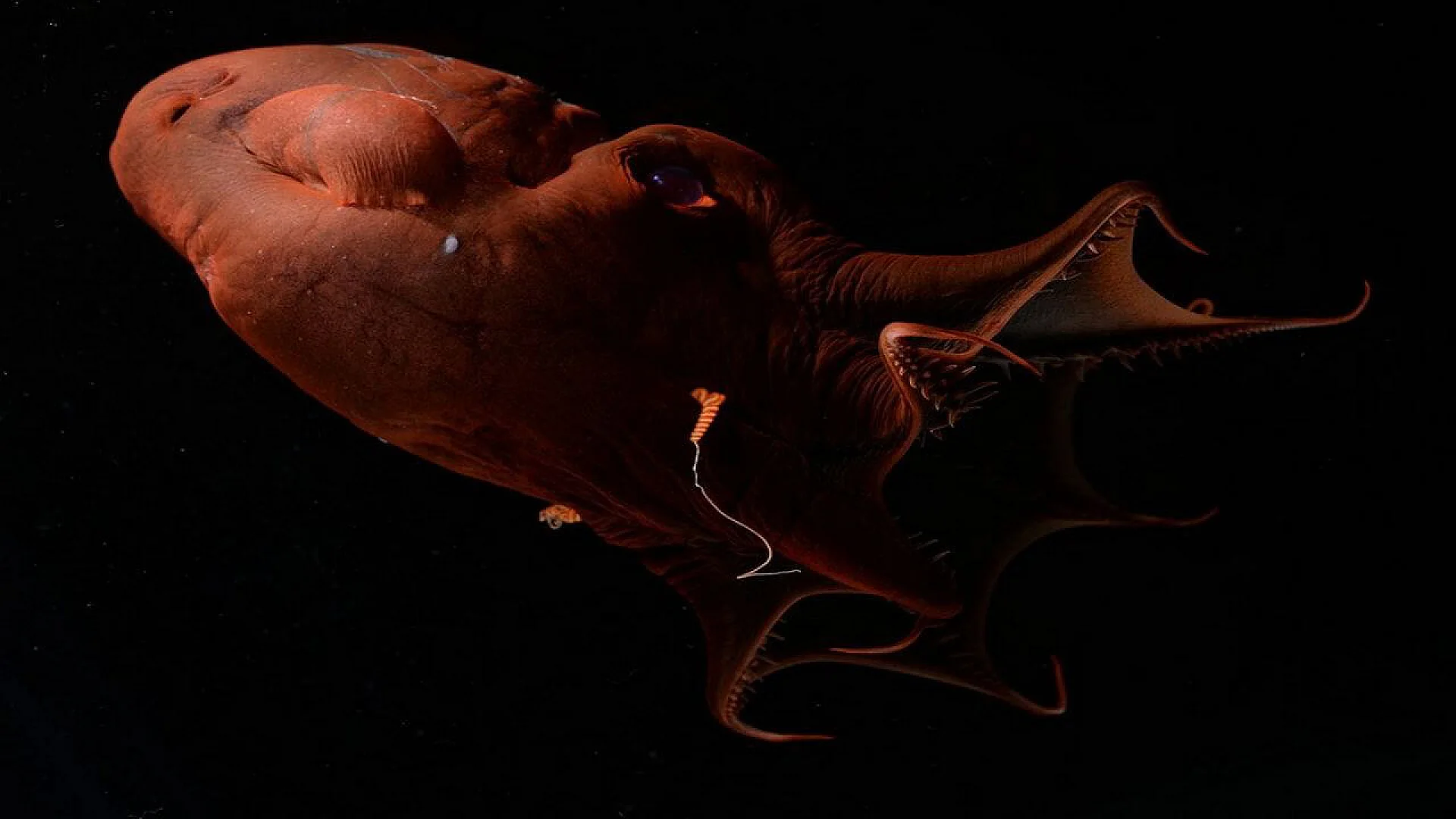
Far below the sunlit surface of the ocean lives a strange, shadowy animal: the vampire squid. Despite its dramatic name and ghostly appearance, this deep-sea dweller is not a ferocious predator. Instead, it is a gentle survivor of the deep that quietly carries something extraordinary inside every cell of its body: one of the largest genomes ever found in a cephalopod.
By decoding the vampire squid’s genome, scientists are uncovering how squids and octopuses evolved from a shared ancestor, and how huge changes in chromosomes helped shape some of the most remarkable brains and bodies in the ocean.
Why the Vampire Squid Matters for Evolution
Cephalopods include octopuses, squids, and cuttlefish. They are famous for their:
- Advanced brains and problem-solving abilities
- Shape-shifting bodies and soft, flexible forms
- Camouflage skills and color-changing skin
Scientists know that octopuses and squids share a distant common ancestor, but their genomes and chromosome numbers look very different today.
- Squids and cuttlefish (decapods) usually have about 46 chromosomes.
- Octopuses (octopods) usually have about 30 chromosomes.
This means that somewhere in their evolutionary history, major chromosomal changes occurred. The big question is: What did the ancestral cephalopod genome look like, and how did octopuses end up with such a reorganized?
The vampire squid sits right between these two groups on the evolutionary tree, making it a powerful “bridge species” for answering this question.
A Giant Genome From the Deep
To investigate, researchers sequenced the entire genome of the vampire squid. Their main findings include:
- Huge Genome Size
- The genome of the vampire squid is extremely large, around 14 billion base pairs.
- This makes it the largest cephalopod genome analyzed so.
- High-Quality Genome Assembly
- Scientists used advanced long-read sequencing technology (PacBio HiFi) to piece the genome together.
- The final assembly is considered highly complete and reliable for comparing chromosome structure across species.
With this powerful dataset in hand, the researchers could look closely at how the chromosomes of vampire squid line up with those of squids, cuttlefish, and octopuses.
Ancestral Chromosomes Preserved
The most striking discovery is that the vampire squid’s chromosomes still look very similar to those of squids and cuttlefish. In other words, it keeps a genome structure that is closer to the ancestral state.
Key points:
- Closer to Squids Than Octopuses
- When scientists compared blocks of genes across species, they found that the vampire squid’s chromosomal layout matches the pattern seen in squids and cuttlefish.
- In contrast, octopus genomes show strong signs of extensive rearrangement.
- Partial Retention of Ancient Architecture
- The vampire squid appears to preserve older, ancestral chromosomal.
- This suggests that it did not experience the same intense genome reshuffling that octopuses did.
This makes the vampire squid a kind of “living archive” of what the early cephalopod genome might have like before major changes occurred the octopus lineage.
How Octopus Genomes Became Different
Octopus genomes out because they are rearranged compared with their relatives. The vampire squid helps clarify how that might have happened.
Researchers found evidence that:
- Octopus Genomes Were Shaped by Fusion-With-Mixing Events
- Multiple chromosomes from an ancestral cephalopod likely fused together.
- During these fusions, pieces of chromosomes mixed, changing which genes sit next to each other
- New Regulatory Landscapes Emerged
- When chromosomes fuse and gene neighborhoods change, gene regulation can be dramatically altered.
- Such changes may affect when and where genes are turned on, potentially influencing:
- Brain development
- Neural circuitry
- Body structure and behavior
This suggests that the extraordinary biology of octopuses may be linked not only to which genes they have, but to how those genes are arranged and controlled on their chromosomes.
Why Chromosomal Evolution Matters
Chromosomal evolution is not just about gene counts. It is about how genes are organized, which neighbors they have, and how they are regulated. The vampire squid study helps scientists understand:
- Direction of Evolutionary Change
- The ancestral state looks more like squids, cuttlefish, and vampire squid.
- Octopuses appear to be the outliers, shaped by repeated chromosomal fusions and rearrangements.
- How Big Structural Changes Influence Traits
- Rearranged chromosomes can reorganize gene networks that control development, nervous systems, and behavior.
- Over millions of years, this can contribute to the emergence of new body plans and complex abilities.
- Broader Lessons for Animal Evolution
- Similar patterns of chromosomal fusion and mixing are seen in other animal groups, including vertebrates.
- This makes the vampire squid a useful comparison model for understanding how chromosome-level changes fuel diversity across the tree of life.
How the Study Was Done
To reach these conclusions, scientists used a combination of modern genomic tools:
- Long-Read Genome Sequencing
- PacBio HiFi sequencing generated long, accurate DNA reads.
- These allowed researchers to assemble a very large and complex genome with high continuity.
- Comparative Genomics
- The vampire squid genome was compared with genomes of other cephalopods, such as:
- The pelagic octopus Argonauta hians
- Squids and cuttlefish
- By tracking which gene blocks stay together on chromosomes in different species, researchers reconstructed patterns of chromosomal fusion and rearrangement.
- The vampire squid genome was compared with genomes of other cephalopods, such as:
- Synteny and Chromosomal Homology Analysis
- “Synteny” refers to stretches of genes that remain linked on the same chromosome across species.
- The degree of shared synteny allowed the team to infer which of the genome were conserved and which were reshuffled along the octopus lineage.
Limitations and Open Questions
Like all research, this study has boundaries. Some of the main limitations include:
- Chromosome-Level Details Still Emerging - While the genome assembly is high quality, fine-scale chromosome structure is not fully resolved. - This is partly due to the difficulty of obtaining suitable biological material, especially from deep-sea species.
- Functional Consequences Need More Work
- Although the study links chromosomal rearrangements to changes in regulatory landscapes, many details remain unknown.
- How exactly these genomic shifts translate into specific behaviors, brain features, or body structures is still an open question.
Despite these gaps, the study sets a strong foundation for further exploration.
What Comes Next in Cephalopod Genomics
The research opens several promising directions:
- Deeper Study of Chromosomal Architecture
- Future work will focus on mapping chromosomes even more precisely, including how they fold and interact in the cell.
- Epigenetics and Genome Organization
- Scientists plan to examine chemical modifications on DNA and associated proteins that help control gene activity.
- These “epigenetic” layers could explain how the same genomic content can produce diverse cell types and complex behavior.
- Expanding to More Species
- Sequencing and comparing genomes from additional ceopods will help refine the evolutionary story.
- This includes both shallow-water and deep-sea species, giving a more complete picture of how environment and evolution at the genomic level.
Why This Matters to the General Public and Science Lovers
For non-specialists and science enthusiasts, the vampire squid story is a vivid example of how:
- A little-known deep-sea animal can reveal big truths about evolution.
- Genome sequencing allows scientists to look back in time and reconstruct ancient biological events.
- Changes in chromosome structure can contribute to the evolution of complex, intelligent life.
The vampire squid does not just survive in one of the most challenging environments on Earth. It also serves as a living key to understanding how octopuses and other cephalopods became some of the most fascinating creatures in the ocean.
Conclusion: A Living Record of Evolutionary Change
The decoding of the vampire squid’s enormous genome shows that its chromosomal architecture is closer to the ancestral condition shared with squids and cuttlefish. In contrast, octopus genomes appear to have undergone multiple fusion and mixing events that reshaped their chromosomes and regulatory networks.
This work clarifies the direction of chromosomal evolution in cephalopods and hints that genome architecture played an important role in the rise of the complex, behaviorally rich oct. As further studies explore chromosome structure and epigenetic mechanisms, the vampire squid will continue to help scientists piece together how radical changes in the genome can give rise to new forms of life and new ways of being intelligent in the sea.
The research was published in iScience on November 21, 2025.
This article has been fact checked for accuracy, with information verified against reputable sources. Learn more about us and our editorial process.
Last reviewed on .
Article history
- Latest version
- Last updated by Dayyal Dungrela, MLT, BSc, BS
Reference(s)
- Yoshida, Masa-aki., et al. “Giant genome of the vampire squid reveals the derived state of modern octopod karyotypes.” iScience, vol. 28, no. 11, 21 November 2025 Elsevier, doi: 10.1016/j.isci.2025.113832. <https://www.cell.com/iscience/fulltext/S2589-0042(25)02093-0>.
Cite this page:
- Posted by Zara Tariq