Mars Express Captures Strange Dark Remains of a 3.5-Billion-Year-Old Waterway on The Red Planet
A fresh image from the European Space Agency showcases Mars’ rugged terrain, where dark volcanic deposits line an ancient valley shaped by flowing water, hinting at the planet’s turbulent and water-rich history.

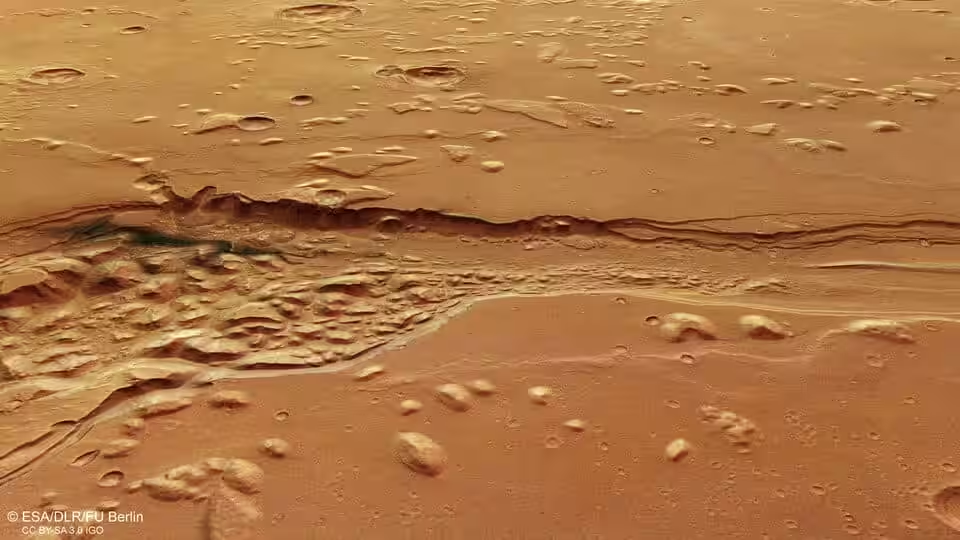
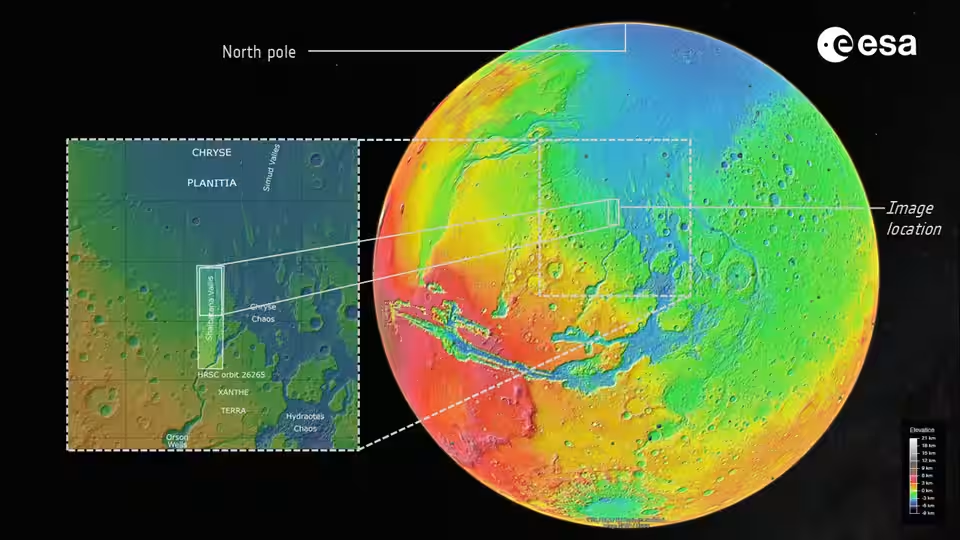
A stunning new image from the European Space Agency (ESA) has unveiled a mysterious dark substance spread across a significant portion of an enormous ancient waterway on Mars, a region where water flowed billions of years ago. The image, captured by the Mars Express spacecraft, focuses on the northern section of Shalbatana Vallis, a massive valley system near the Martian equator that formed approximately 3.5 billion years ago during a much wetter era in the planet’s history.
Ancient Rivers Once Carved This Region of Mars
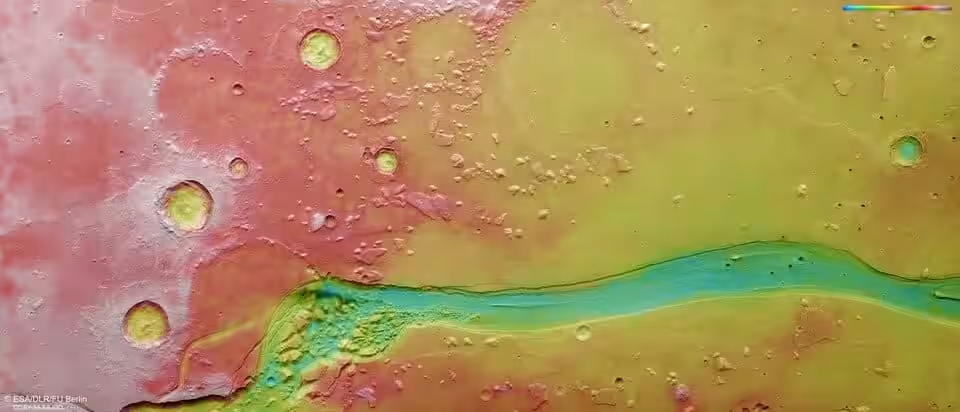
The enormous channel known as Shalbatana Vallis stretches for nearly 800 miles, or about 1,300 kilometers, across the Martian surface. Planetary scientists believe the valley was formed when massive amounts of liquid water rushed across the terrain billions of years ago, carving deeply into the rock as it moved downhill. The newly released image highlights a section where the valley reaches approximately 6 miles wide and around 0.3 miles deep. Researchers suspect the channel was once even deeper before natural processes gradually filled parts of it with sediment, dust, ash, and lava over geological time.
Credit: ESA/DLR/FU Berlin
The valley itself stands as one of the clearest remnants of Mars’ ancient hydrological past. Over the last several decades, orbiters and rovers have uncovered overwhelming evidence that rivers, lakes, and perhaps even oceans once existed on the planet. Networks of channels, mineral deposits formed in water, and sedimentary layers have transformed scientific understanding of early Mars. Regions like Shalbatana Vallis are especially valuable because they preserve direct physical traces of catastrophic flooding events that likely reshaped entire sections of the planet.
Scientists studying these channels believe intense floods may have occurred after underground water reservoirs burst onto the surface. Such events could have released enormous volumes of water in relatively short periods, carving valleys at extraordinary speed. The winding structure visible inside the ESA imagery reflects the erosive power of those ancient flows, preserving a frozen record of a world that once supported stable liquid water.
The Dark Material Appears To Be Volcanic Ash Swept Across Mars
One of the most striking elements in the new image is the presence of dark blue and black-toned material concentrated along parts of the valley floor. According to scientists analyzing data from ESA’s Mars Express mission, the material is most likely volcanic ash that was transported across the surface by powerful Martian winds. Although Mars currently shows no evidence of active volcanoes, the planet experienced intense volcanic activity in its distant past, and signs of that era remain visible today.
The ash deposits provide another reminder that ancient Mars was shaped not only by water but also by large-scale volcanic processes. The planet hosts Olympus Mons, the largest volcano in the Solar System, towering nearly three times higher than Mount Everest. Massive volcanic eruptions in Mars’ past may have blanketed huge regions with ash and lava, creating layers that can still be identified from orbit today.
Credit: ESA/DLR/FU Berlin
The dark material visible in the image appears particularly concentrated near an unusual bulging structure along the channel. Researchers believe this feature may have formed when buried ice beneath the Martian surface began to melt. As the underground ice disappeared, the terrain above it likely collapsed, creating the distorted landscape visible today. This process, known as subsidence, has been observed elsewhere on Mars and points to the long-term interaction between volcanic heating, buried ice, and shifting geological layers.
The combination of volcanic ash and evidence of ancient ice makes this region scientifically valuable because it preserves several major chapters of Martian history in one location. Scientists continue to study how these environments evolved and whether some may once have provided temporary conditions suitable for microbial life.
ESA’s Mars Express Continues To Reveal Mars In Extraordinary Detail
The imagery was produced using data gathered by ESA’s Mars Express spacecraft, which has been orbiting Mars since 2003. Over more than two decades, the mission has transformed scientific understanding of the planet by mapping its surface, studying its atmosphere, and identifying minerals linked to ancient water activity. The spacecraft’s high-resolution imaging system allows scientists to examine Martian terrain in remarkable detail, revealing geological structures that are often invisible in lower-resolution observations.
According to ESA, the surrounding terrain near Shalbatana Vallis also contains evidence of extensive volcanic flooding. Much of the landscape appears unusually smooth, suggesting lava once spread across the region before cooling and hardening. In several locations, the cooling lava contracted and buckled, creating formations known as “wrinkle ridges.” These ridges remain visible today as textured patterns stretching across the plains surrounding the ancient water channel.
Credit: NASA/USGS; ESA/DLR/FU Berlin
Impact craters scattered throughout the area add another layer to the region’s complex history. These craters formed when asteroids and other space rocks slammed into the Martian surface over billions of years. Because Mars lacks the active plate tectonics and dense atmosphere found on Earth, many of these ancient scars remain preserved for immense periods of time.
The latest image demonstrates how multiple geological forces shaped Mars simultaneously across different eras. Water erosion, volcanic eruptions, underground ice collapse, lava flooding, and asteroid impacts all contributed to the landscape now visible from orbit. For researchers, this combination provides a rare opportunity to reconstruct environmental conditions that existed billions of years ago on a planet that may once have looked far more Earth-like than previously imagined.
This article has been fact checked for accuracy, with information verified against reputable sources. Learn more about us and our editorial process.
Last reviewed on .
Article history
- Latest version
Reference(s)
- “Waterworn chaos on Mars.” <https://www.esa.int/Science_Exploration/Space_Science/Mars_Express/Waterworn_chaos_on_Mars>.
Cite this page:
- Posted by Aisha Ahmed