Astronomers Confirm a Giant 3.3-Million-Light-Year Radio Halo in a Galaxy Cluster That Was Supposed to Be Quiet
Astronomers trained advanced radio telescopes on a seemingly ordinary galaxy cluster and uncovered an enormous radio halo, far exceeding all prior expectations in size.
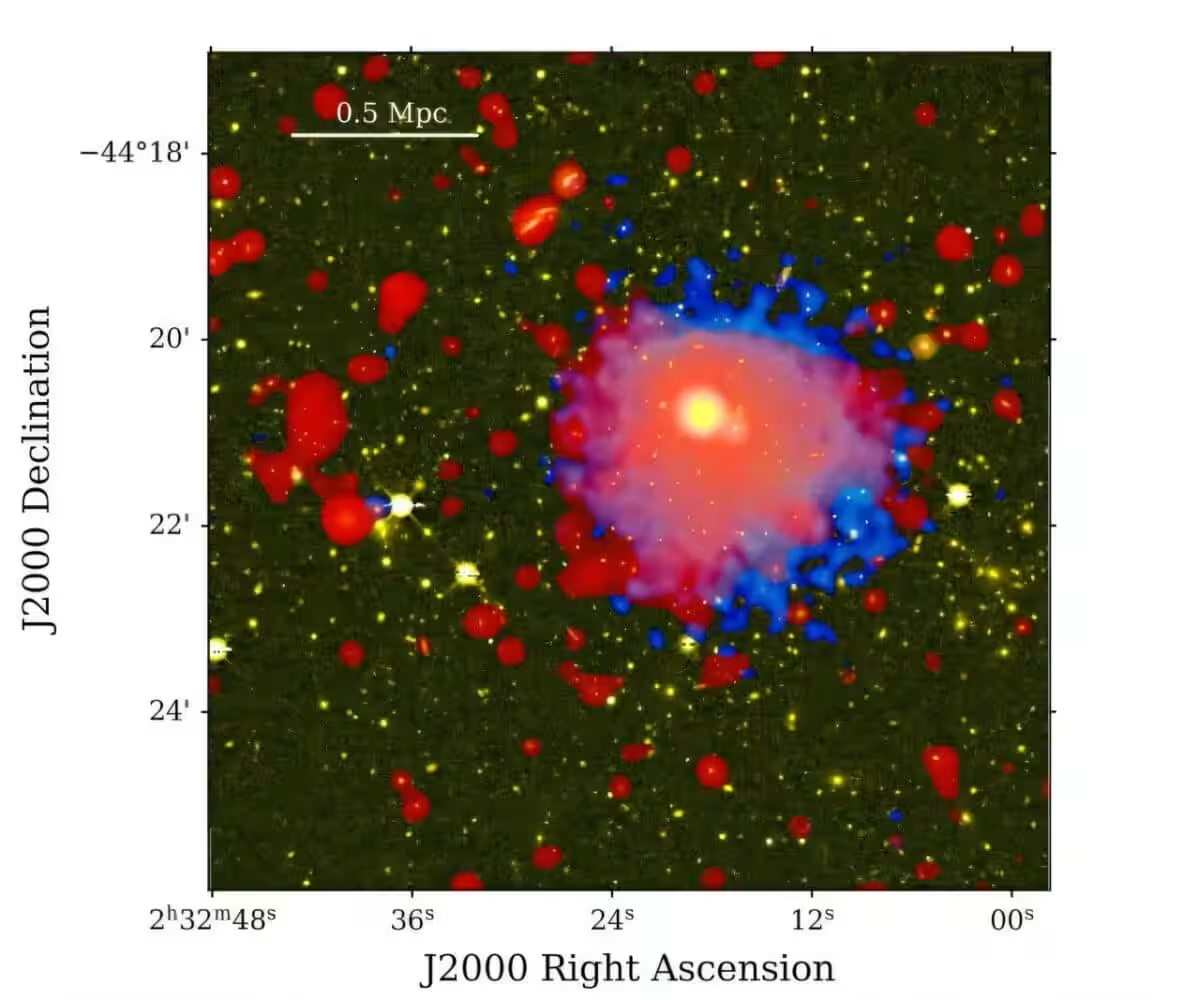
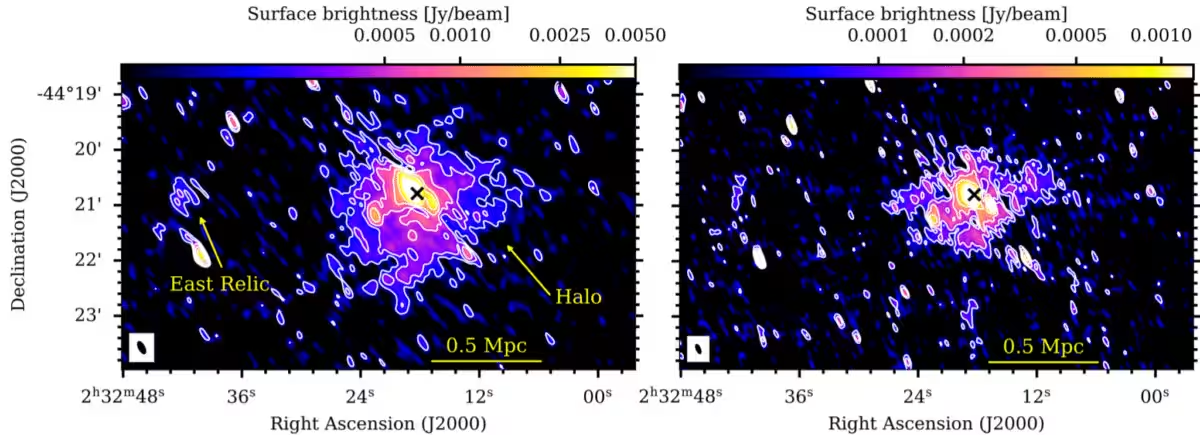
A groundbreaking discovery has been made by a team of astronomers, confirming the presence of a massive radio halo spanning more than 3.3 million light-years within the galaxy cluster RXCJ0232-4420. Utilizing observations from the upgraded Giant Metrewave Radio Telescope (uGMRT) and South Africa’s MeerKAT telescope, researchers identified diffuse radio emission on an unprecedented scale, challenging the notion that such structures are exclusive to turbulent cluster environments. The findings, published on the arXiv preprint server on April 29, strengthen the hypothesis that large radio halos can coexist with cool cores in galaxy clusters. Led by Pralay Biswas from the National Center for Radio Astrophysics in Pune, the study reveals that RXCJ0232-4420 exhibits characteristics of an intermediate dynamical state, defying expectations that giant radio halos are typically associated with clusters undergoing violent mergers. RXCJ0232-4420 was first discovered in 2002, sparking controversy due to conflicting interpretations of earlier radio observations. Some studies suggested a compact mini-halo centered on one of the cluster’s brightest galaxies, while others proposed that the diffuse emission stretched across vast distances. The new observations conclusively demonstrate that the diffuse radio emission extends beyond 3.3 million light-years at every observed frequency, establishing the existence of a genuine giant radio halo within RXCJ0232-4420. Astronomers also identified an eastern radio relic with an estimated linear size of approximately 980,000 light-years. The cluster itself contains two brightest cluster galaxies, BCG-A and BCG-B, separated by roughly 330,000 light-years. A multiwavelength image of RXCJ0232-4420 reveals the giant radio halo, providing a visual representation of the unprecedented scale of the structure. The image, credit to arXiv, showcases the complexity and beauty of the galaxy cluster. Previous observations had primarily detected diffuse emission around BCG-A, leading researchers to compare the source to a radio mini-halo. However, the broader structures revealed by uGMRT and MeerKAT substantially altered this picture, demonstrating that the diffuse radio emission is, in fact, a giant radio halo. Spectral analysis of the radio halo and eastern relic revealed a uniform spectral index, with values ranging between -1.0 and -1.3. This lack of spectral variation suggests that charged particles are being re-energized across much of the cluster, rather than in isolated spots. X-ray analysis of the cluster revealed a strong positive link between non-thermal radio emission and hot X-ray-emitting gas. Further measurements suggested that the cluster is in an intermediate dynamical state, exhibiting signs of mild structural disturbance. This unusual combination of characteristics makes RXCJ0232-4420 an intriguing subject for further study. The discovery of a giant radio halo in RXCJ0232-4420 has significant implications for our understanding of galaxy clusters and the processes that shape their evolution. This finding highlights the importance of continued observations and research into the complex phenomena that govern the behavior of these vast cosmic structures.
This article has been fact checked for accuracy, with information verified against reputable sources. Learn more about us and our editorial process.
Last reviewed on .
Article history
- Latest version
Cite this page:
- Posted by Aisha Ahmed