Barnard’s Star’s Four Rocky Worlds Reveal Exotic Magnesium Cores and Vanished Atmospheres
Astronomers discover a unique planetary system around a nearby star, featuring traits unlike any previously known exoplanets.
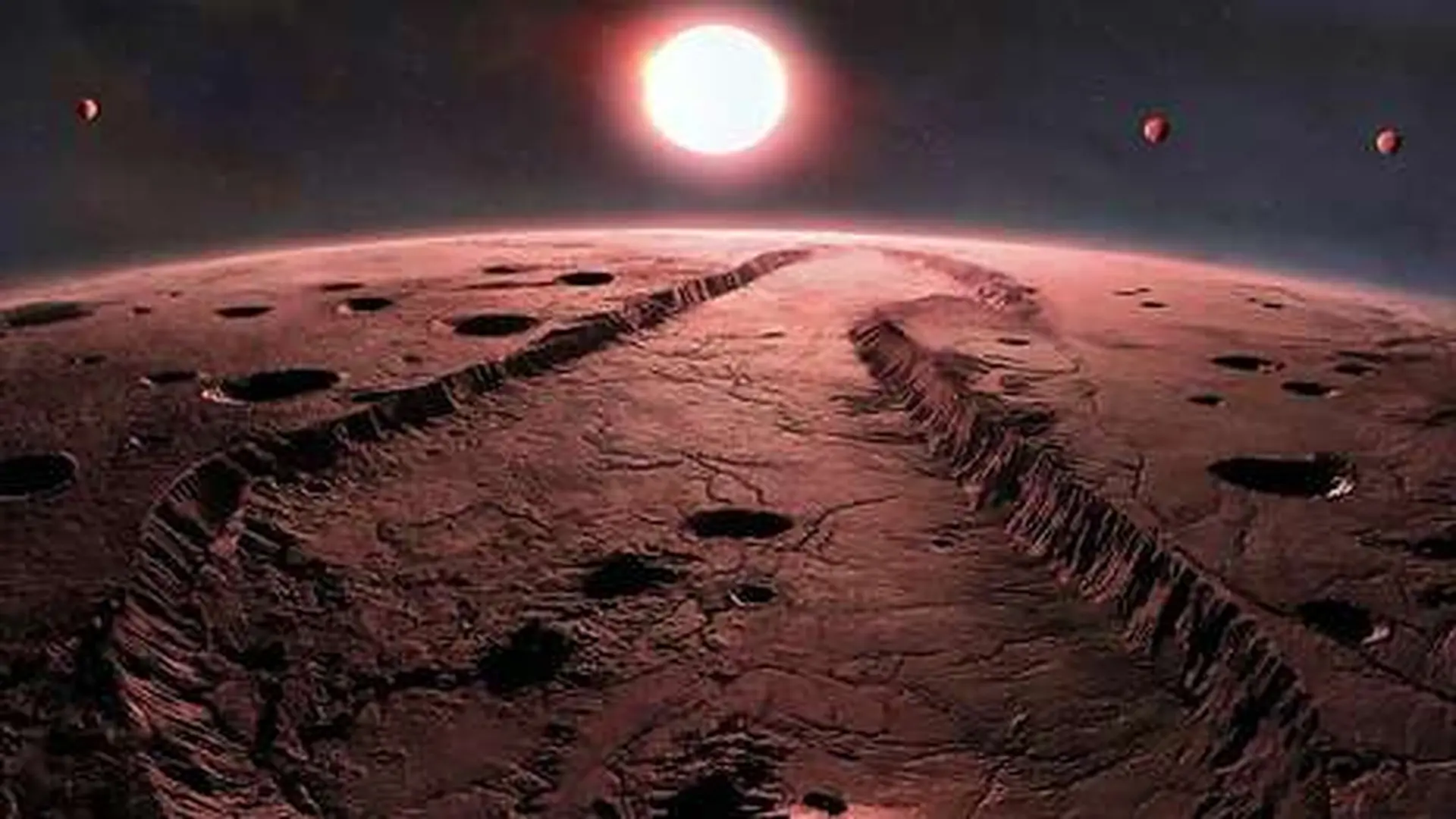
A new study published in Monthly Notices of the Royal Astronomical Society offers the most comprehensive look yet at the quartet of planets circling Barnard’s Star, one of Earth’s nearest stellar neighbors. The research suggests these compact, rocky bodies possess atypical internal make‑ups, have likely shed any primordial atmospheres long ago, and are inhospitable to life as we know it.
First identified in 2025, the four companions to Barnard’s Star sit between the sizes of Earth and Venus, yet exceed Mars, occupying a size class absent from our own solar system. Their tight orbits around a red dwarf and distinctive chemistry provide a rare laboratory for probing the birth and transformation of small, terrestrial planets.
Scientists at the University of Cambridge examined how the host star’s elemental inventory might be echoed in its planets, delivering fresh clues about the substances that could reside within these distant worlds.
The analysis highlighted an unusually magnesium‑rich composition for Barnard’s Star, implying that its planetary cohort may share this elemental signature.
Mineral Profile Diverges From Earth’s Rock Cycle
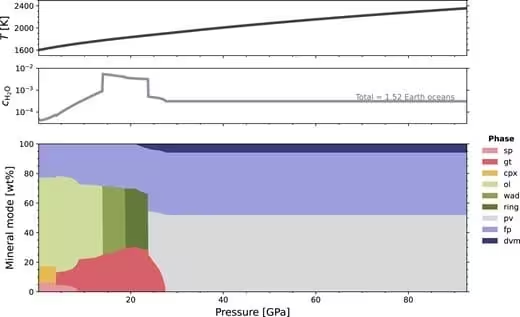
Elevated magnesium levels appear to have steered the crystallisation pathways on the planets, favoring the formation of periclase—a mineral not prevalent in Earth’s mantle. By contrast, terrestrial magnesium is typically locked in olivine, a mineral that plays a key role in sequestering water deep beneath the surface. The Cambridge team argues that periclase‑dominated interiors would be far less efficient at retaining water.
“Barnard’s Star has an enormous amount of the element magnesium compared to other stars, so its planets are likely to be rich in magnesium too,” said Xander Byrne, lead author of the study from the Institute of Astronomy at the University of Cambridge.
These compositional distinctions furnish a fresh example of how planets with broadly similar rocky frameworks can diverge dramatically in their internal chemistry, underscoring the influence of stellar elemental abundances on planetary make‑up.
Proximity Strips Planets of Their Gases
The planets’ orbits hug their red dwarf host so tightly that even the outermost world circles at roughly one‑tenth the distance Mercury maintains from the Sun. Such closeness has profound implications for atmospheric retention.
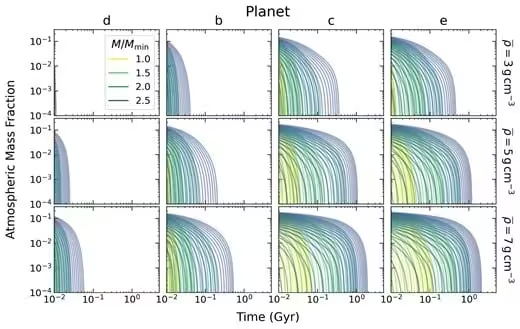
Modeling indicates that any primordial atmospheres would have dissipated within about 2 billion years, a fraction of the system’s estimated 10‑billion‑year age. The authors attribute this rapid loss to a combination of relentless stellar radiation and the planets’ modest gravitational pull.
“These planets were always going to be hostile because they’re really close to their star,” Byrne explained. “When you’re that close to your star and have such little gravity, your atmosphere just gets blown off.”
With scant atmospheric pressure, the worlds would present environments starkly different from Earth’s, offering little prospect for habitability.
Orbital Resonance May Guard Long‑Term Stability
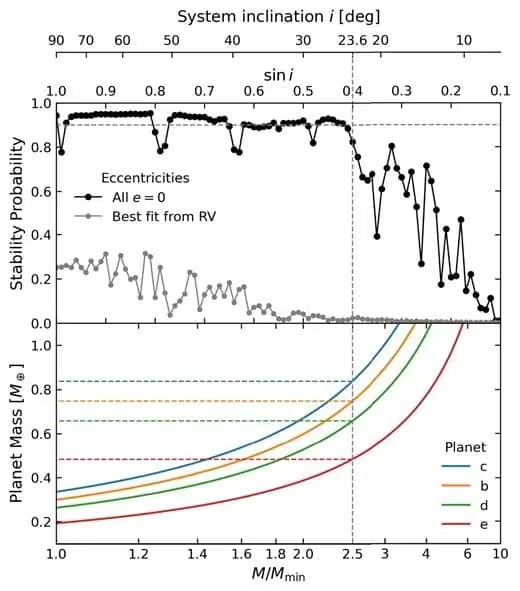
Compact planetary arrangements can be vulnerable to chaotic gravitational interactions, potentially leading to collisions or ejection from the system. The Cambridge researchers propose that a resonant orbital configuration—where the inner trio follows a 9:12:16 period ratio—acts as a stabilising mechanism.
Such resonances are familiar in our own Solar System, notably among Jupiter’s moons, where they preserve orderly motion. In the Barnard’s Star system, the resonance likely curtails disruptive encounters between the four planets.
“Larger planets are much easier to detect than small ones, so we know about very few sub‑Earth planets like the ones in this system,” stated Byrne. “But the sensitivity of these new missions will help reduce this bias, allowing us to discover more and more planets that are small and rocky, like Earth.”
Future observatories such as the European Space Agency’s PLATO mission promise to broaden the census of sub‑Earth planets, enabling more detailed comparisons with the Barnard’s Star system.
This article has been fact checked for accuracy, with information verified against reputable sources. Learn more about us and our editorial process.
Last reviewed on .
Article history
- Latest version
Reference(s)
- “Xander Byrne | Institute of Astronomy.” <https://www.ast.cam.ac.uk/people/xander.byrne>.
- <https://www.esa.int/Science_Exploration/Space_Science/Plato>.
Cite this page:
- Posted by Bilal Abbasi