Cosmic Sweet Surprise: First Sugar Erythrulose Discovered in Deep Space Cloud
Scientists discover the first interstellar sugar, unveiling a new chemical route that could have delivered life’s building blocks to early Earth.
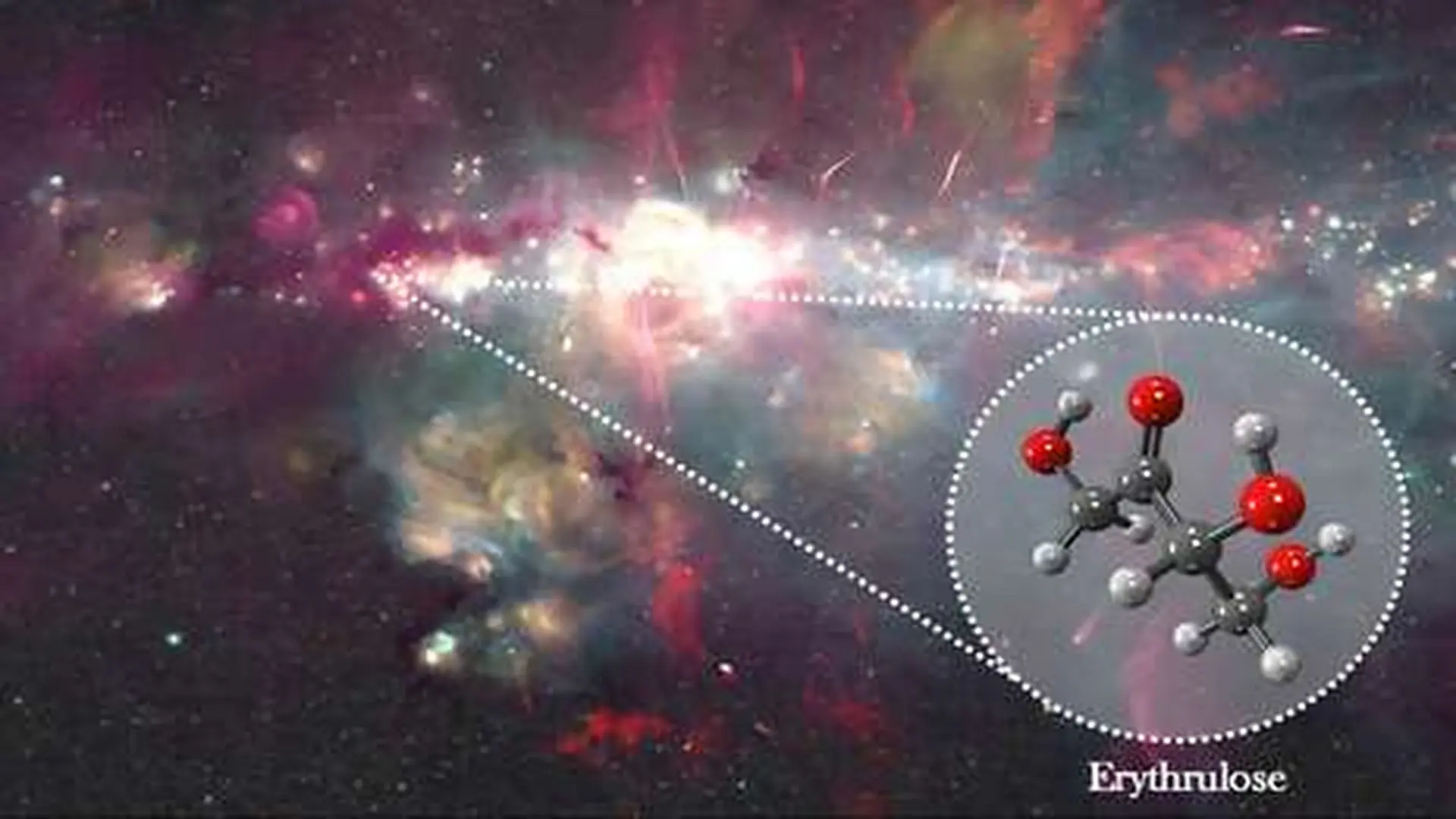
Astronomers have announced the first unequivocal detection of a sugar molecule in interstellar space, a milestone that reshapes expectations about the chemical inventory available before planets form. The molecule, identified as erythrulose, was found in a massive molecular cloud near the Milky Way’s central region, offering concrete evidence that complex sugars can arise naturally long before a planetary system emerges.
Interstellar Sugar Discovered in a Galactic‑Center Cloud
For years, surveys of the galaxy’s dense gas and dust clouds have cataloged a wide variety of organic species—amino acids, alcohols, aldehydes, and many carbon‑based compounds—but sugars have remained elusive despite their biological importance. The new detection of erythrulose, a four‑carbon ketose, inside the cloud designated G+0.693−0.027, located close to the Milky Way’s galactic center, overturns that gap. The international team, led by Izaskun Jiménez‑Serra of the Spanish National Research Council’s Center for Astrobiology (CAB), used ultra‑sensitive broadband spectroscopy from Spain’s 40‑meter Yebes radio telescope and the 30‑meter IRAM telescope to secure the signal.
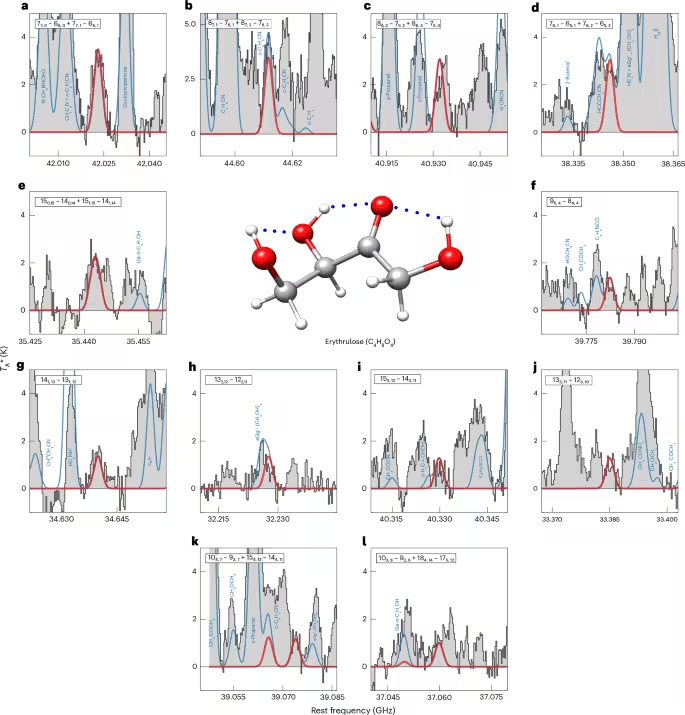
Twelve independent spectral features matched laboratory measurements of erythrulose produced at the University of the Basque Country, leaving little room for ambiguity. The findings, published in Nature Astronomy, constitute the first confirmed presence of any sugar in the interstellar medium and broaden the roster of complex molecules that predate star and planet formation.
Abundance Pattern Defies Traditional Formation Scenarios
The observed quantity of erythrulose was far higher than predicted by standard astrochemical models, which assume that larger molecules grow stepwise through the addition of single carbon atoms. In this cloud, erythrulose appears at least eight times more abundant than three‑carbon sugars, none of which were detected alongside it, prompting researchers to explore alternative synthetic routes.
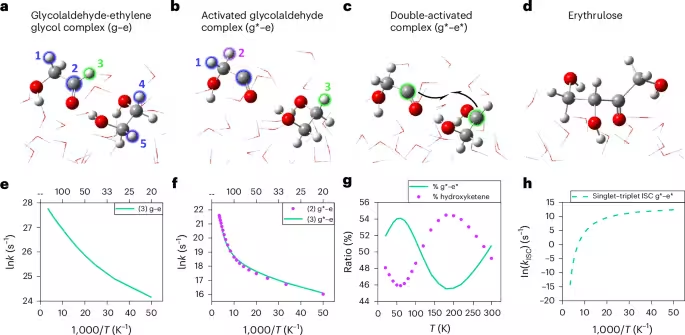
Collaboration with chemists from the University of Extremadura and Radboud University revealed that erythrulose can emerge within frozen interstellar ices via reactions involving simple two‑carbon alcohols and aldehydes. These ice‑coated dust grains act as natural reactors where radiation and extreme cold drive chemistry that would be difficult to reproduce in terrestrial laboratories.
“This finding was unexpected, as the prevailing view in astrochemistry is that interstellar molecules grow in size through the sequential addition of carbon atoms,” says Jiménez‑Serra, lead author of this work.
The proposed ice‑mediated pathway accounts for the surprisingly high erythrulose levels and suggests that interstellar chemistry may be more versatile than previously assumed.
Potential Contribution to Early Earth Chemistry
The discovery extends earlier findings of sugars such as ribose and glucose in meteorites, supporting the notion that biologically relevant sugars existed before the solar system coalesced. Using the measured erythrulose abundance in G+0.693−0.027, the team estimates that between half a million and fifty million metric tons of this sugar could have been deposited on Earth during the Late Heavy Bombardment, roughly 4.1 to 3.8 billion years ago. Such influxes may have enriched primordial environments with molecules capable of fueling the first metabolic and replicative processes.
Next Steps in the Search for Cosmic Biomolecules
Identifying erythrulose demonstrates that complex sugars can form naturally in deep space and sets the stage for targeting even more biologically significant compounds. Ribose, the backbone of RNA, is a prime candidate; its detection in interstellar clouds would reinforce the hypothesis that key ingredients for life were already widespread before planetary formation. “The detection of erythrulose is very exciting because it opens up the possibility of discovering in space other sugars such as ribose, which is part of RNA, and other important molecules for the origin of life,” says Carlos Briones, co‑author of the study. Ongoing and future observations with increasingly sensitive radio facilities, coupled with laboratory simulations of interstellar ice chemistry, will clarify whether this sugar is an isolated case or part of a broader family of cosmic carbohydrates.
This article has been fact checked for accuracy, with information verified against reputable sources. Learn more about us and our editorial process.
Last reviewed on .
Article history
- Latest version
Reference(s)
- Jiménez-Serra, Izaskun. “Detection of a four-carbon sugar in interstellar space - Nature Astronomy.”, July 13, 2026, pp. 1-11. Nature, doi: 10.1038/s41550-026-02905-7. <https://www.nature.com/articles/s41550-026-02905-7>.
Cite this page:
- Posted by Bilal Abbasi