Webb Detects Methane On Interstellar Comet 3I/ATLAS
James Webb découvre du méthane sur une comète interstellaire pour la première fois
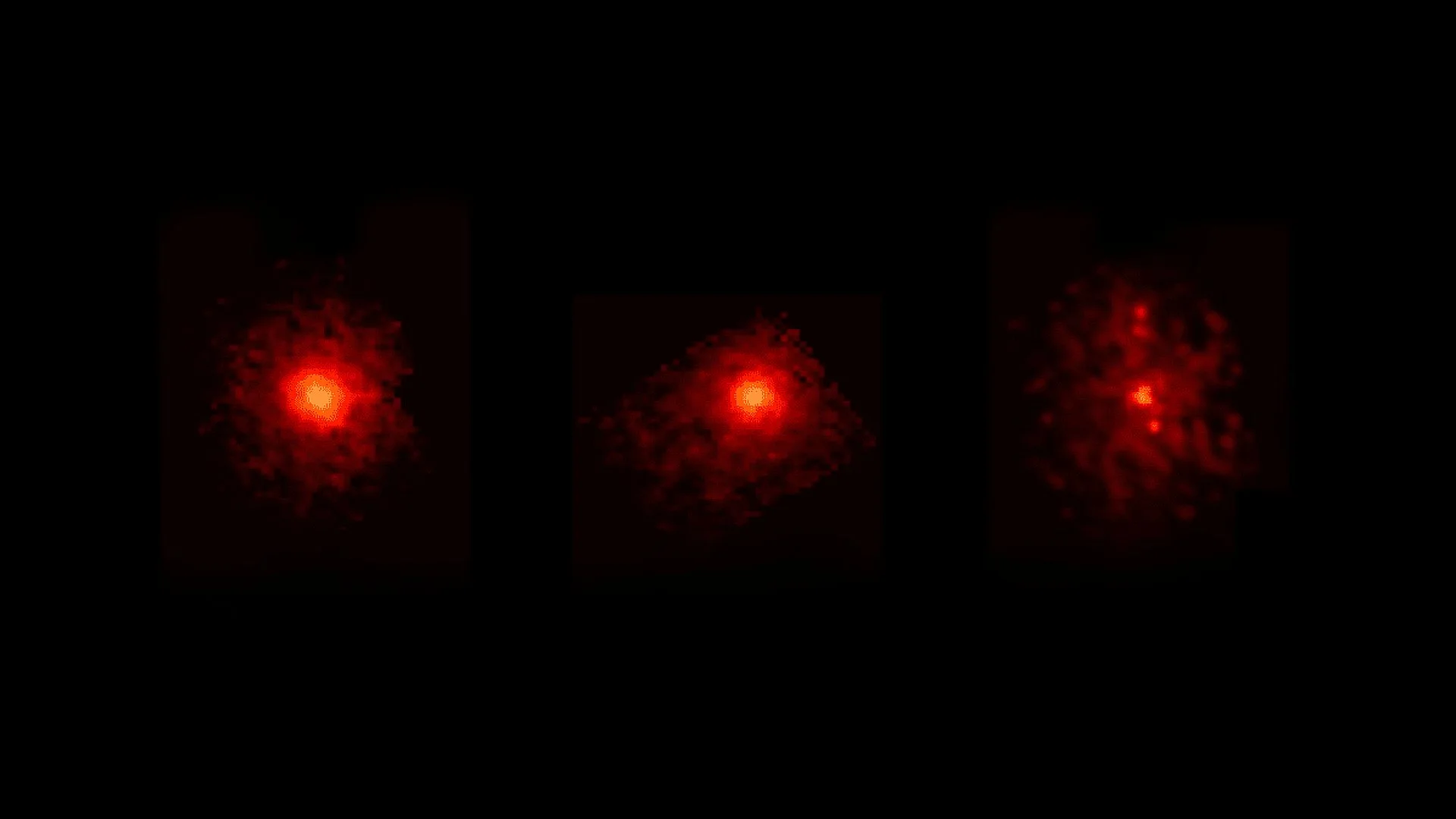
A new set of infrared measurements from the James Webb Space Telescope has identified a clear signature of methane in the coma of the interstellar comet 3I/ATLAS, providing the first direct evidence of this molecule on a visitor from another star system. The findings, released by the European Space Agency, suggest that the comet formed in a chemical environment far unlike the icy bodies that orbit our Sun.
Webb Targets an Extraterrestrial Wanderer
During a December campaign, Webb aimed its Mid‑Infrared Instrument (MIRI) at 3I/ATLAS as the object accelerated away from the inner Solar System. By dispersing the incoming infrared radiation into its constituent wavelengths, scientists were able to chart the spatial distribution of several volatile gases around the nucleus with unprecedented clarity. The analysis highlighted three dominant species – water vapor, carbon dioxide and methane – each showing a distinct pattern of emission.
Water vapor was observed to stretch far beyond the comet’s core, indicating that icy grains within the surrounding coma were sublimating and releasing gas over a wide area. In contrast, both carbon dioxide and methane remained tightly confined to the region close to the nucleus, implying that these molecules were trapped beneath a surface layer of ice and only escaped when solar heating penetrated deeper into the comet’s interior.
Methane Emerges as a Key Interstellar Marker
The presence of methane on 3I/ATLAS marks a milestone for interstellar chemistry research. According to ESA, methane is unusually scarce in the comets that belong to our Solar System, typically appearing at levels far below those of water. In 3I/ATLAS, however, the methane signal is comparable in strength, suggesting that the compound survived in a protected pocket until the comet’s perihelion approach warmed its interior.
This elevated methane abundance, together with the high carbon dioxide output, points to a formation zone that was likely colder and richer in volatiles than the region that produced the comets we are familiar with. The detection therefore offers a rare glimpse into the chemical makeup of a planetary system beyond our own.

Credit: NASA, ESA, CSA, STScI, M. Belyakov (Caltech), I. Wong (STScI), Image Processing: A. Pagan (STScI)
MIRI’s Spectral Mapping Reveals Gas Distribution
The Medium Resolution Spectrometer on MIRI captured a spectrum at each pixel across a small sky patch, enabling researchers to quantify the concentration of each molecule and to visualize how the gases disperse around the comet. The resulting maps display a patchwork of bright emission zones: a broad halo of water vapor, a tighter clump of carbon dioxide, and a sharply defined region of methane emission.
Observations were made on two separate dates – 15–16 December and again on 27 December – when the comet was approximately 330 million km and 380 million km from the Sun, respectively. These snapshots illustrate how solar heating progressively liberated volatile compounds, providing a dynamic view of the comet’s evolving atmosphere.
Broader Consequences for Planetary System Formation
The unusual chemical profile of 3I/ATLAS challenges current models of cometary genesis and suggests that interstellar icy bodies can preserve distinct chemical records for billions of years. By analyzing such visitors, astronomers hope to broaden their understanding of the diversity of planetary systems throughout the galaxy and to refine theories describing the origin and transport of organic molecules in space.
This article has been fact checked for accuracy, with information verified against reputable sources. Learn more about us and our editorial process.
Last reviewed on .
Article history
- Latest version
Reference(s)
- “Webb sniffs methane from interstellar Comet 3I/ATLAS.” <https://www.esa.int/ESA_Multimedia/Images/2026/06/Webb_sniffs_methane_from_interstellar_Comet_3I_ATLAS>.
Cite this page:
- Posted by Bilal Abbasi