Decade‑Long X‑Ray Tracking Shows Asymmetric Expansion in Supernova Remnant G292.0+1.8
NASA Chandra’s 10‑year study shows supernova remnant G292.0+1.8 expanding unevenly, a puzzling clue that could rewrite how we view stellar explosions.
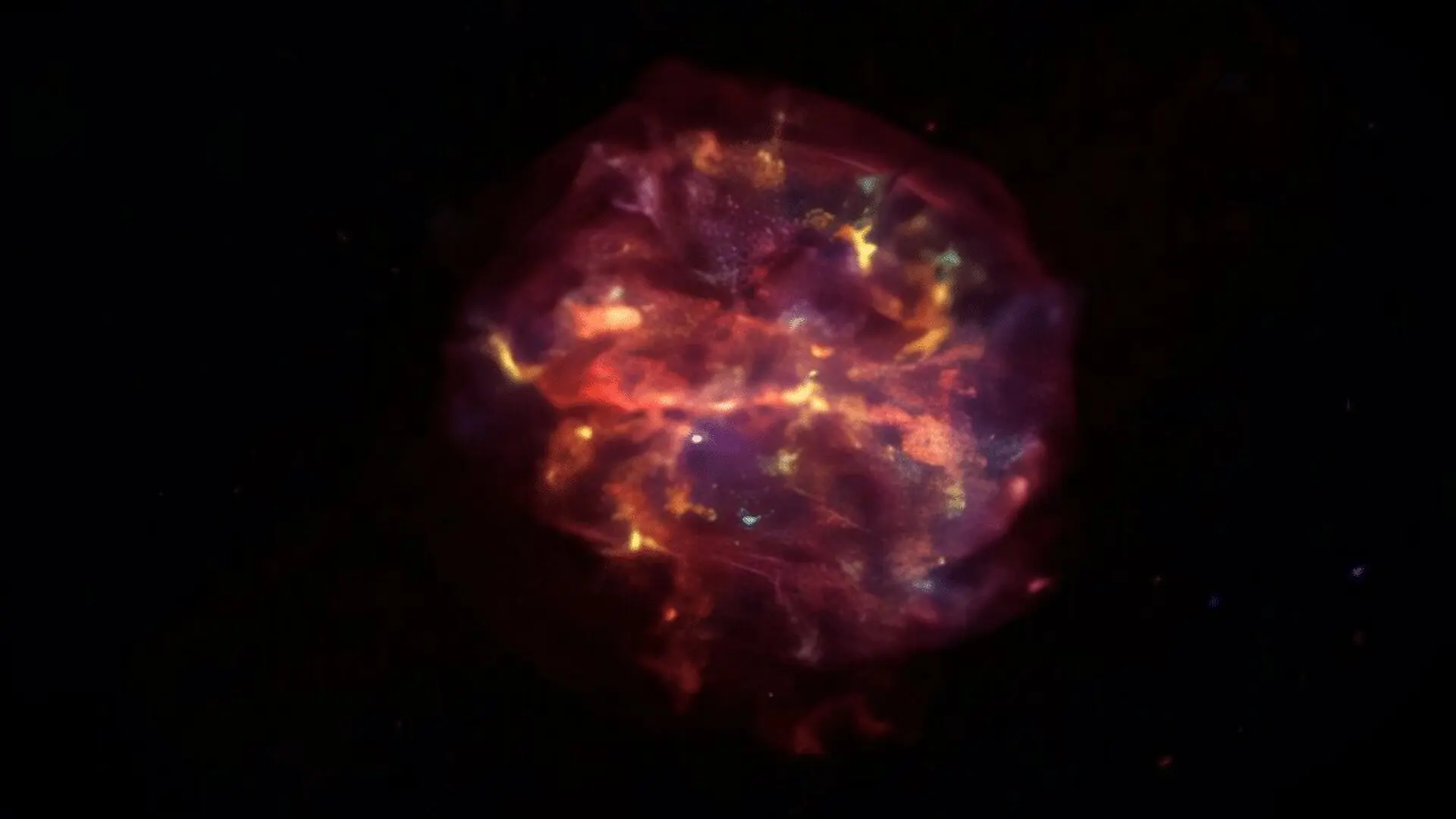
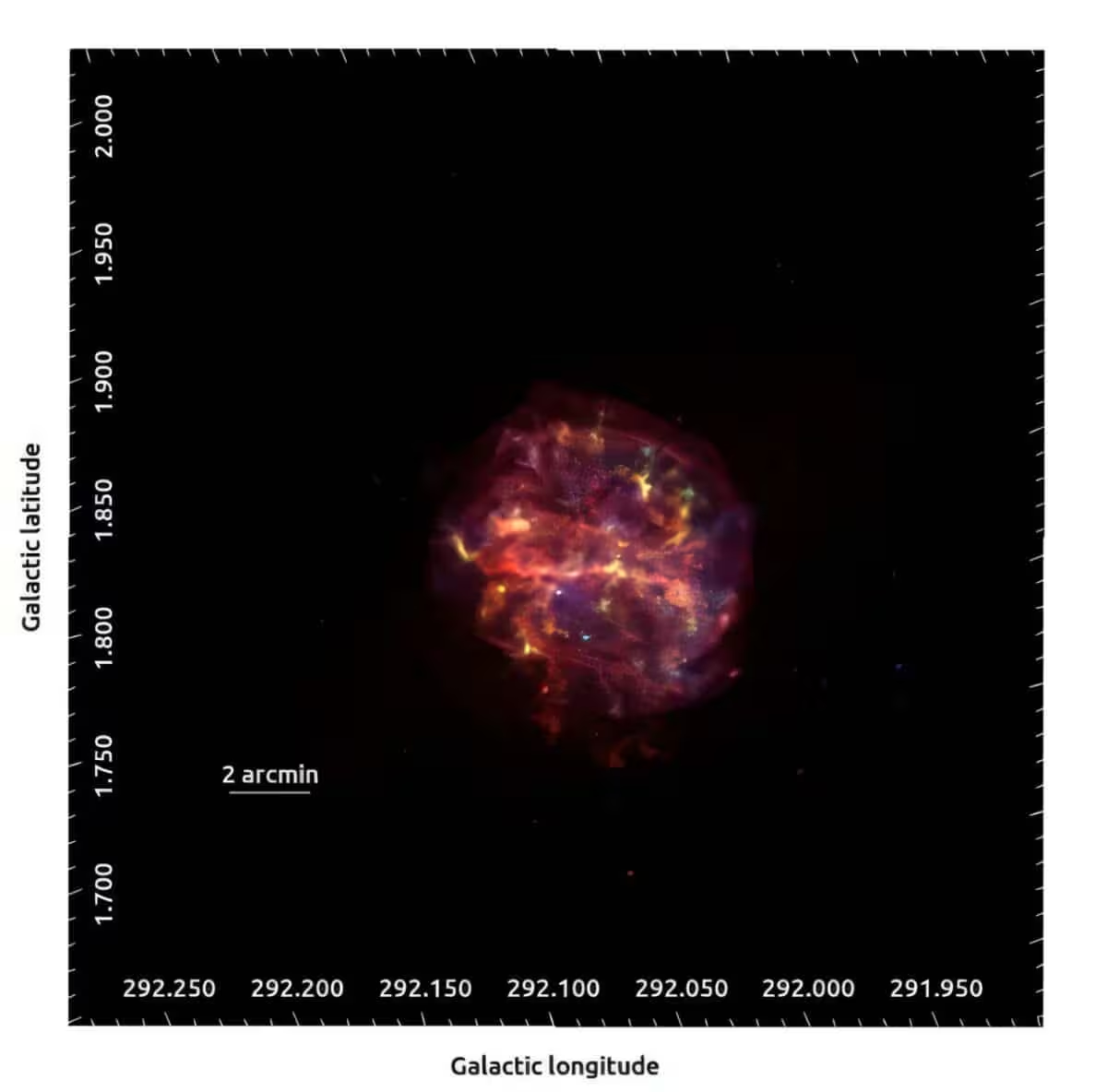
Ten years of observations with NASA’s Chandra X‑ray Observatory have exposed an irregular expansion pattern inside the young supernova remnant G292.0+1.8. The study, posted as a preprint on arXiv, delivers the first weighted‑mean X‑ray measurement of the nebula’s growth and uncovers a pronounced asymmetry that challenges the simplest models of supernova evolution.
Decade‑Long X‑Ray Monitoring Captures the Remnant’s Real Motion
At a distance of roughly 15,000 light‑years, G292.0+1.8 belongs to a small class of oxygen‑rich remnants in our galaxy and is thought to be the aftermath of a core‑collapse supernova that produced both expanding ejecta and a rapidly rotating neutron star. Although the object has been examined for many years, only a series of deep images taken with Chandra’s Advanced CCD Imaging Spectrometer (ACIS) over a ten‑year span allowed researchers led by Maria Aslanidou of the University of Amsterdam to track subtle changes across different sections of the nebula.
Their analysis yields a weighted‑mean X‑ray expansion rate of about 0.016 % per year, implying an expansion age between 2,500 and 4,200 years. This range aligns with previous age estimates derived from optical data and from the spin‑down age of the central pulsar. The team noted,
“This study examines the expansion rate of the Galactic SNR G292.0+1.8 using deep X-ray observations in order to better understand its dynamical evolution and the structure of the ejecta,” the researchers wrote in the paper.
These results provide one of the clearest pictures to date of how the remnant continues to evolve long after the initial stellar explosion.
Irregular Growth Highlights Complex Shock Interactions
The most striking discovery lies not in the average expansion speed but in the pronounced regional differences. The eastern side of G292.0+1.8 appears to be advancing more rapidly than other sectors, indicating that the ejecta are encountering their environment in a highly non‑uniform manner. The authors suggest, based on the arXiv analysis, that collisions between the pulsar wind nebula and the reverse shock could generate reflected shock fronts that push the surrounding material unevenly.
Such reflected shocks would naturally produce pockets of faster‑moving debris, breaking the symmetry expected from a simple spherical explosion. The findings underscore the importance of long‑term X‑ray monitoring, as these minute motions become detectable only after years of precisely aligned observations. By charting the spatial variation in expansion, astronomers can reconstruct the conditions that followed the original blast and refine models of how supernova remnants interact with internal shock waves and the ambient interstellar medium.
Velocity Alignment Defies Simple Momentum Expectations
A second surprise emerges from the relationship between the remnant’s fastest‑expanding regions and the motion of its neutron star. Basic momentum conservation would predict that the quickest ejecta should travel opposite to the direction in which the newborn neutron star was propelled. However, the data show that several of the most rapidly expanding sectors lie roughly along the same vector as the neutron star’s trajectory. The research team summarised this paradox, stating, “In some sectors, the largest expansion is observed broadly in the same direction as the neutron‑star kick, rather than opposite to it as a simple momentum argument might suggest.”
This discrepancy points to a more intricate post‑explosion history, where reflected shocks, density gradients in the surrounding medium, or complex ejecta dynamics have reshaped the remnant’s evolution over millennia. Rather than preserving a straightforward imprint of the original explosion, the debris now carries the signatures of prolonged and multifaceted interactions.
This article has been fact checked for accuracy, with information verified against reputable sources. Learn more about us and our editorial process.
Last reviewed on .
Article history
- Latest version
Reference(s)
- Aslanidou, Maria. “Expansion rate of the young, oxygen-rich supernova remnant G292.0+1.8.” arXiv.org <https://arxiv.org/abs/2606.30643>.
Cite this page:
- Posted by Karan Das