Scientists Uncover Solar System’s Secret “Planet Factory” Beyond Jupiter
Beyond Jupiter’s colossal ring sparked generations of planets and meteorites in a cosmic nursery
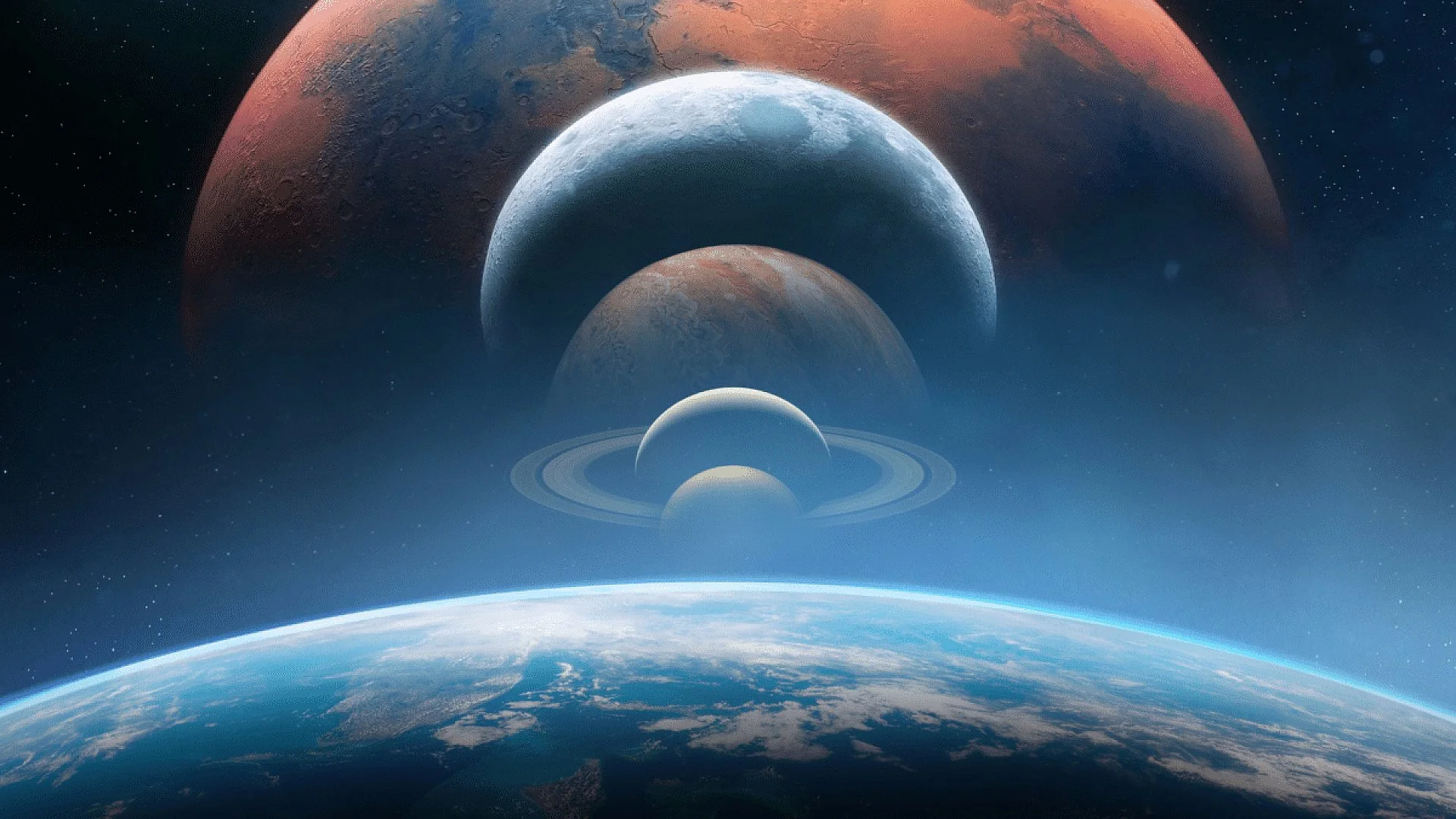
New computer‑driven research has identified a narrow belt just beyond Jupiter’s orbit that acted as a prolific nursery for the primordial rocks known as planetesimals. Published in The Astrophysical Journal, the study shows that this pressure‑enhanced ring captured dust and pebbles for millions of years, allowing a diverse suite of planetary building blocks to emerge in the early Solar System.
A High‑Pressure Ring Served as a Cosmic Dust Reservoir
Within two to four million years of the Solar System’s inception, Jupiter had already swept clean much of the material along its orbit, carving a gap in the surrounding protoplanetary disk. Researchers say this created a zone of elevated gas pressure just exterior to the giant planet, effectively corralling large quantities of dust and pebble‑sized particles. Such “dust traps” provided the conditions needed for tiny grains to collide, adhere, and gradually assemble into larger bodies over extended timescales.
“The same region of the early disk gave rise to different planetesimal families at distinct epochs. The environment just beyond Jupiter’s path was especially conducive to this process,” explained Joanna Drążkowska, leader of the Lise Meitner Group on planet formation. The simulations indicate that a single, ring‑shaped zone could host a range of material compositions, seeding the variety of planets and asteroids we observe today.
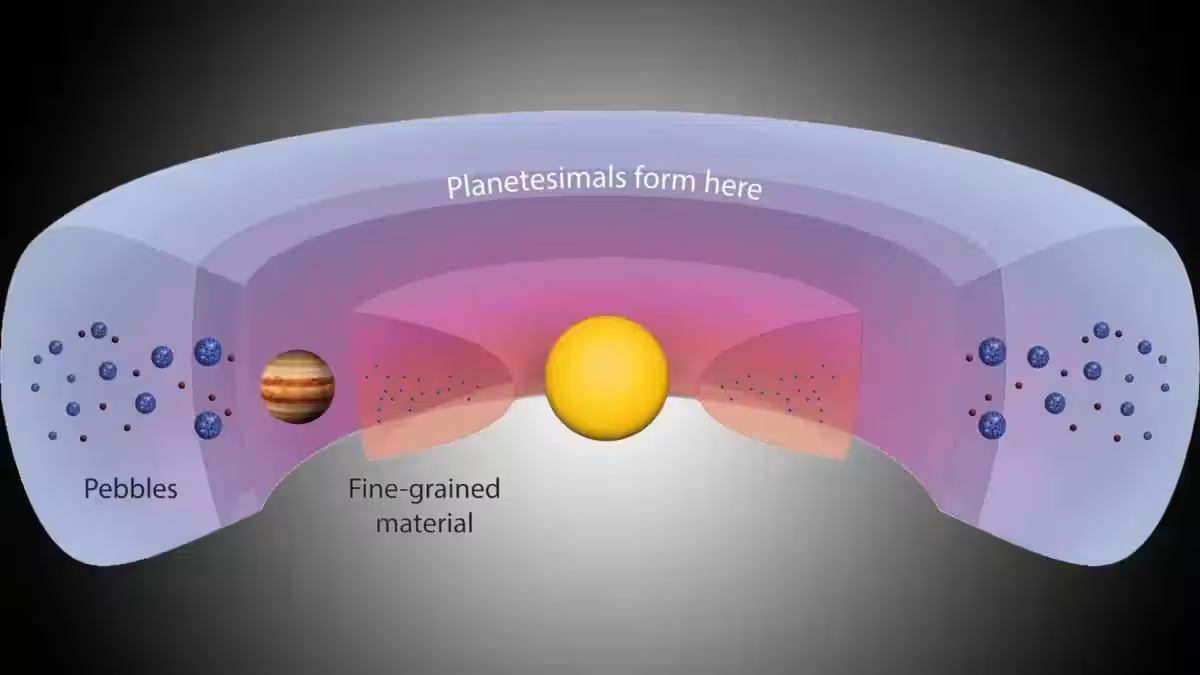
Credit: MPS / hormesdesign.de
Matching Simulations to Meteorite Chemistry
Earth‑falling meteorites preserve a chemical imprint of the early Solar System, offering a tangible record of planetesimal formation. The team concentrated on carbon‑rich chondrites, which are thought to originate beyond Jupiter. Laboratory work has sorted these meteorites into distinct groups based on age and mineralogy, ranging from delicate, fine‑grained matrices to sturdier inclusions embedded within the dust.
“Our models needed to capture how both fragile and rigid components behaved across a wide range of scales,” said Nerea Gurrutxaga, a PhD candidate at the Max Planck Institute for Solar System Research (MPS) and lead author of the paper. By tracing collisions, drift, and accumulation within the pressure bump, the researchers recreated conditions that reproduce the observed diversity of carbonaceous chondrites, linking laboratory findings to large‑scale disk dynamics.
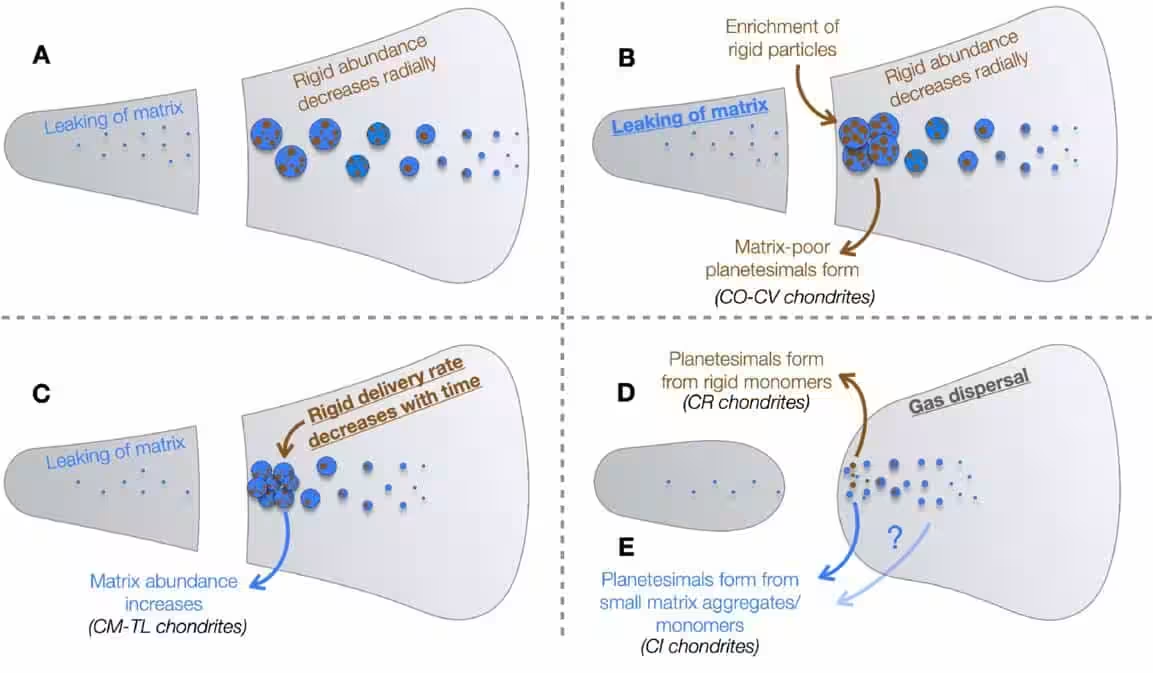
Credit: The Astrophysical Journal
Successive Waves of Planetesimal Formation
The simulations portray Jupiter as a selective filter: larger, sturdier grains encountered greater resistance, while smaller particles slipped through more easily. Over millions of years this segregation gave rise to multiple generations of planetesimals, each characterized by different material strengths.
“For the first time we have reproduced laboratory meteorite results using a full‑scale model of the nascent Solar System. In that sense, meteorites act as a benchmark for planet‑formation theories,” noted Thorsten Kleine, director of MPS and a leading cosmochemist. The study, appearing in The Astrophysical Journal, argues that such dust traps functioned as long‑lived factories, continuously supplying material for emerging planetary bodies.
Broader Consequences for Solar System Architecture
These findings underscore the importance of localized pressure enhancements in directing the early Solar System’s evolution. By concentrating solids in a confined ring, dust traps enabled rapid, compositionally diverse planetesimal growth. Drążkowska emphasizes that “the evidence strongly supports dust traps as the primary birthplace of planetesimals in our system.”
Linking simulation outcomes directly to meteorite records provides a rare test of theoretical models against tangible samples. The work suggests that planetary assembly was a staggered, region‑specific process rather than a uniform sweep across the disk, offering fresh insight into how the Sun’s family of worlds took shape.
This article has been fact checked for accuracy, with information verified against reputable sources. Learn more about us and our editorial process.
Last reviewed on .
Article history
- Latest version
Reference(s)
- Gurrutxaga, Nerea., et al. “Carbonaceous Chondrites Provide Evidence for Late-stage Planetesimal Formation in a Pressure Bump.” The Astrophysical Journal, vol. 1003, no. 2, May 22, 2026, pp. 132 American Astronomical Society, doi: 10.3847/1538-4357/ae6104. <https://iopscience.iop.org/article/10.3847/1538-4357/ae6104>.
Cite this page:
- Posted by Aisha Ahmed