James Webb Detects Strange Dust Structure Around a 23-Billion-Solar-Mass Black Hole
Webb’s latest observations hint hidden polar dust could explain the extreme infrared glow of the brightest early galaxy ever detected
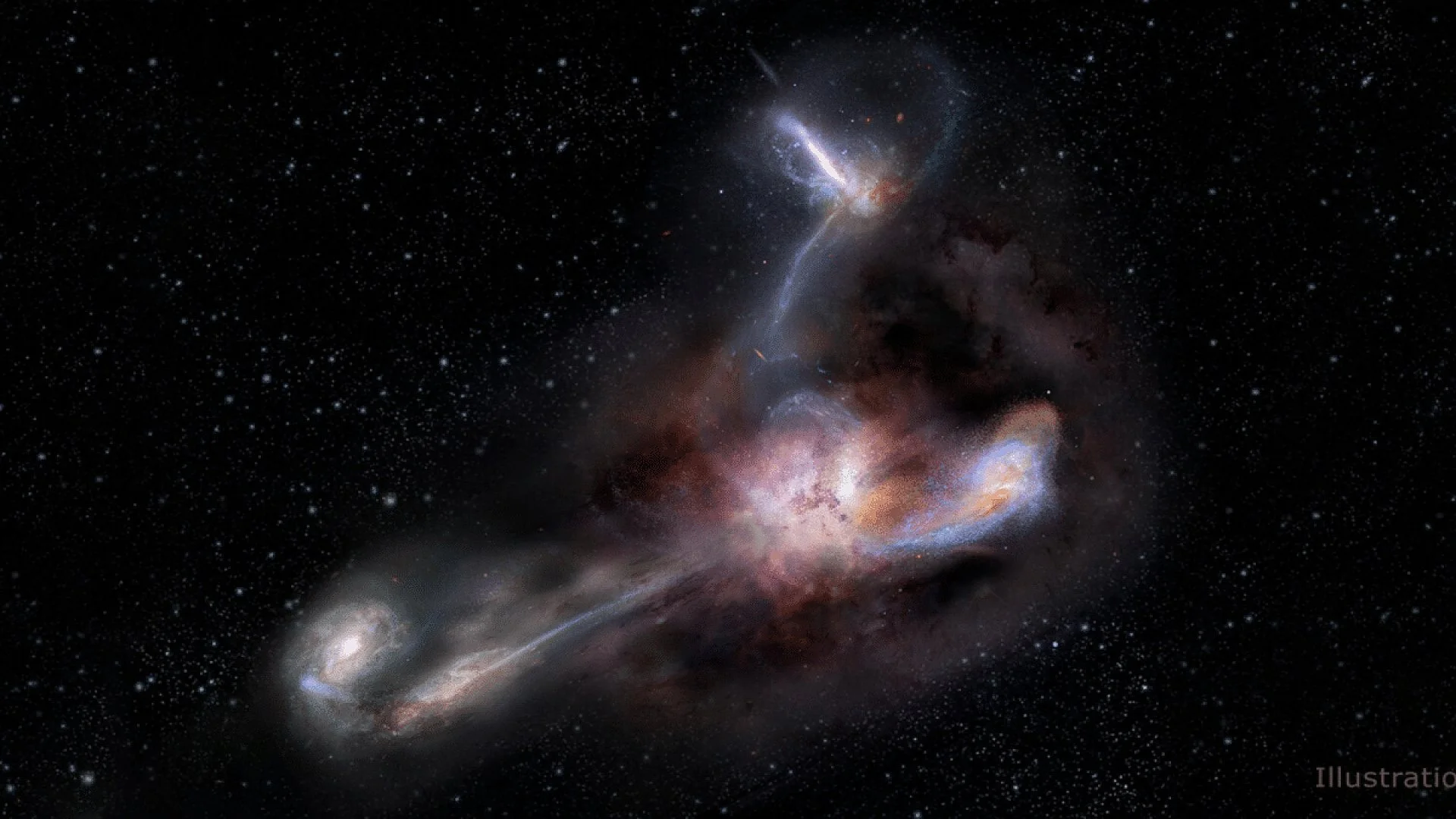
A recent paper in Monthly Notices of the Royal Astronomical Society presents new evidence that the staggering infrared output of the distant galaxy W2246−0526 is amplified by extensive polar dust clouds surrounding its central black hole. The analysis, which incorporates high‑resolution observations from the James Webb Space Telescope, suggests that this “Hot DOG” galaxy—detected only 1.2 billion years after the Big Bang—derives much of its brilliance from dust that reprocesses energetic radiation into the infrared regime.
A Hidden Giant Among the First Galaxies
W2246−0526 belongs to the rare class of hot dust‑obscured galaxies (Hot DOGs), objects that dominate the infrared sky with luminosities exceeding 1014 times that of the Sun. Their power stems from supermassive black holes accreting material at extreme rates, while thick layers of dust absorb the high‑energy output and reradiate it at longer wavelengths, rendering the galaxies nearly invisible in optical light. At a redshift of 4.6, W2246−0526 is the most distant and luminous Hot DOG identified, previously known to host dust heated to roughly 450 K (about 180 °C), a temperature indicative of a vigorous active galactic nucleus.
Credit: Monthly Notices of the Royal Astronomical Society
JWST Data Reveal Dust Extending Above the Torus
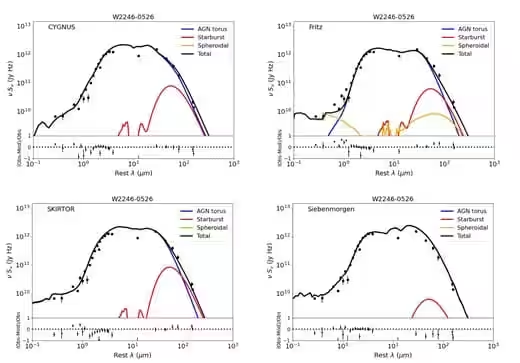
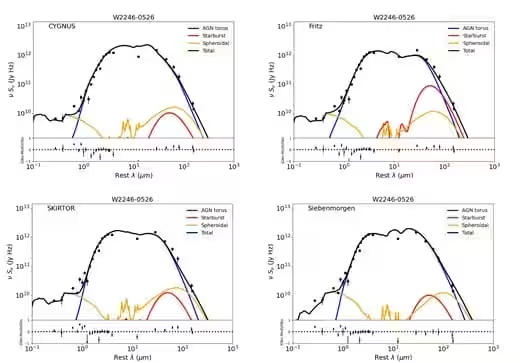
Lead author Charalambia Varnava of the European University Cyprus combined multi‑wavelength measurements with sophisticated spectral‑energy‑distribution modeling. By integrating fresh infrared photometry from the James Webb Space Telescope, the team probed structures hidden deep within the dust envelope. Initial configurations—incorporating the canonical dusty torus, star‑forming regions, and the host galaxy—failed to reproduce the pronounced mid‑infrared excess observed from Earth.
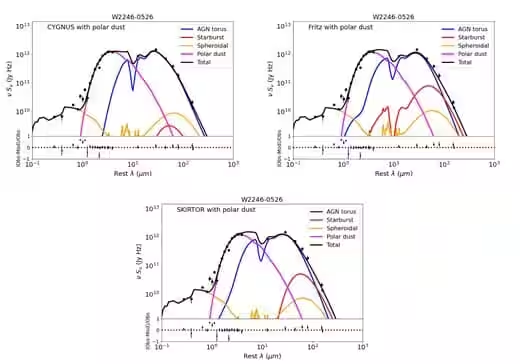
The breakthrough emerged when a polar dust component was introduced, representing dense clouds situated above and below the black‑hole plane rather than confined to the equatorial torus. Simulations that included this geometry achieved a markedly better match to the observed spectral profile, indicating that radiation from the active nucleus is intercepted by the polar dust and re‑emitted in the infrared, thereby boosting the galaxy’s apparent luminosity.
Credit: Monthly Notices of the Royal Astronomical Society
“For all models, the inclusion of polar dust statistically significantly improves their fit to the data of W2246−0526,” the authors write. “We argue that the observed infrared SED of W2246−0526 can be most plausibly explained by re‑radiation by optically thick dust clouds in the polar regions of the torus, as well as an optically thick torus viewed almost edge‑on.” Although the polar dust is inferred rather than directly imaged, the consistency of the updated models makes this interpretation compelling.
A Black Hole Growing at Super‑Eddington Rates
Revised modeling also yields new estimates for the galaxy’s central engine. The black hole is inferred to have a mass of roughly 2.3 × 10¹⁰ solar masses, placing it among the most massive early‑universe black holes known. Its energetic output appears to dominate 72 %–81 % of the total luminosity of the host galaxy. Simultaneously, the system exhibits an intense starburst, with star‑formation rates thousands of times higher than those of the Milky Way, suggesting a brief but violent growth phase that may be only tens of millions of years old.
Credit: Monthly Notices of the Royal Astronomical Society
The elevated black‑hole mass and the possibility of super‑Eddington accretion—where material falls onto the black hole faster than conventional theoretical limits—imply that W2246−0526 is a prime example of rapid early‑universe growth. The authors note that similar, heavily obscured galaxies may be lurking throughout the distant cosmos, hidden behind layers of dust that conventional surveys miss. Applying the polar‑dust modeling framework to other datasets could uncover a hidden population of luminous, dust‑enshrouded active galaxies.
This article has been fact checked for accuracy, with information verified against reputable sources. Learn more about us and our editorial process.
Last reviewed on .
Article history
- Latest version
Cite this page:
- Posted by Aisha Ahmed