Stunning NASA Photo Captures Mars Drifting Through a Star Cluster Under Northern Lights
A solar eruption lit up the Swedish sky as Mars made a rare celestial alignment with the Beehive star cluster in a stunning astronomical coincidence.
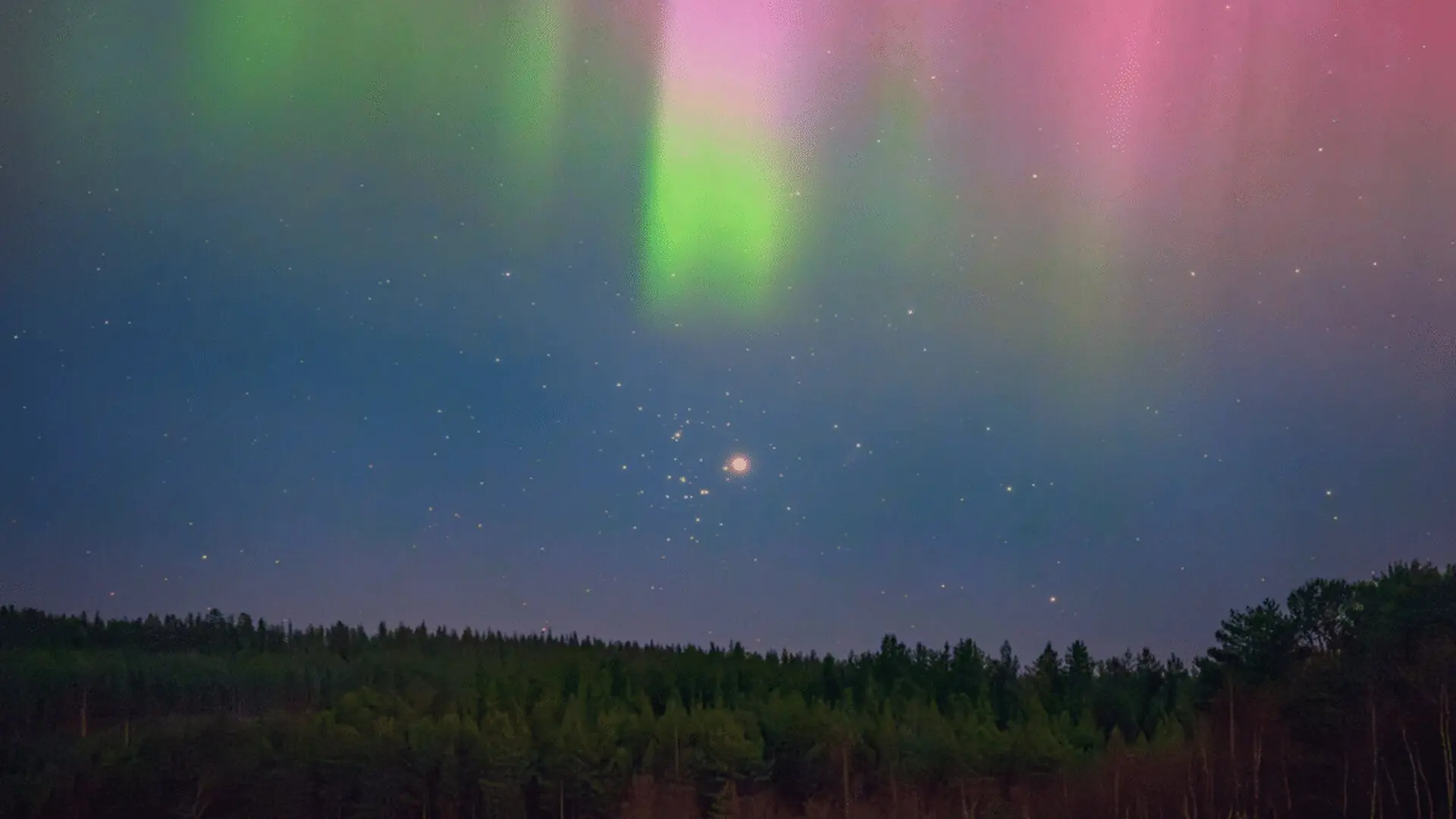
A striking celestial convergence over northern Sweden has captured the attention of astronomers and night-sky enthusiasts alike, as a powerful geomagnetic event provided a luminous backdrop for a rare planetary alignment. The image, which was featured as NASA’s Astronomy Picture of the Day on October 14, 2026, showcases the intersection of local atmospheric phenomena, inner solar system mechanics, and deep-space stellar clusters.
Atmospheric Light Meets Planetary Transit
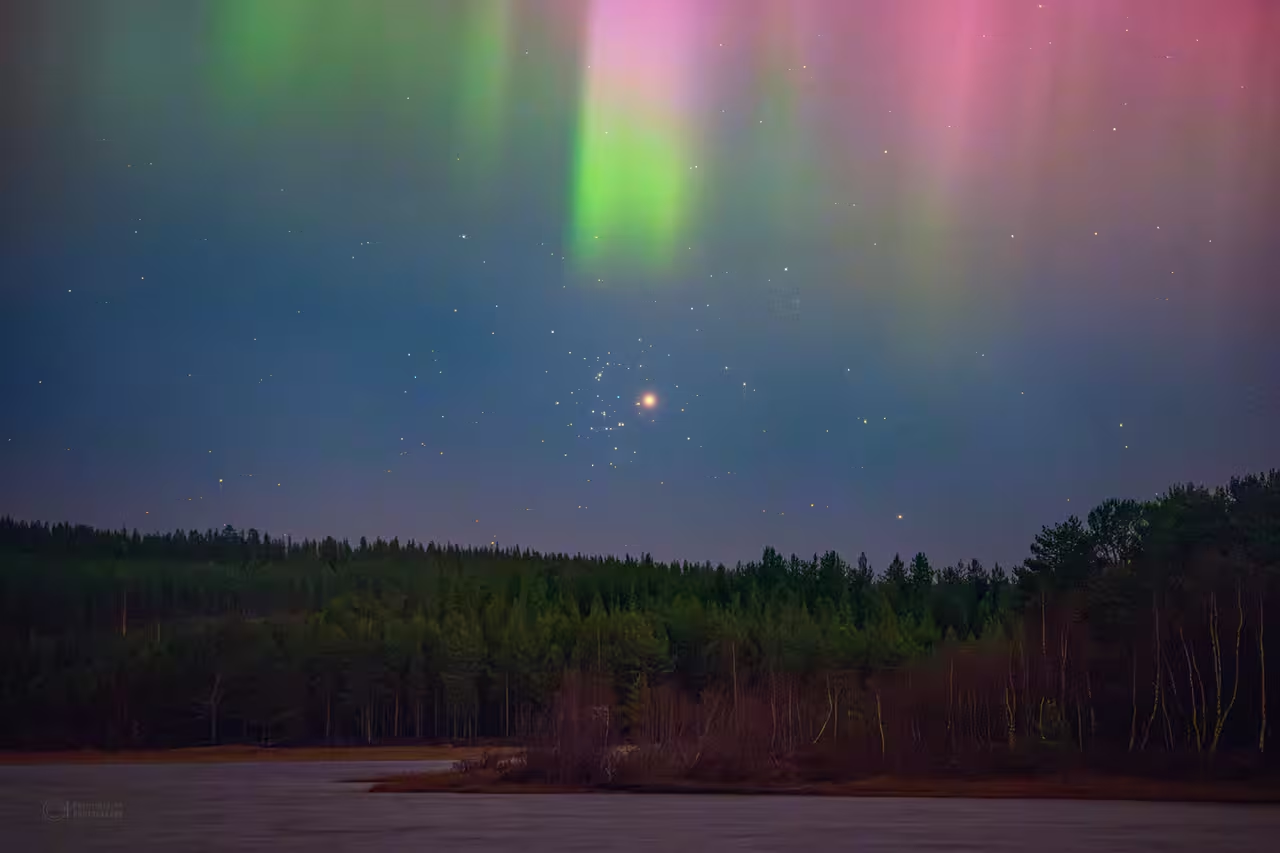
The photograph was captured near the village of Lansjärv, where the night sky erupted into a vivid display of the northern lights. This auroral activity was the direct result of a solar eruption that reached our planet on October 10, 2026. As high-energy particles from the Sun collided with Earth’s magnetic field, they cascaded into the upper atmosphere, exciting gas molecules and triggering the vibrant curtains of light seen hovering over the dark Swedish forest.
Simultaneously, the planet Mars reached a position in its orbit that made it appear to pass through the center of the Beehive cluster, also designated as Messier 44. While the two events—the aurora and the planetary transit—were entirely unrelated in their physical origins, their accidental alignment created a complex visual layering of space, ranging from the immediate vicinity of Earth to stars situated hundreds of light-years away.
Cosmic Perspective and Stellar Evolution
Although the composition suggests a close encounter, the distance between the subjects is immense. Messier 44 is an open star cluster located roughly 600 light-years away in the constellation Cancer. It acts as a natural laboratory for astrophysicists studying stellar aging. Because the stars within this cluster were born from the same molecular cloud, researchers can use them as a controlled group to measure how rotation periods change as stars lose angular momentum through magnetized stellar winds.
Mars, by contrast, is a near neighbor, with its apparent motion across the sky dictated by the differing orbital velocities of Earth and the Red Planet around the Sun. The visual overlap is merely a matter of perspective, a quirk of Earth-based observation that briefly unified the chaotic energy of the Sun’s corona with the steady, ancient light of distant stars.
Cultural Significance in the Arctic
Beyond the scientific implications, the event holds deep cultural resonance. In the traditions of the Sámi people, the Indigenous inhabitants of the Arctic regions where these auroras are frequently observed, the lights—known as guovssahasat—have long been treated with profound reverence. By capturing the convergence of atmospheric, solar, and galactic elements, the image serves as a reminder of the vast, interconnected processes that define our place in the universe.
This article has been fact checked for accuracy, with information verified against reputable sources. Learn more about us and our editorial process.
Last reviewed on .
Article history
- Latest version
Reference(s)
- Bonnell, Jerry. “APOD: 2026 October 14 - Mars and the Beehive Under an Aurora - NASA Science.”, October 14, 2026 NASA <https://science.nasa.gov/image-article/apod-2026-october-14-mars-and-the-beehive-under-an-aurora/>.
Cite this page:
- Posted by Farah Siddiqui