German And Belgian Abyssal Sediments Reveal Surprising Molybdenum Mobility In The Pacific Ocean
New pore water analysis across five meters of deep-sea sediment uncovers unexpected trace metal heterogeneity and mineral transformations.
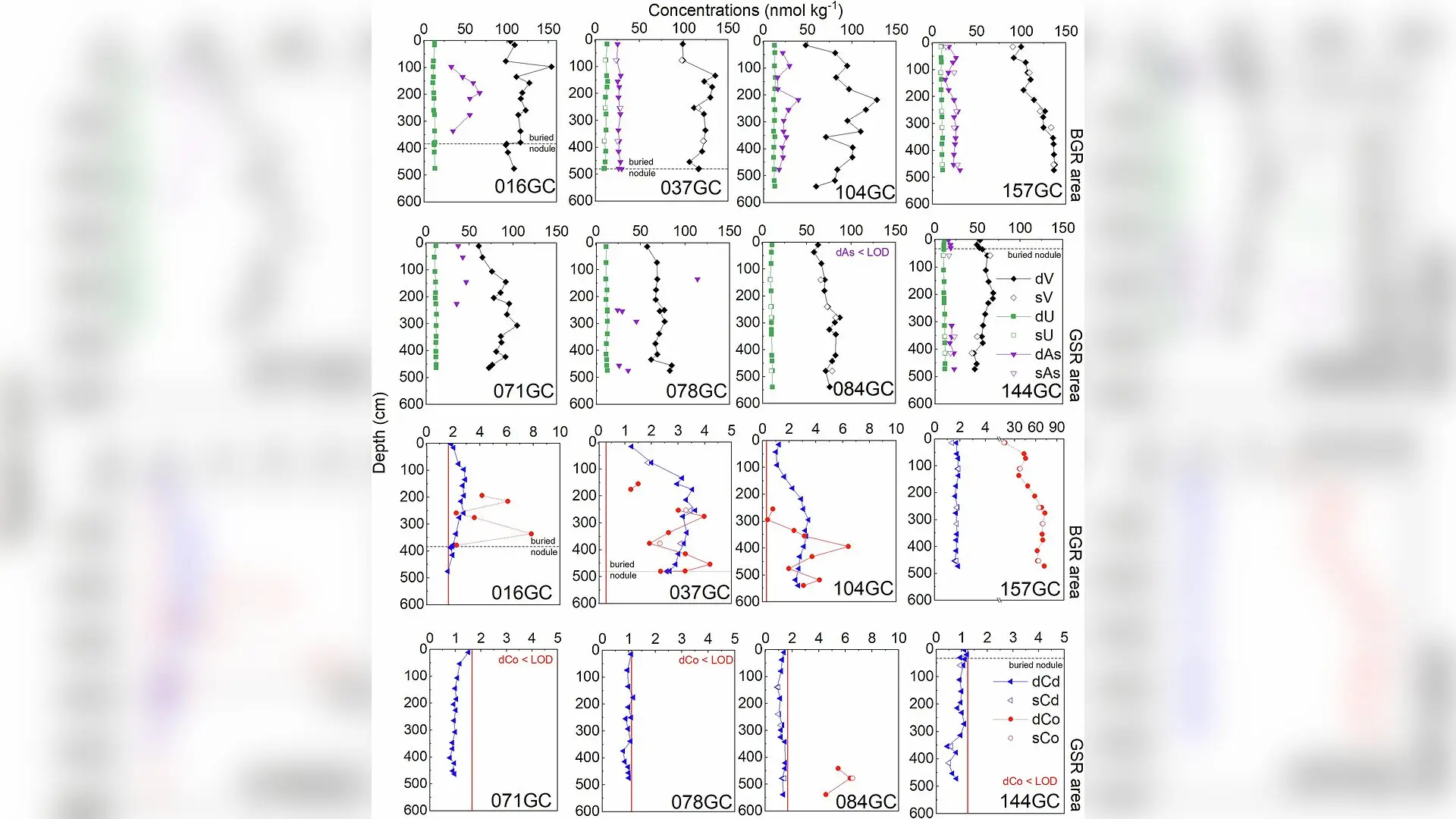
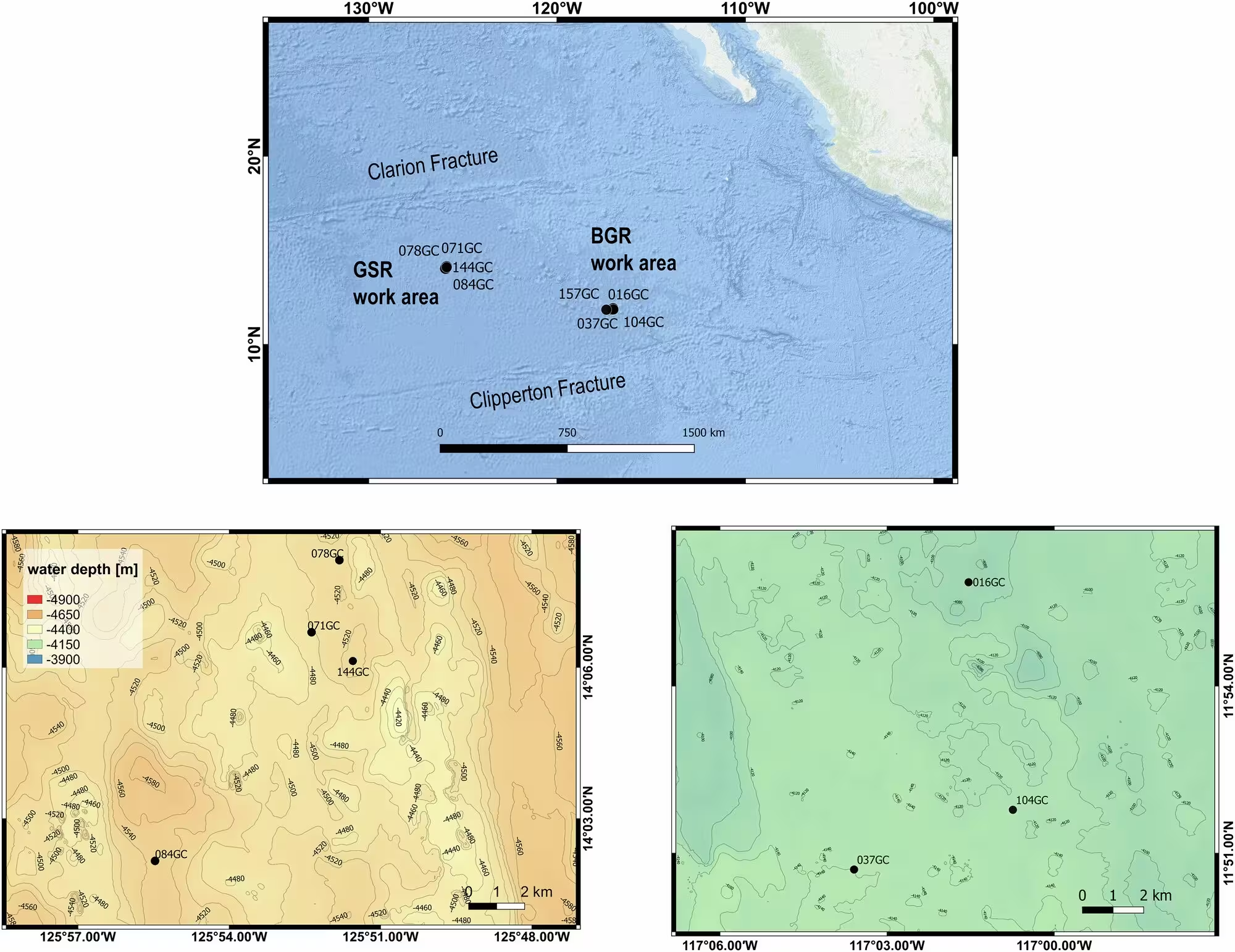
Deep-sea sediments in the Clarion-Clipperton Zone of the central North Pacific Ocean display striking geochemical contrasts in how trace metals move and accumulate across a depth of 500 cm. Researchers led by Sophie A. L. Paul and colleagues at Constructor University and the Federal Institute for Geosciences and Natural Resources investigated pore water and solid phase chemistry in two major exploration contract areas.
Trace metal cycling in marine sediments is driven by early diagenetic processes, which are chemical reactions occurring in sediments after deposition that cause minerals to dissolve, migrate, or precipitate under varying oxygen levels. In the abyssal plains of the Clarion-Clipperton Zone, low inputs of organic carbon mean that oxygen penetrates several meters into the seafloor, spreading out the natural sequence of chemical reactions known as the redox cascade. This extended transition zone makes these sediments ideal for studying how changing oxygen and reduction conditions mobilize metals over geological time scales, though obtaining samples requires specialized coring equipment.
How Oxygen Gradients Shape Metal Mobility
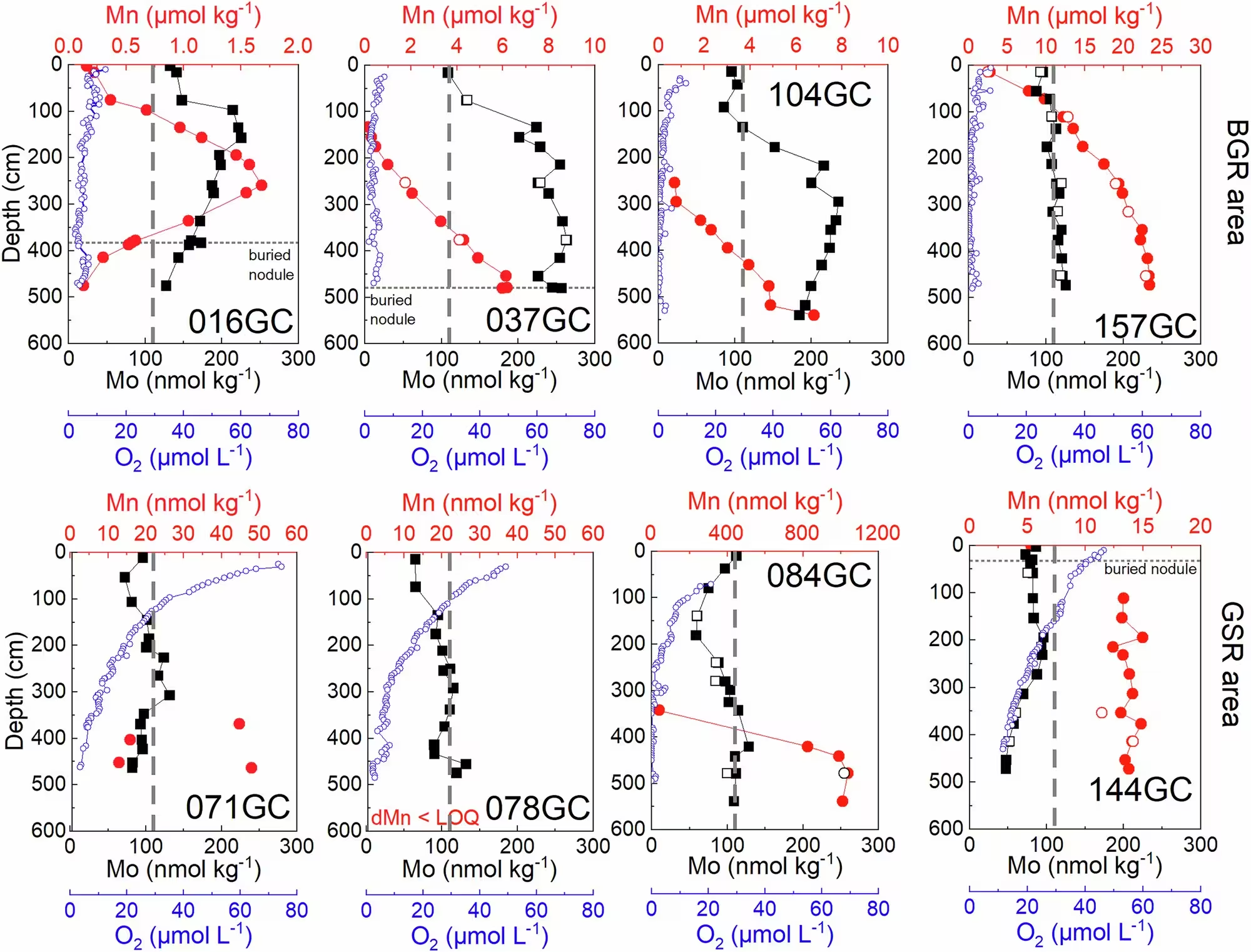
The research team found that dissolved manganese concentrations in pore waters were much lower in the contract area operated by Global Sea Mineral Resources than in the area managed by the Federal Institute for Geosciences and Natural Resources. This difference stems from higher particulate organic carbon fluxes in the eastern sector, which drive faster oxygen consumption and trigger earlier manganese oxide reduction. As oxygen levels drop with depth, solid manganese and iron oxides become unstable and dissolve, releasing trapped trace metals into the surrounding pore water.
Dissolved molybdenum concentrations showed an even more pronounced divergence between the two regions. In the German exploration area, molybdenum in suboxic pore waters reached roughly 250 nmol kg^-1, whereas levels in the Belgian area rarely exceeded 100 nmol kg^-1. These patterns are detailed in the study published in Communications Earth & Environment, which highlights how local variations in organic matter input alter deep-sea chemistry. Molybdenum typically adsorbs onto manganese oxides in oxic surface sediments, but it is released back into solution when those mineral hosts dissolve deeper in the sediment column.
Mineral Transformations Drive Decoupled Metal Cycles
The behavior of molybdenum sharply contrasted with that of cobalt and other trace elements. While cobalt strongly associates with manganese oxides and tends to follow dissolved manganese profiles during reductive dissolution, molybdenum is preferentially remobilized because it binds to mineral surfaces as an inner-sphere complex rather than incorporating directly into crystal structures. This difference causes molybdenum concentration peaks to form stratigraphically above manganese and cobalt peaks within the sediment cores.
X-ray diffraction analyses of deeply buried nodules revealed the presence of todorokite, a tunnel-structured manganese mineral that forms during diagenetic alteration. In contrast, shallow sediments were dominated by 10-angstrom phyllomanganates in the German contract area and 7-angstrom phyllomanganates in the Belgian contract area. The transformation from layered phyllomanganates to tunnel-structured todorokite modifies the binding environments of associated trace metals, facilitating the retention of divalent metals like nickel and copper while releasing molybdenum into the pore water.
Implications for Paleoceanography and Mining Baselines
Molybdenum isotopes serve as a key geochemical proxy for reconstructing past ocean oxygenation levels, relying on the assumption that isotope signatures remain stable after burial. The new data demonstrate that molybdenum undergoes active diagenetic mobilization and diffuses both upward and downward following its release from dissolving manganese oxides. This mobility introduces significant spatial heterogeneity that must be accounted for when interpreting paleoceanographic records.
As commercial interest in deep-sea mining grows, establishing robust environmental baselines becomes increasingly vital. While potential seabed mining operations will primarily disturb the uppermost layer of surface sediment, understanding the complex biogeochemical processes occurring down to depths of 500 cm provides essential context for evaluating long-term ecosystem impacts and regional environmental heterogeneity.
The research was published in Communications Earth & Environment on November 28, 2026.
This article has been fact checked for accuracy, with information verified against reputable sources. Learn more about us and our editorial process.
Last reviewed on .
Article history
- Latest version
Reference(s)
- Paul, Sophie A. L.., et al. “Heterogeneous cycling of molybdenum and other trace metals in oxic to suboxic Pacific pelagic sediments.” Communications Earth & Environment, vol. 7, no. 1, November 28, 2026 Springer Science and Business Media LLC, doi: 10.1038/s43247-026-04210-7. <https://doi.org/10.1038/s43247-026-04210-7>.
Cite this page:
- Posted by Michael Ellison