Hidden Patterns in Xinjiang Deserts Reveal How Plants Survive Extreme Aridity
A survey of 527 desert plots uncovers how elevation and moisture gradients shape plant communities across Central Asia.
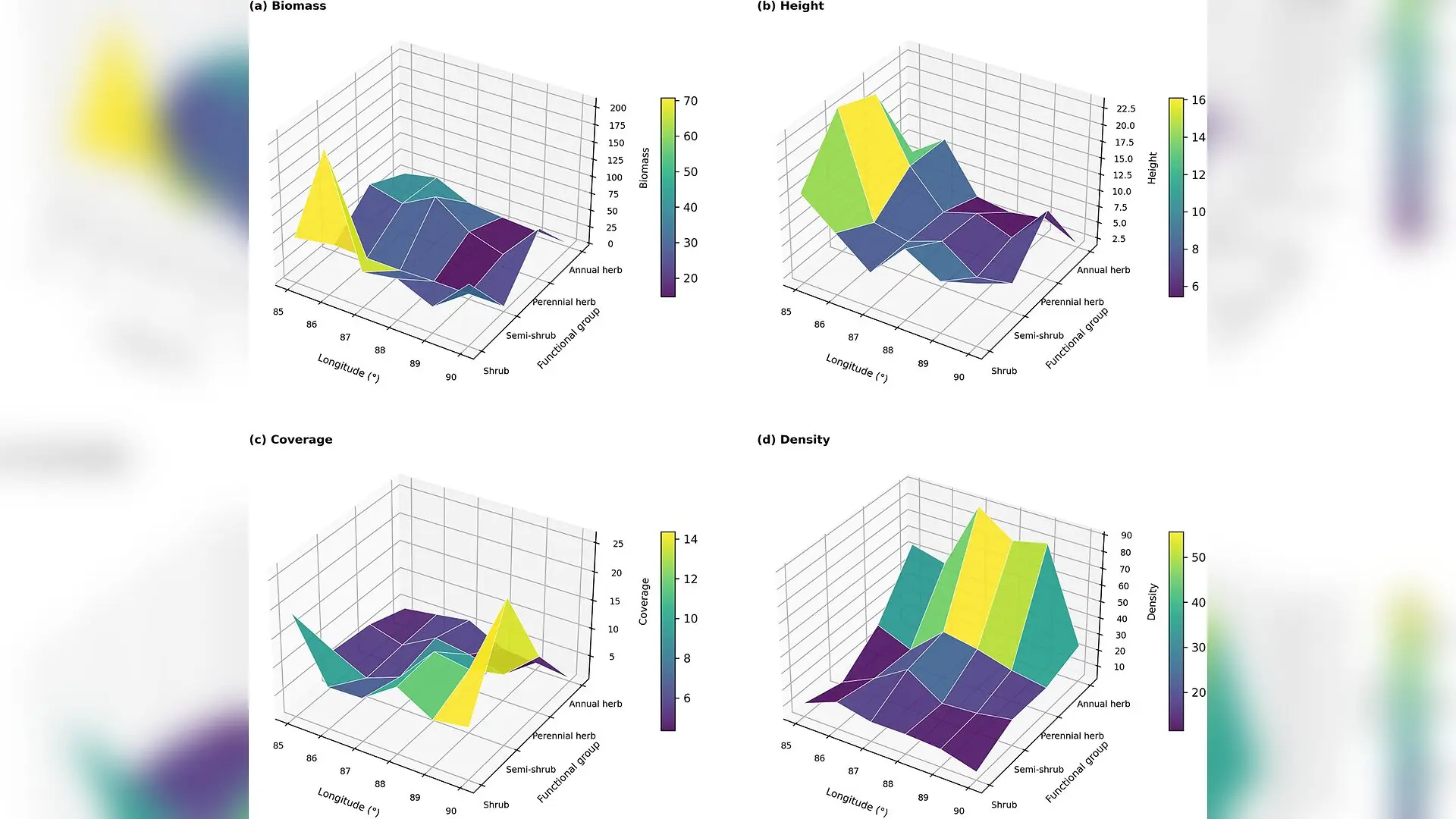
Mountain temperate deserts in Xinjiang take decades or centuries to assemble their sparse vegetation under extreme environmental stress. A comprehensive survey of 527 sample plots across northern Xinjiang, published in PLOS One, reveals that plant height, coverage, density, and aboveground biomass follow distinct spatial patterns driven by elevation and aridity. Desert ecosystems cover over one-third of Earth’s land area, and understanding how these harsh habitats function is critical for regional conservation.
How Elevation Shapes Plant Height and Coverage
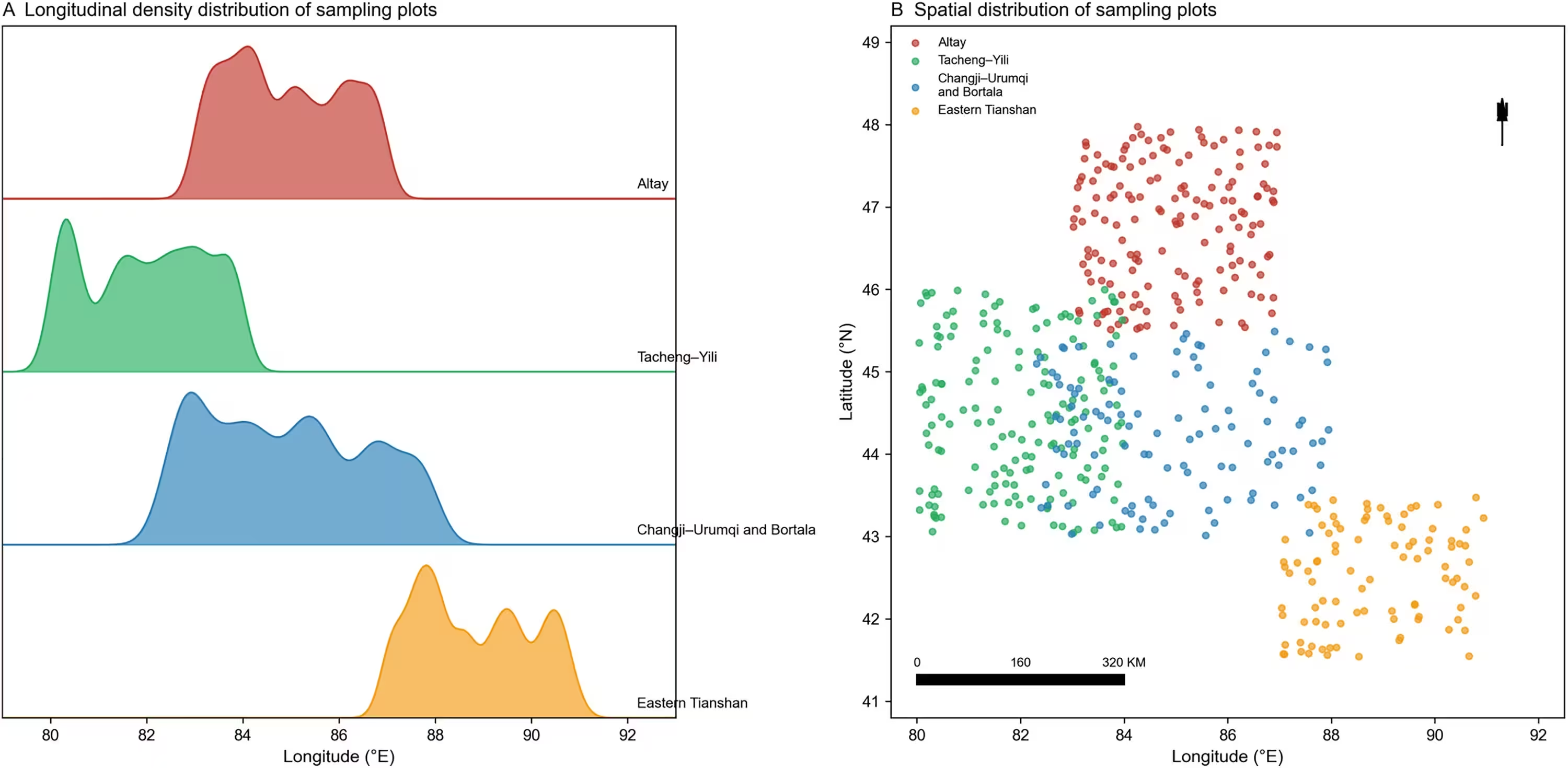
The research team analyzed four distinct plant life forms, including shrubs, semi-shrubs, perennial herbs, and annual herbs, across five major desert sub-regions. Most community structural attributes exhibited parabolic patterns along elevational gradients, reaching peak values at mid-elevations between 700 and 1100 meters. At low elevations of 200 to 600 meters, high temperatures and intense evaporation create severe drought stress that limits plant growth. At mid-elevations, orographic precipitation combined with moderate temperatures creates an optimal window for vegetation expression. Above 1100 meters, low temperatures and short growing seasons restrict plant performance, resulting in shorter statures and lower biomass.
What Happens Along the West-to-East Aridity Gradient
Vegetation performance decreases steadily from west to east in parallel with the declining westerly precipitation gradient. The hyper-arid Eastern Tianshan sub-region, where mean annual precipitation drops to just 34 millimeters, showed the lowest observed community structural attribute values. In contrast, the Tacheng and Ili sub-regions in the west benefit from moisture delivered by westerly airflows, supporting higher overall shrub biomass and vegetation cover. A biogeographic threshold appears near 90 degrees east longitude, where coverage and density values for multiple life forms reach regional minimums.
Why Different Life Forms Respond Differently to Stress
The four plant life forms showed divergent structural strategies along the combined geographic gradients. Shrubs and semi-shrubs maintained relatively stable dominance across environmental gradients, utilizing deep root systems and wood-based tissues to withstand drought. Perennial herbs favored mesic mid-elevation habitats, showing high sensitivity to local soil moisture availability. Annual herbs exhibited the strongest spatial fluctuations, adopting an opportunistic strategy of rapid germination and reproduction in response to episodic rainfall events.
The research was published in PLOS One on November 13, 2026.
This article has been fact checked for accuracy, with information verified against reputable sources. Learn more about us and our editorial process.
Last reviewed on .
Article history
- Latest version
Reference(s)
- Fei, Cheng., et al. “Spatial patterns of plant life-forms along elevation and aridity gradients in temperate deserts of northern Xinjiang, China.” PLOS One, vol. 21, no. 11, November 13, 2026, pp. e0362455 Public Library of Science (PLoS), doi: 10.1371/journal.pone.0362455. <https://doi.org/10.1371/journal.pone.0362455>.
Cite this page:
- Posted by Michael Ellison