Shishaldin Volcano Uncovers Hidden Magma Dike That Created Massive Summit Trough
Earth Science

Shishaldin Volcano Uncovers Hidden Magma Dike That Created Massive Summit Trough

Satellite data reveal how subsurface magma movement carved an 885-meter trough across the Aleutian peak without a surface eruption.
By Vikram Desai
Published:
Email this Article
Shishaldin Volcano Uncovers Hidden Magma Dike That Created Massive Summit Trough
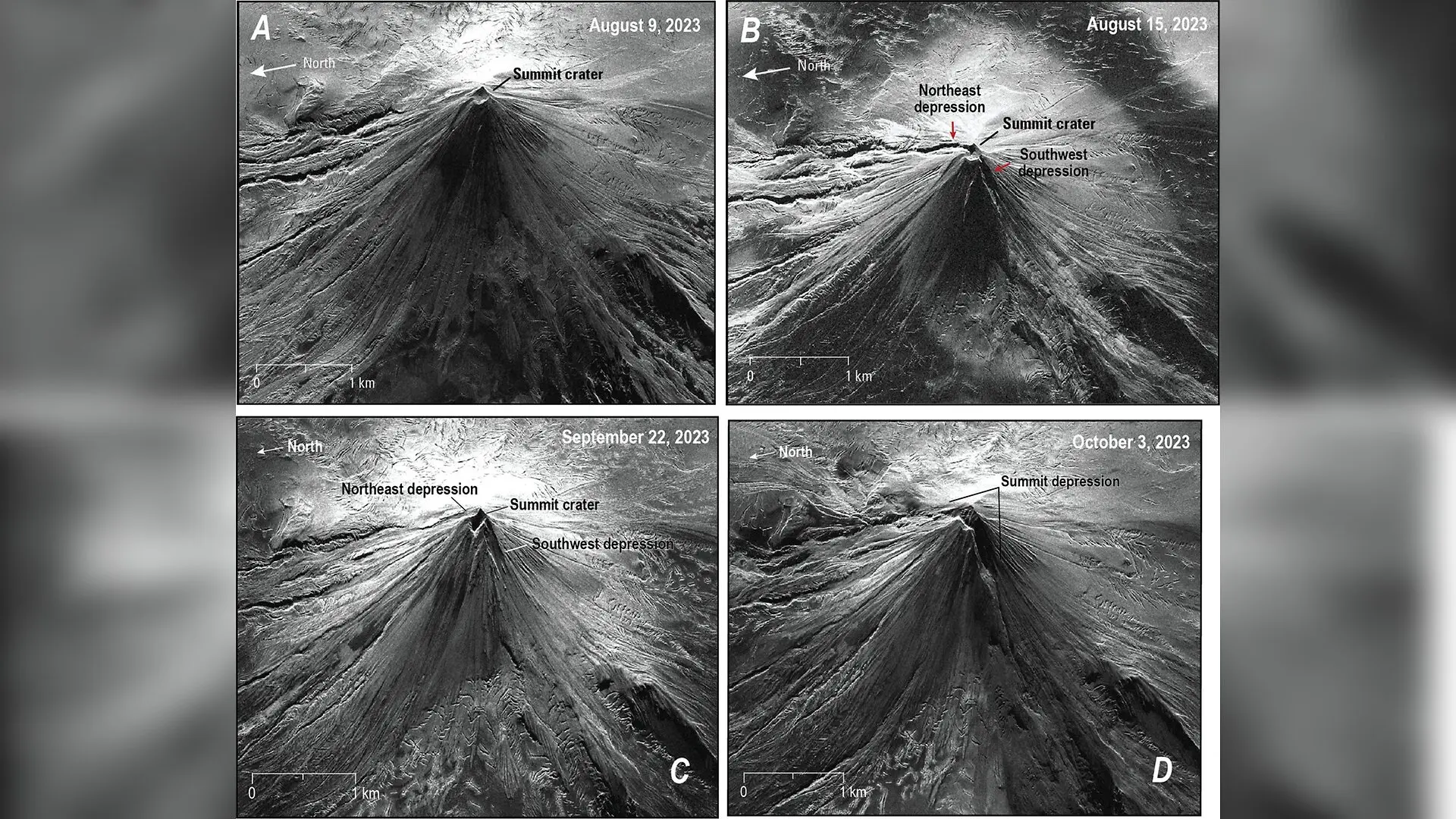
TerraSAR-X high resolution spotlight amplitude imagery (©2026 German Aerospace Center (DLR)) showing the development of depressions on the summit of Shishaldin Volcano. Images are all right-looking descending tracks oriented in this figure with illumination from the top with the north direction labeled to better visualize terrain change. A August 9, 2023 (orbit 55, incidence angle 42°). B August 15, 2023 (orbit 146, incidence angle 51°). Distinct depressions, northeast and southwest of the summit. C September 22, 2023 (orbit 55, incidence angle 42°), continuous depression absent. D October 3, 2023 (orbit 55, incidence angle 42°). Nearly continuous linear depression across the volcano summit Waythomas et al. / Bulletin of Volcanology

During the 2023 eruption of Shishaldin Volcano in Alaska, an unusual elongate depression measuring 885 meters in length and covering 142,000 square meters developed directly across the summit.

This unprecedented summit trough, documented in research published in the Bulletin of Volcanology, provides rare surface evidence of magma moving laterally through the upper cone rather than erupting directly through the central crater. A dike is a vertical or near-vertical sheet of magma that forces its way upward through cracks or weak zones inside a volcanic mountain.

For years, scientists studying this symmetrical Aleutian stratovolcano observed explosive ash plumes and lava flows without noticing any major structural deformation at the summit. Now, high-resolution satellite monitoring and digital elevation models have captured how subsurface magma pathways can reshape the peak of a restless volcano without causing an immediate flank failure.
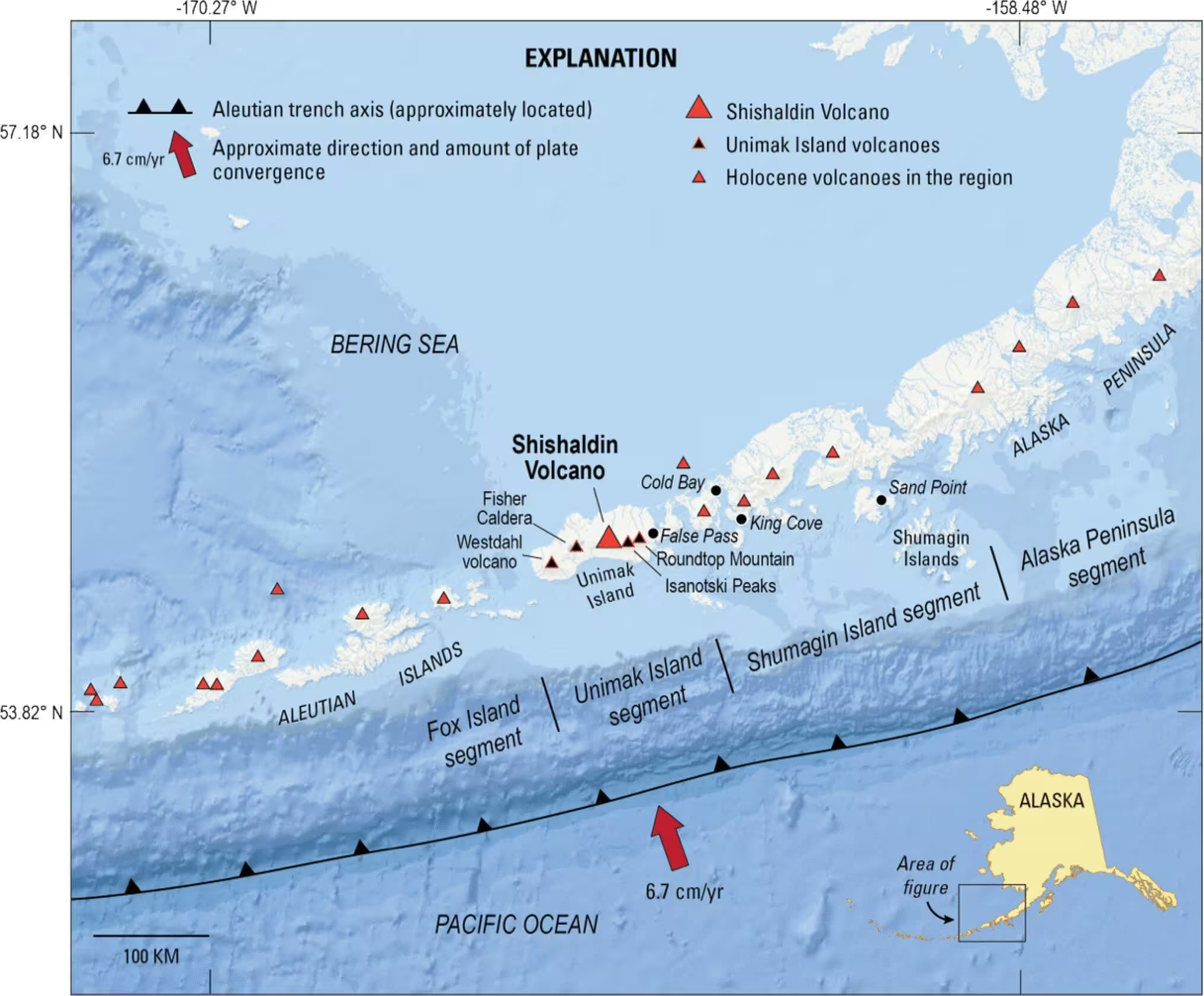
Fig. 1: Setting of Shishaldin Volcano in the eastern Aleutian Islands of Alaska. The red triangles outlined in black indicate Holocene volcanoes in the region. The black triangles outlined in red are volcanoes on Unimak Island. Seismic rupture zones along the eastern Aleutian arc from Nishenko and Jacobs (45). Base map from Esri (22) World Ocean Base, depth scale not given. Redlands, CA: Esri. Retrieved (March 30, 2026) from (https://usgs.maps.arcgis.com/). Volcano locations from Cameron and Nye 14. Plate convergence and velocity from DeMets et al. 16
Setting of Shishaldin Volcano in the eastern Aleutian Islands of Alaska. The red triangles outlined in black indicate Holocene volcanoes in the region. The black triangles outlined in red are volcanoes on Unimak Island. Seismic rupture zones along the eastern Aleutian arc from Nishenko and Jacobs (45). Base map from Esri (22) World Ocean Base, depth scale not given. Redlands, CA: Esri. Retrieved (March 30, 2026) from (https://usgs.maps.arcgis.com/). Volcano locations from Cameron and Nye 14. Plate convergence and velocity from DeMets et al. 16 Credit: Waythomas et al. / Bulletin of Volcanology

How Did the Summit Trough Form Step by Step?

Between August 9 and August 15, 2023, two separate depressions began forming on opposite sides of the active summit crater. Researchers Christopher Waythomas, Matthew Loewen, and Hannah Dietterich from the Alaska Volcano Observatory tracked how these hollows progressively deepened and widened during the months of unrest. By late October 2023, the two distinct pits merged into a single continuous linear trough cutting right across the peak. The authors note that the central crater remained stationary while the northeast and southwest zones dropped downward by as much as 113 meters.

What Role Did Shallow Dike Intrusion Play?

The research team interprets the trough as surface subsidence caused by a shallow dike intruding into the upper edifice of the volcano. When magma moves into a narrow vertical fracture just beneath the surface, it creates tensional mechanical stresses that pull the overlying rock apart and cause the ground to sink. This geometry closely matches features documented during eruptions at other basaltic stratovolcanoes like Mount Etna in Italy and Pacaya Volcano in Guatemala.
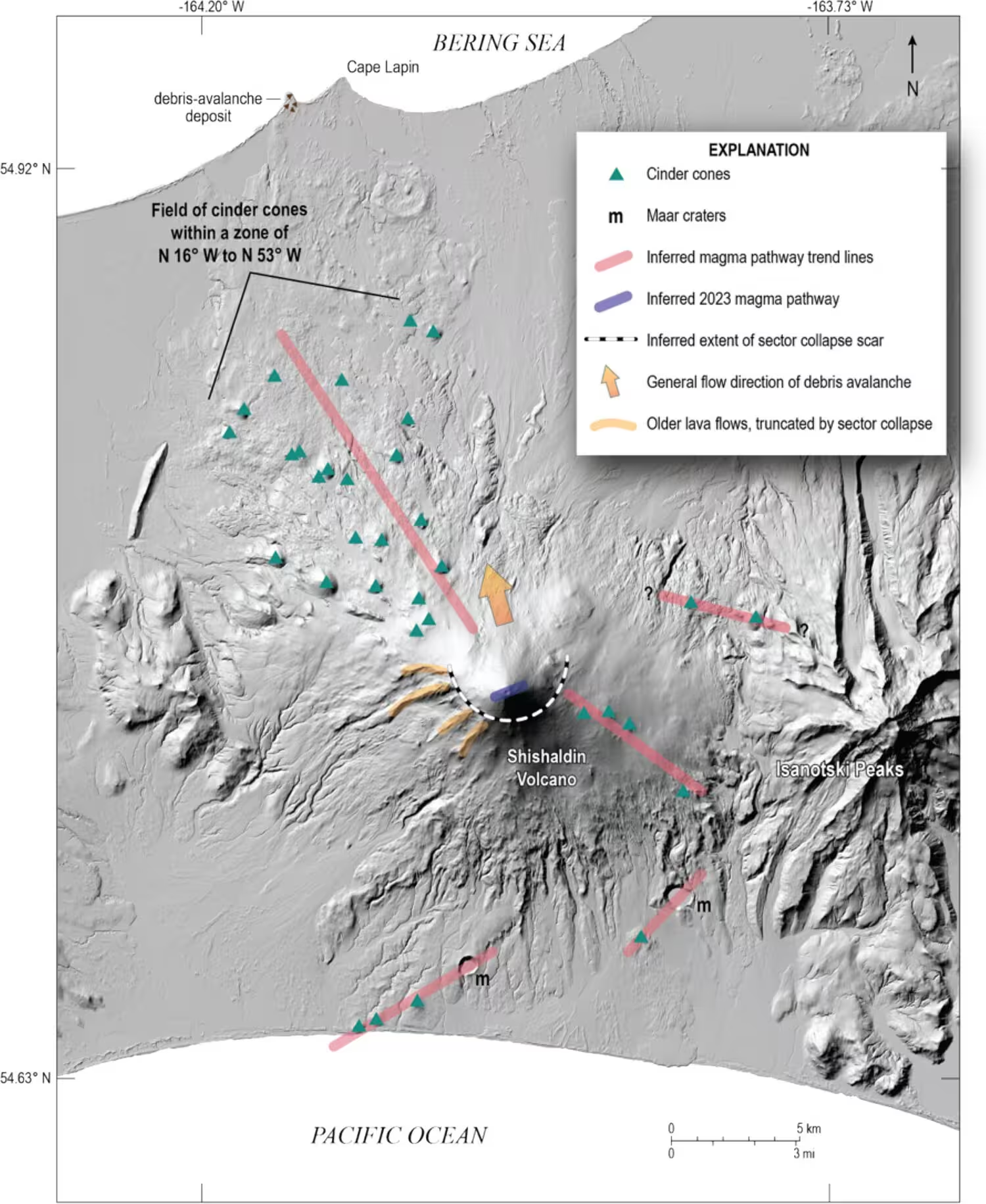
Fig. 2: Hillshade image of Shishaldin Volcano showing the location of cinder cones and maars on the volcano. The approximate alignment of these features maps out inferred magma pathways, as described in Tibaldi and Bonali (59, Fig. 8). Also shown are parts of the older edifice that were truncated by sector collapse in the late Pleistocene (Fournelle 23). The sector collapse produced a debris avalanche that flowed to the Bering Sea and is now exposed near Cape Lapin. Hillshade image derived from Interferometric Synthetic Aperture Radar (IFSAR) digital elevation (DEM) data (U.S. Geological Survey 60)
Hillshade image of Shishaldin Volcano showing the location of cinder cones and maars on the volcano. The approximate alignment of these features maps out inferred magma pathways, as described in Tibaldi and Bonali (59, Fig. 8). Also shown are parts of the older edifice that were truncated by sector collapse in the late Pleistocene (Fournelle 23). The sector collapse produced a debris avalanche that flowed to the Bering Sea and is now exposed near Cape Lapin. Hillshade image derived from Interferometric Synthetic Aperture Radar (IFSAR) digital elevation (DEM) data (U.S. Geological Survey 60) Credit: Waythomas et al. / Bulletin of Volcanology

Why Did the Magma Stop Before Reaching the Surface?

Despite the creation of a massive summit depression and intense heating along the floor, no lava erupted along the length of the trough itself. Strong linear thermal anomalies and continuous sulfur dioxide gas emissions persisted from late September through November 2023, confirming that magma stalled at shallow depths. The authors suggest that encountering stratigraphic discontinuities or layers with different mechanical properties within the volcanic cone may have arrested the upward propagation of the dike before it could breach the surface.

Could This Subsurface Activity Trigger a Major Collapse?

Because the modern cone of Shishaldin Volcano grew rapidly by accumulating about 10 cubic kilometers of loose lava, spatter, and pyroclastic debris over roughly 10,000 years, its steep slopes remain inherently unstable. Repeated dike intrusions can increase internal pressures and weaken the internal architecture of the edifice, raising the long-term risk of a future sector collapse similar to the one that deposited debris near Cape Lapin in the late Pleistocene. However, the researchers emphasize that current monitoring networks would likely detect any future structural shifts promptly.

The research was published in Bulletin of Volcanology on November 28, 2026.

Fact Checked

This article has been fact checked for accuracy, with information verified against reputable sources. Learn more about us and our editorial process.

Last reviewed on .

Article history

  • Latest version

Reference(s)

  1. Waythomas, Christopher F.., et al. “Syneruptive edifice subsidence during the 2023 eruption of Shishaldin Volcano, Alaska.” Bulletin of Volcanology, vol. 88, no. 12, November 28, 2026 Springer Science and Business Media LLC, doi: 10.1007/s00445-026-02055-8. <https://doi.org/10.1007/s00445-026-02055-8>.

Cite this page:

Desai, Vikram. “Shishaldin Volcano Uncovers Hidden Magma Dike That Created Massive Summit Trough.” BioScience. BioScience ISSN 2521-5760, 28 November 2026. <https://www.bioscience.com.pk/en/subject/earth-science/syneruptive-edifice-subsidence-during-the-2023-eruption-of-shishaldin-volcano-alaska>. Desai, V. (2026, November 28). “Shishaldin Volcano Uncovers Hidden Magma Dike That Created Massive Summit Trough.” BioScience. ISSN 2521-5760. Retrieved November 28, 2026 from https://www.bioscience.com.pk/en/subject/earth-science/syneruptive-edifice-subsidence-during-the-2023-eruption-of-shishaldin-volcano-alaska Desai, Vikram. “Shishaldin Volcano Uncovers Hidden Magma Dike That Created Massive Summit Trough.” BioScience. ISSN 2521-5760. https://www.bioscience.com.pk/en/subject/earth-science/syneruptive-edifice-subsidence-during-the-2023-eruption-of-shishaldin-volcano-alaska (accessed November 28, 2026).
End of the article