Scientists Found 77 Hidden Quasars, and They Could Reveal a Rare Stage of Black Hole Growth Never Seen This Clearly Before
Billions of years hidden quasars revealed behind cosmic dust clouds
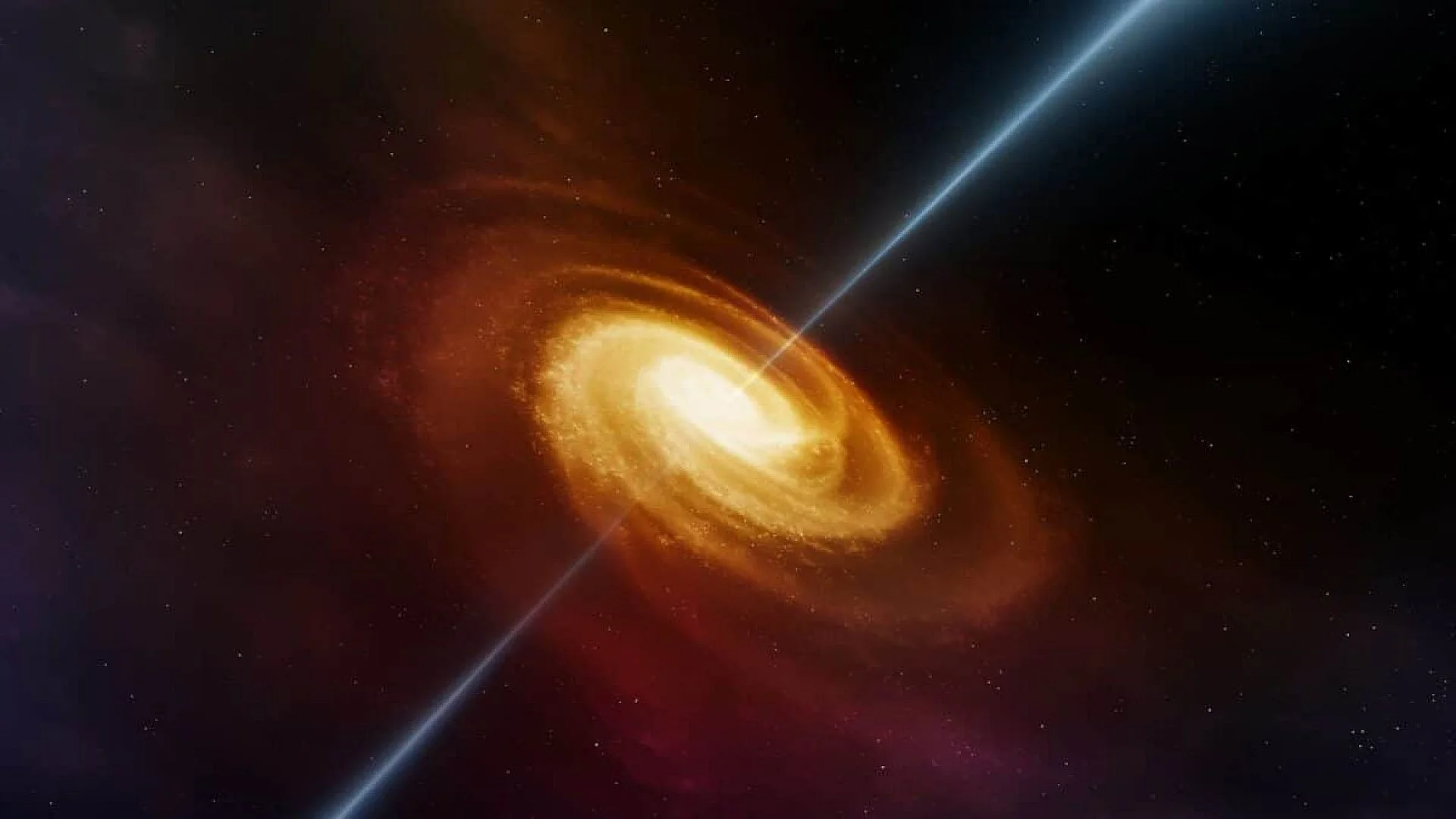
Astronomers using infrared data from NASA’s SPHEREx have uncovered a batch of 77 previously unseen quasars whose light is heavily reddened by intervening dust. The discovery, led by Matthew Stepney of the Center of Excellence in Astrophysics and Related Technologies in Chile, more than doubles the catalog of such obscured objects.
Quasars are powered by supermassive black holes at the cores of galaxies; as gas spirals inward, the resulting energy output makes them visible across billions of light‑years. However, dense dust clouds can mask a large fraction of that radiation, rendering whole classes of quasars difficult to spot.
New Sample Expands Known Heavily Reddened Quasars
The team’s findings, posted on arXiv, report 77 newly identified dust‑obscured quasars, pushing the total count beyond the previous tally. These objects existed when the universe was between 1.6 billion and 4.3 billion years old, and seven of them lie at redshifts greater than 3, marking the first examples of this class seen within the first 2.1 billion years of cosmic history.
Dust Characteristics Bridge Two Quasar Types
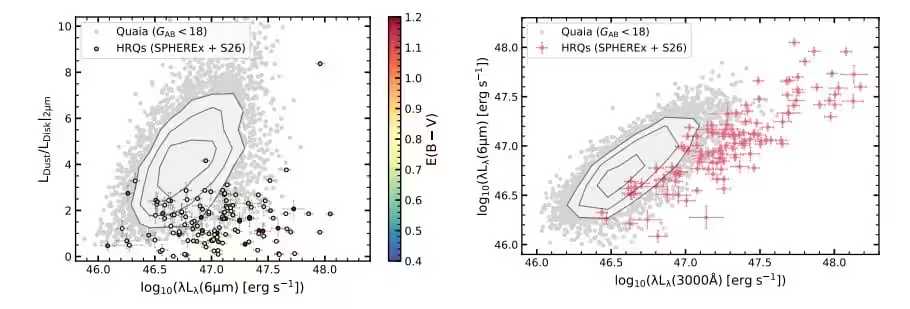
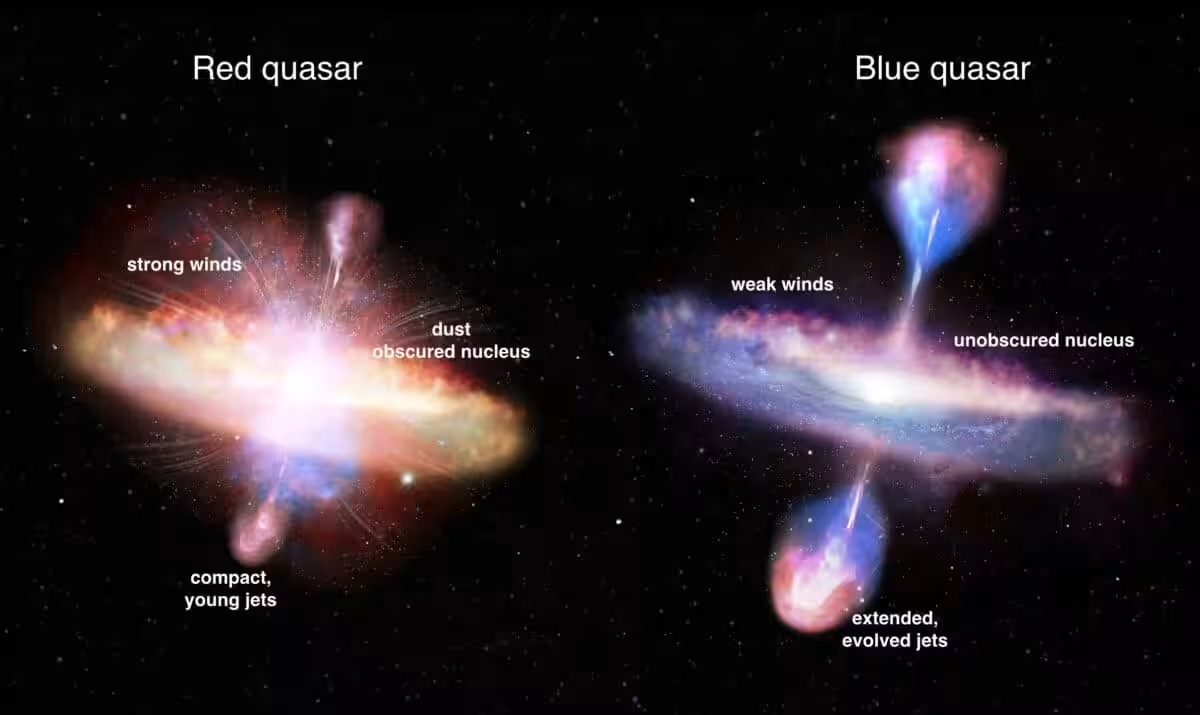
To place the new sample in context, the researchers contrasted heavily reddened quasars with two well‑studied groups: Hot Dust‑Obscured Galaxies (Hot DOGs), whose emission is dominated by extremely hot dust, and the more exposed “blue” quasars that still shine brightly in the infrared. The analysis suggests that heavily reddened quasars occupy an intermediate niche in terms of dust obscuration.
Unexpectedly, the heavily reddened quasars displayed less hot‑dust emission than the blue quasars, a result that runs contrary to expectations based on their overall brightness and dust content.
Signs Point to a Brief ‘Blow‑Out’ Episode
After correcting for dust extinction, the newly catalogued quasars rank among the most luminous ever recorded. Yet their infrared output falls short of what would be predicted from the surrounding dusty material. The authors interpret this mismatch as evidence of a rapid “blow‑out” phase, during which intense black‑hole activity drives gas and dust outward from the galaxy’s core.
“This combination of depleted torus‑scale dust reservoirs and higher luminosities compared to Hot DOGs and blue quasars supports a scenario in which HRQs represent a blow‑out phase when strong feedback has begun to clear the central regions of obscuring material,” the authors wrote.
Approximately three‑quarters of the sample also show excess ultraviolet emission. The team proposes that this extra UV light could arise from radiation escaping around the edges of the dusty cocoon, although vigorous star formation within the host galaxies may also contribute, and in some cases could dominate the signal.
This article has been fact checked for accuracy, with information verified against reputable sources. Learn more about us and our editorial process.
Last reviewed on .
Article history
- Latest version
Reference(s)
- Cermak, Alicia. “SPHEREx.”, June 15, 2023 NASA <https://science.nasa.gov/mission/spherex/>.
- “Hidden Monsters with SPHEREx I: A goldmine for heavily reddened quasars at cosmic noon.” <https://arxiv.org/pdf/2605.06791>.
- “WVU Planetarium and Observatory | What’s a Hot DOG galaxy?.”, November 16, 2023 <https://planetarium.wvu.edu/mountaineer-skies-blog/2023/11/16/what-s-a-hot-dog-galaxy>.
Cite this page:
- Posted by Aisha Ahmed