NASA’s TESS Reveals a Rare Triple Star System You Won’t Believe Exists
NASA’s TESS discovers rare triple star system with giant star causing unique triply-eclipsing events
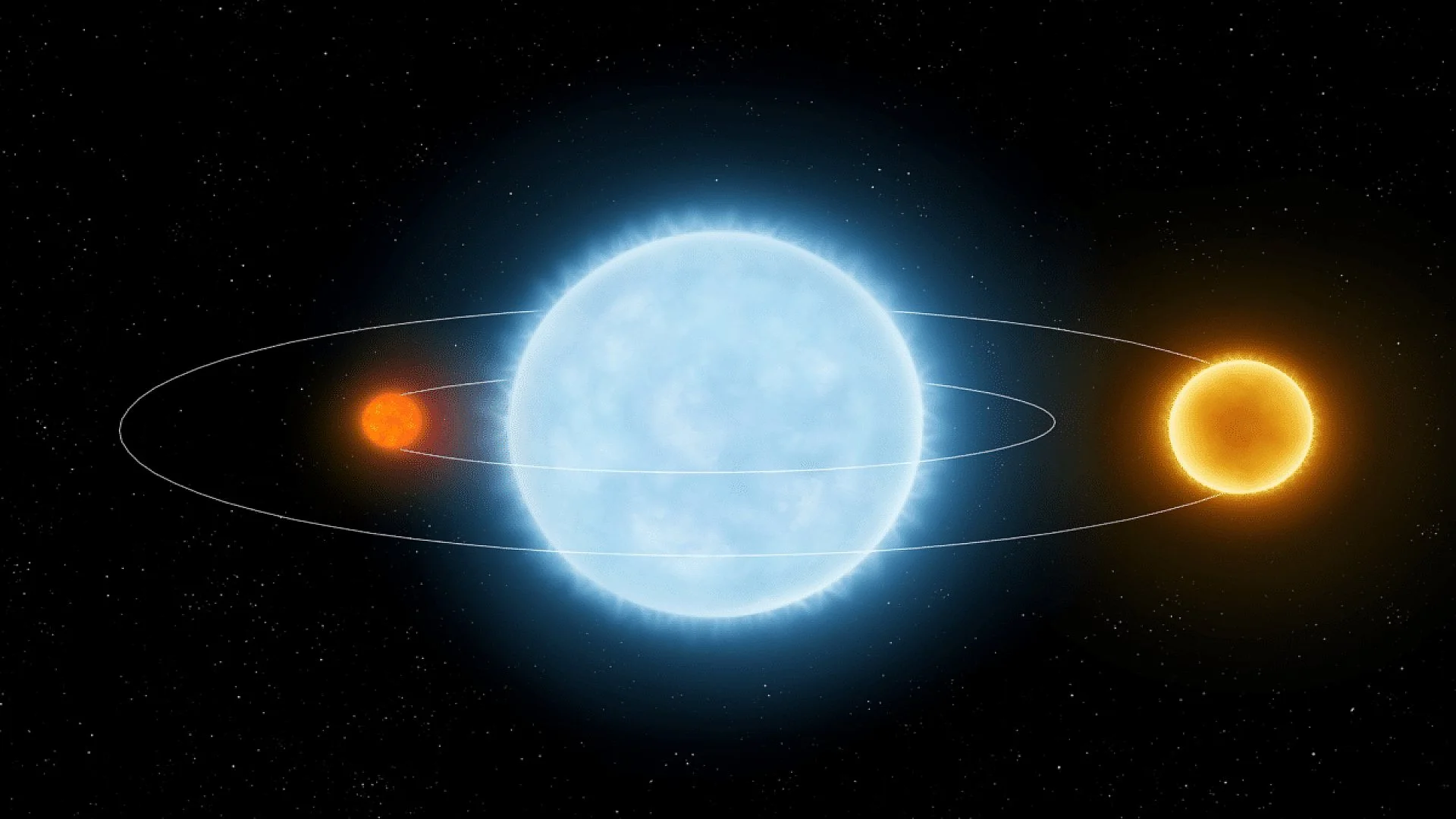
A team of astronomers has uncovered an exceptionally uncommon triple‑star configuration in the Milky Way, using data from NASA’s Transiting Exoplanet Survey Satellite (TESS). The object, catalogued as TIC 295741342, consists of a close pair of Sun‑like stars orbited by a massive third companion that generates a triply‑eclipsing signature—an event documented in only a few known systems. The findings were posted to arXiv on 19 May, offering fresh constraints on how multi‑star arrangements form and evolve.
TESS Captures a Complex Eclipse Pattern
While TESS was primarily built to scan roughly 200 000 bright stars for planetary transits, its high‑precision photometry also reveals intricate stellar dances. In this case, the satellite recorded a distinctive dip in the light curve that corresponds to a triple eclipse, a phenomenon that would be difficult to detect with less sensitive instruments. The light curve shows a characteristic “head‑and‑shoulders” shape, indicating the sequential passage of the binary components behind the larger tertiary star.
Researchers explained that the first shallow dip marks the secondary star of the inner binary slipping fully behind the tertiary, followed by a deeper combined dip when both binary members are eclipsed, and finally a second shallow feature as the primary emerges. This sequence permits precise determination of each star’s luminosity and size, a capability rarely achievable for triple systems.
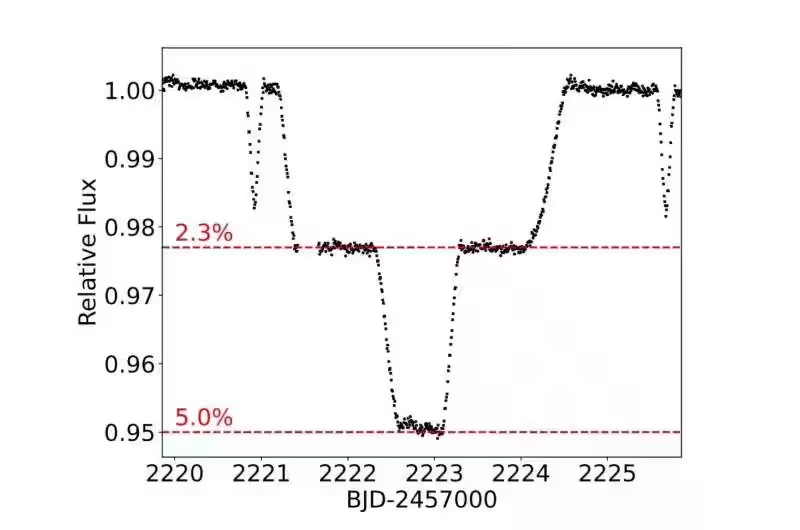
Credit: Powell et al., 2026.
Physical Characteristics of the Three Stars
The inner pair, labeled Aa and Ab, are main‑sequence stars with temperatures near 6 400 K and orbit each other every 4.75 days. Their companion, designated TIC 295741342 B, is a giant star of about 1.7 solar masses and a radius exceeding ten times that of the Sun. This tertiary circles the binary at roughly 1.7 AU with a period of 1.13 years, radiating at an effective temperature of 4 839 K. Metallicity measurements place the system at –0.337 dex, and age estimates suggest it is about 1.46 billion years old. Located approximately 3 080 light‑years from Earth, the system’s total brightness in the TESS band is dominated (≈95 %) by the giant component.
A striking feature is the near‑perfect coplanarity of the orbits, with a mutual inclination of only 0.25–0.33 degrees. This alignment provides an ideal testbed for investigating dynamical interactions in hierarchical triples.
Implications for Stellar Formation Scenarios
The authors propose that TIC 295741342 originated through fragmentation of a protoplanetary disk, followed by inward migration of the inner binary and subsequent gas dispersal. Such a pathway naturally yields the observed low inclination and compact orbital architecture. The presence of a giant tertiary makes the system one of the few known triply‑eclipsing triples with a massive outer star, and it exhibits the smallest mutual inclination recorded among them.
These characteristics enable refined modeling of mass exchange, tidal forces, and long‑term orbital stability in multi‑star environments, contributing to a deeper understanding of how complex stellar systems evolve.
Looking Ahead: Ongoing Monitoring and Future Discoveries
The distinctive eclipse event offers a rare window into the dynamics of tightly bound triples, prompting astronomers to continue tracking TIC 295741342 with TESS and complementary facilities. The system serves as a natural laboratory for testing theories of orbital mechanics, tidal interaction, and hierarchical stability. As TESS persists in its sky survey, additional rare configurations are expected to emerge, further expanding the catalogue of multi‑star phenomena.
This article has been fact checked for accuracy, with information verified against reputable sources. Learn more about us and our editorial process.
Last reviewed on .
Article history
- Latest version
Cite this page:
- Posted by Aisha Ahmed