New AI Training Method Lets Humanoid Robots Master Real‑World Rough Terrain Faster and Cheaper
See how researchers teach a robot to walk across gravel, grass, hills and more in this captivating training video.
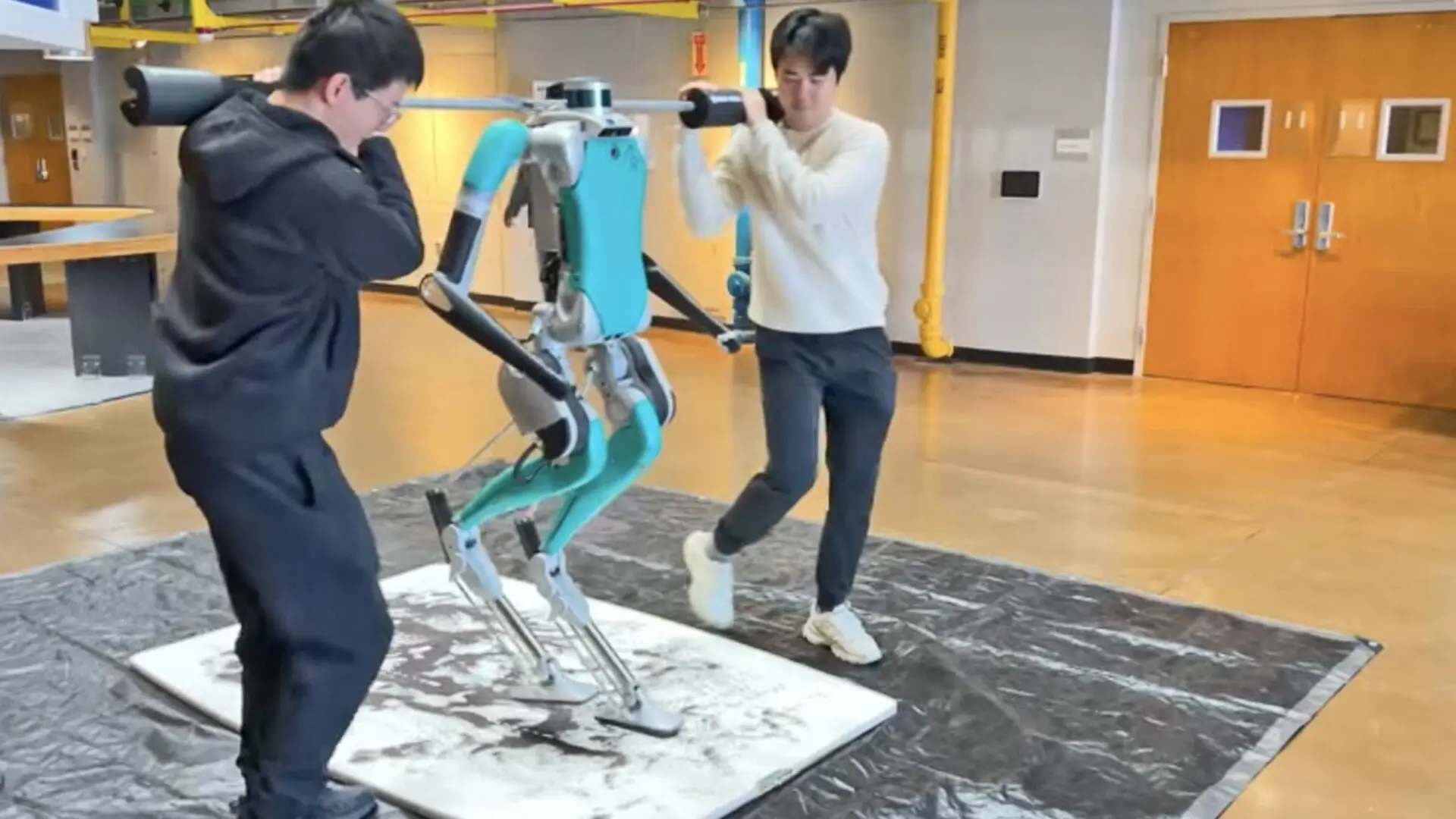
Georgia Tech researchers have unveiled a streamlined method for teaching a bipedal robot to navigate complex outdoor terrain, dramatically reducing the computational load and expense of traditional training approaches.
Accelerated whole‑body control for diverse surfaces
From loose sand and wet grass to gravel, inclined planes, and stairways, the newly developed controller enabled the robot to maintain stable locomotion across a wide array of real‑world conditions. The system, engineered by machine‑learning PhD candidate Feiyang Wu, demonstrated reliable performance even on ground types that were absent from its training set.
Parallel teacher‑student reinforcement learning
The breakthrough hinges on a reimagined reinforcement‑learning scheme that departs from the conventional sequential “teacher‑then‑student” routine. Instead, Wu’s team trained both the expert (teacher) agent and the novice (student) agent concurrently, allowing the teacher to impart insights while still refining its own policy. This simultaneous training cuts down on the hours of GPU‑intensive simulation that typically dominate robotics research budgets.
To bridge the disparity that often arises when a student agent receives incomplete information—a problem known as the teacher‑student imitation gap—the researchers enabled the teacher to incorporate data harvested from the student’s experiences. This bidirectional feedback loop helped align the teacher’s guidance with the practical challenges the robot would face.
Real‑world validation on a two‑legged platform
After finalizing the controller in simulation, the team deployed it on a humanoid robot in the laboratory of Associate Professor Ye Zhao. The robot traversed uneven ground without stuttering, and it continued to adjust its gait when subjected to external pushes and pulls, evidencing a robust adaptive capability.
Professor Zhao, who co‑supervises Wu alongside CSE Assistant Professor Anqi Wu, noted that the new controller outperformed the manufacturer‑supplied system, underscoring the advantage of integrating advanced machine‑learning techniques with hands‑on robotics expertise.
Broader applicability and future directions
Although the experiments focused on a bipedal platform, the “Learn to Teach” framework is designed to be hardware‑agnostic, opening the door for its use with other robotic configurations and tasks beyond locomotion. Wu’s interdisciplinary background in machine learning and robotics positions him to explore such extensions.
The project received funding from the Office of Naval Research, the U.S. Department of Agriculture, and the National Science Foundation. Opinions expressed herein reflect the authors’ views and not necessarily those of the sponsoring agencies.
This article has been fact checked for accuracy, with information verified against reputable sources. Learn more about us and our editorial process.
Last reviewed on .
Article history
- Latest version
Cite this page:
- Posted by Asif Iqbal