New Software Trick Makes James Webb Telescope 15 Times More Sensitive to Hidden Planets
Astronomers have finally uncovered a giant planet hidden in James Webb Space Telescope data using a clever new image processing technique, not new hardware.
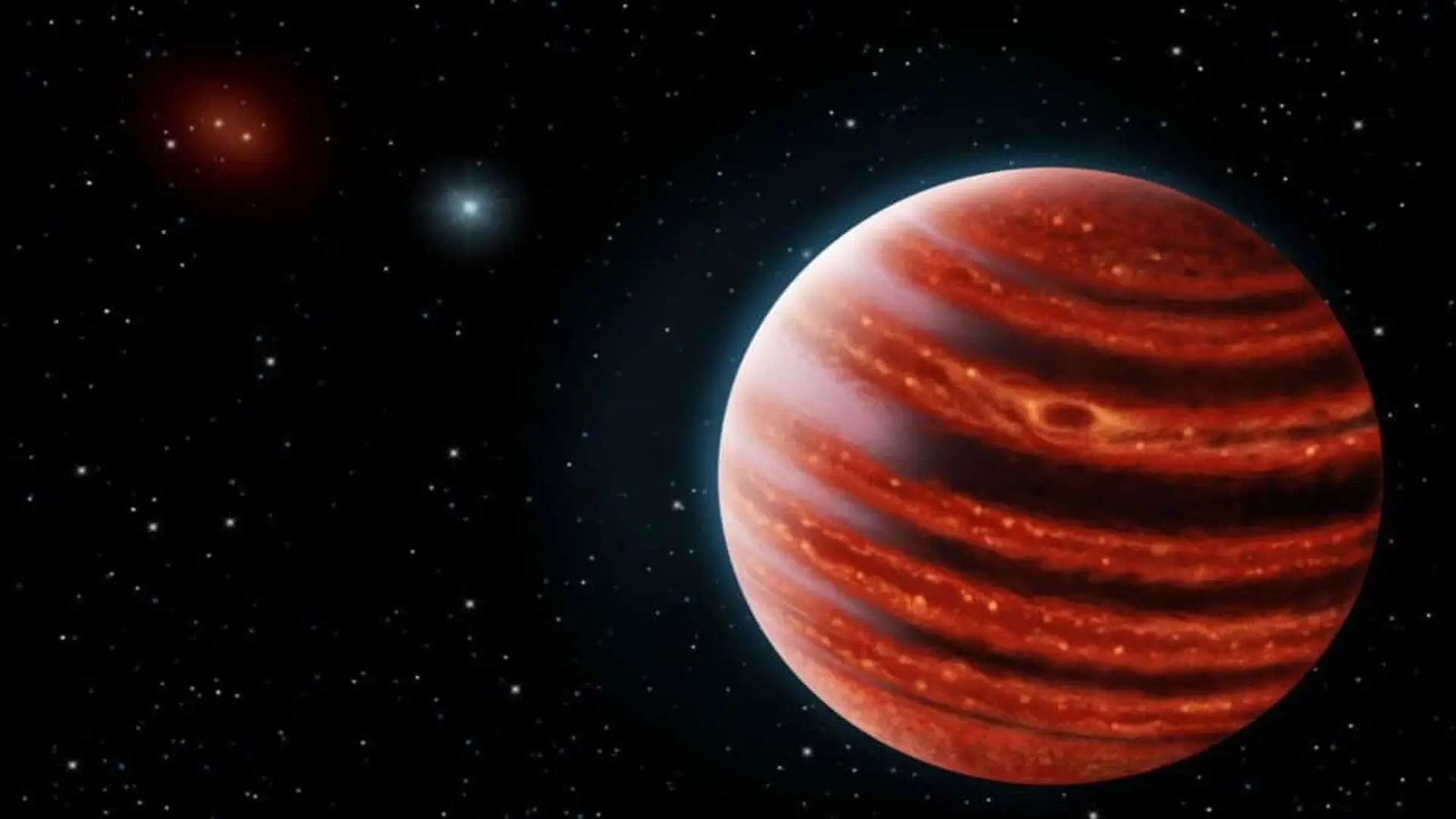
Researchers at Northwestern University have unlocked a breakthrough in space imaging, revealing a giant exoplanet that had remained hidden within archival James Webb Space Telescope (JWST) data for two years. By developing a sophisticated image-processing technique, the team has effectively boosted the telescope’s sensitivity to faint celestial objects by up to 15 times, all without requiring any hardware modifications.
Directly photographing planets orbiting distant stars is an immense challenge because of the extreme contrast between the two bodies. A young gas giant can be 100,000 times fainter than its host star, effectively rendering it invisible to conventional imaging. While the JWST employs specialized coronagraphs to physically mask the intense glare of a central star, residual light often persists, creating diffraction patterns that can obscure orbiting worlds.
Solving the Optical Interference Puzzle
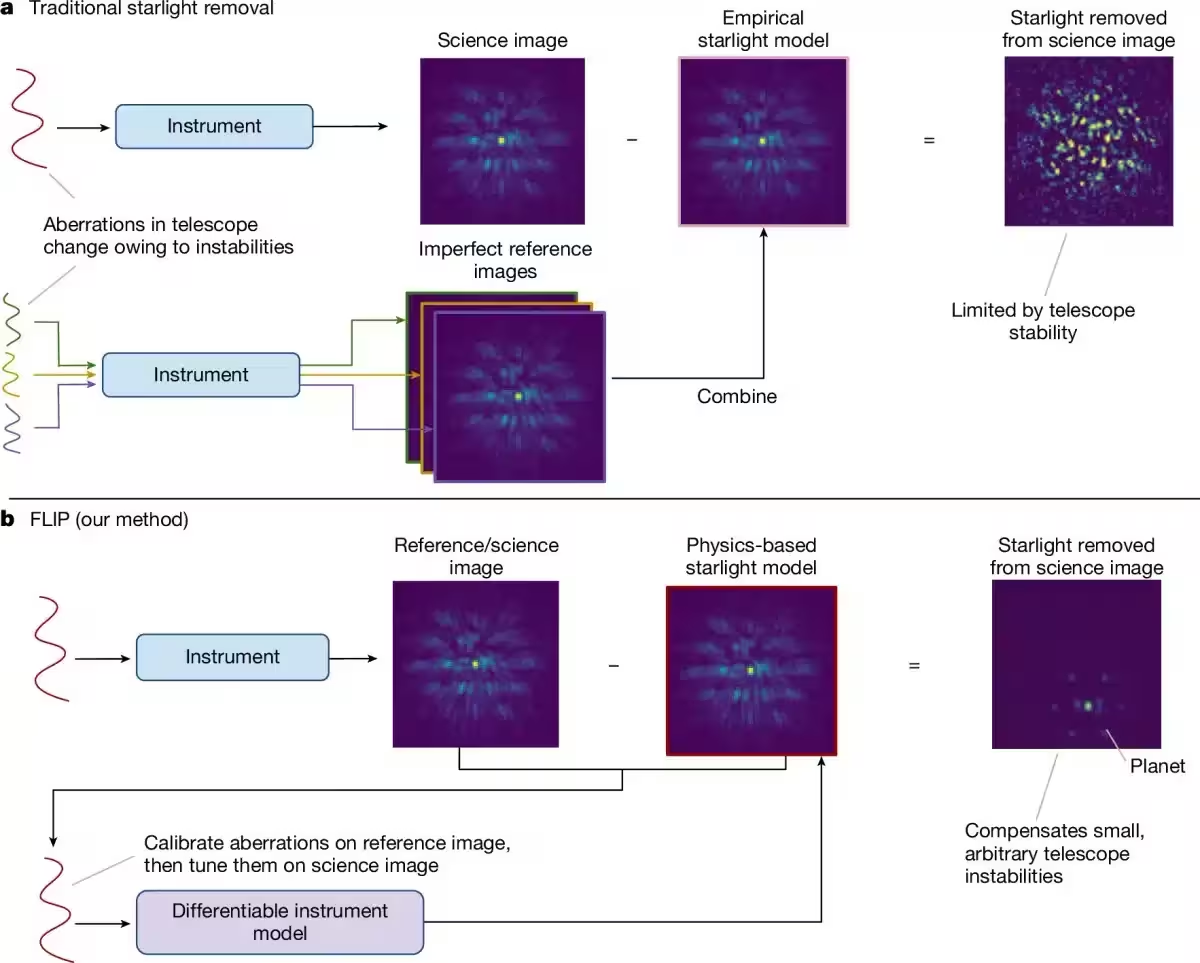
Traditional methods for cleaning up stellar glare often involve subtracting the light profile of a reference star from the target image. However, this approach is limited by the physical realities of the telescope itself. As noted in research published November 4 in the journal Nature, microscopic thermal fluctuations and mechanical vibrations—often caused by the telescope’s cooling motors—can shift the mirrors by mere picometers. These subtle movements, while negligible for most observations, are enough to alter the appearance of starlight, making standard subtraction techniques less precise.
“Small thermal changes could cause a mirror to expand or contract by a picometer,” explained Jason Wang, an assistant professor of physics and astronomy at Northwestern. “Those coolers have little motors that can cause the mirrors to vibrate. So, there are issues like those but also issues that we still don’t understand as we learn how to build these complex telescopes.”
Physics-Based Digital Reconstruction
To overcome these limitations, doctoral student Rodrigo Ferrer-Chavez and his team developed a methodology dubbed Physics-based Learning for Imaging Planets (FLIP). Rather than relying on observational comparisons, FLIP creates a high-fidelity digital twin of the telescope, simulating how light interacts with the mirrors and optics. By adjusting millions of individual parameters to align the simulation with actual telescope data, the researchers can subtract the starlight with unprecedented accuracy.
Unlike some image-enhancement tools that lean on artificial intelligence to guess missing data, FLIP is grounded in deterministic optical physics. “Because we already know the physics, we don’t need AI to understand what’s happening,” Wang noted.
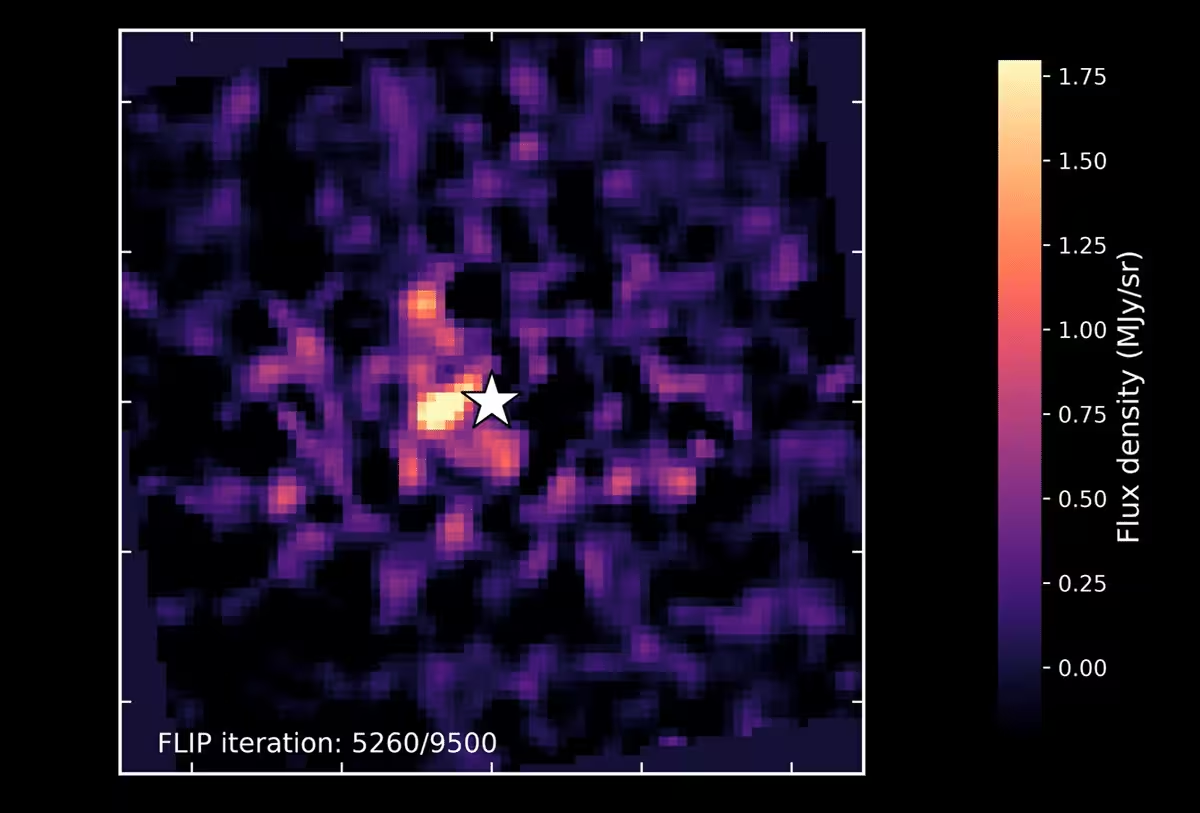
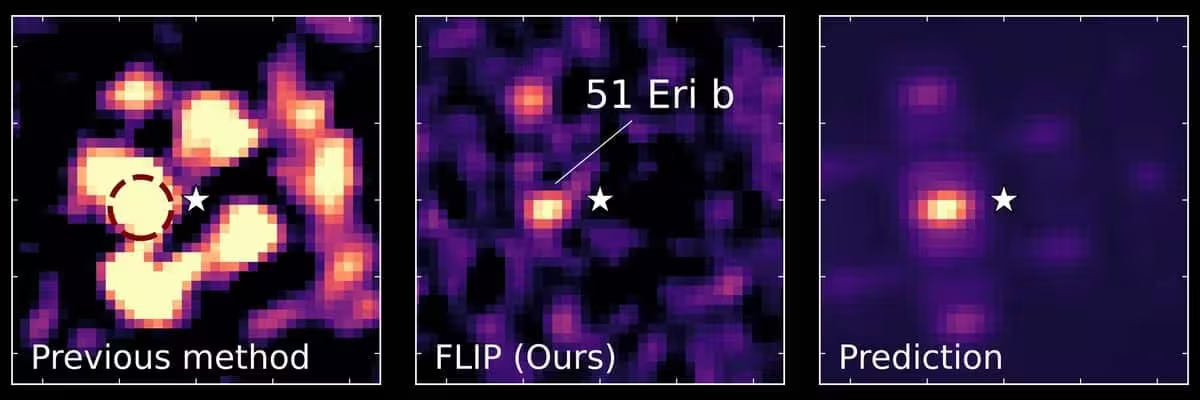
The team successfully validated their method by re-examining observations of three stars: HIP 65426, TYC 5899, and 51 Eridani. The process clearly isolated the giant exoplanet 51 Eridani b, which had previously eluded detection in these specific JWST frames. The planet’s detection was particularly difficult because its atmosphere is rich in carbon dioxide, which absorbs infrared light at 4.3 microns, further dimming its signature.
Future Implications for Deep Space Observation
The success of FLIP suggests a promising path forward for existing and future missions. By shifting the burden of optical stability from physical hardware to post-processing software, the technique could become an essential asset for NASA’s forthcoming Habitable Worlds Observatory. As researchers aim to identify Earth-like planets, which require significantly higher contrast ratios, FLIP’s ability to “see” what was previously lost in the glare may prove vital.
“It’s not that they don’t exist,” Ferrer-Chavez said. “It’s that we cannot see them.”
This article has been fact checked for accuracy, with information verified against reputable sources. Learn more about us and our editorial process.
Last reviewed on .
Article history
- Latest version
Reference(s)
- Ferrer-Chavez, Rodrigo. “Imaging exoplanets below the telescope stability limit - Nature.”, vol. 659, no. 8139, pp. 58-62. Nature, doi: 10.1038/s41586-026-11213-z. <https://www.nature.com/articles/s41586-026-11213-z>.
- “Jason Wang: Department of Physics and Astronomy - Northwestern University.” <https://physics.northwestern.edu/people/faculty/core-faculty/jason-wang.html>.
- Arroyo, Yesenia. “Habitable Worlds Observatory - NASA Science.”, December 11, 2023 NASA <https://science.nasa.gov/astrophysics/programs/habitable-worlds-observatory/>.
Cite this page:
- Posted by Deepak Malhotra