Astronomers Just Mapped 63,000 Cosmic Radio Sources in Unprecedented Detail
An unprecedented 8-billion-pixel radio image has mapped nearly 63,000 cosmic sources, revealing distant galaxies and black hole jets in stunning detail.
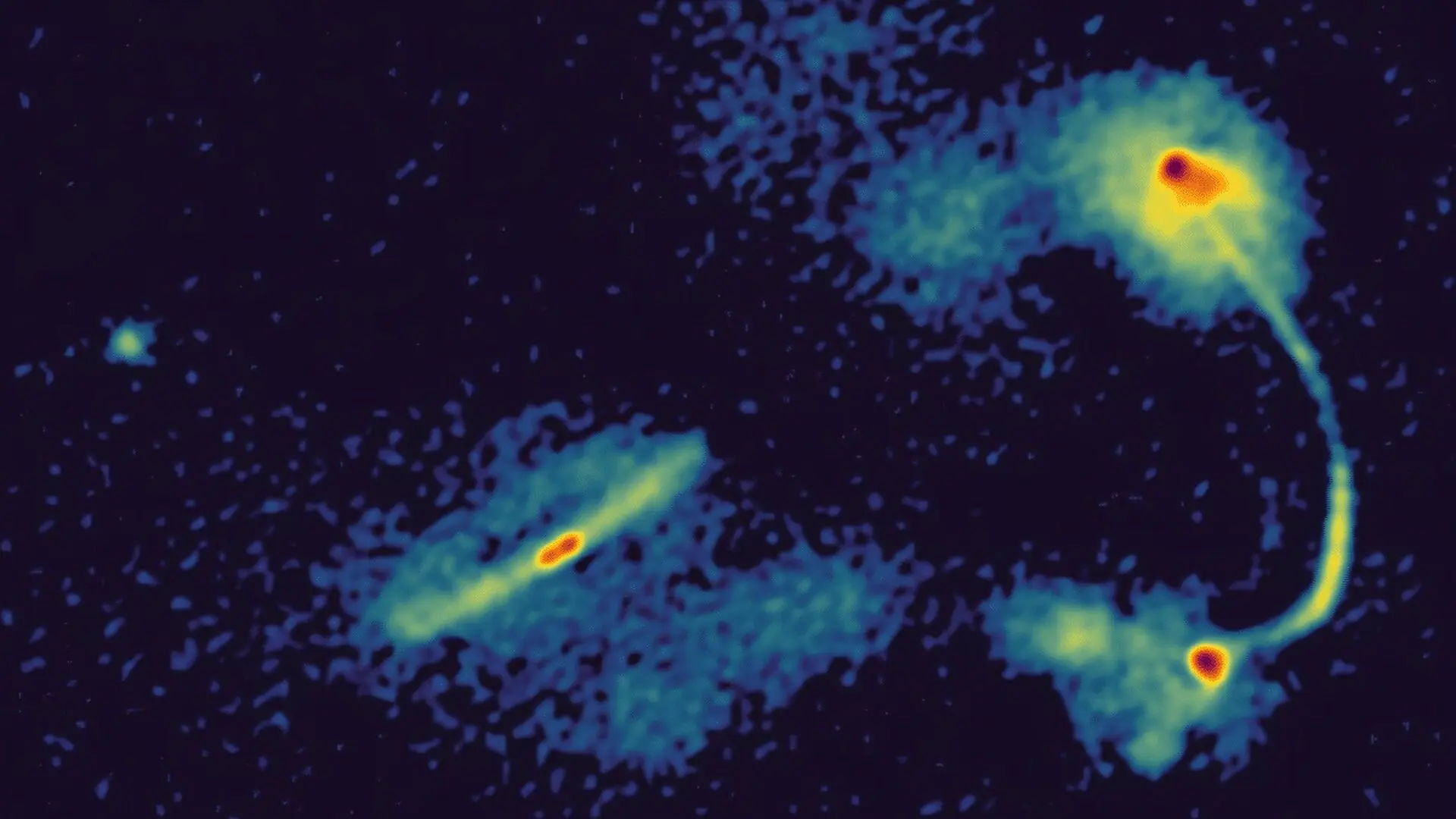
Astronomers have unveiled a remarkably high-resolution map of the low-frequency radio sky, capturing nearly 63,000 distinct cosmic sources in a single survey field. Using the Low Frequency Array (LOFAR), the team generated an 8-billion-pixel image that provides a deep-field look at distant galaxies, the jets of active supermassive black holes, and the obscured regions where new stars are born.
A Clearer View of the Distant Universe
Led by researchers at Leiden University in the Netherlands, the project targeted the ELAIS-N1 region, a well-mapped area of the northern sky teeming with faint, remote galaxies. Spanning a field of view 25 times the size of the full moon, the new image overcomes the traditional trade-off in radio astronomy between sensitivity and resolution. By achieving a level of detail 20 times sharper than previous LOFAR surveys of the same area, the team can now resolve individual structures that were once blurred into indistinct patches. To put the scale into perspective, the resolution is equivalent to identifying a coin from a distance of 10 kilometers (6 miles).
The findings have been accepted for publication in Astronomy & Astrophysics, and the team has released the full dataset to the global scientific community. The study is also currently available on the arXiv preprint server.
Computational Breakthroughs in Data Processing
Transforming 200 hours of raw radio signals into a coherent, high-fidelity image required the management of 400 terabytes of data. Processing radio interferometry data at low frequencies is notoriously difficult due to the distorting influence of Earth’s ionosphere and the complex nature of stitching together signals from a vast array of antennas.
However, recent advancements in calibration techniques and software have drastically lowered the barrier to entry for this kind of imaging. By refining these data-reduction processes, the team was able to cut computational costs by more than a factor of 10.
“The entire data set could be processed on Spider, the high-performance data-processing platform hosted at SURF in the Netherlands, in just a few months,” says Jurjen de Jong, who led this work and is a postdoctoral researcher at Leiden Observatory and ASTRON.
Probing Black Hole Feedback
A significant portion of the catalog consists of active galactic nuclei (AGN), where supermassive black holes generate colossal jets of high-energy particles. These radio-bright features often extend well beyond their host galaxies. In past surveys, these complex structures were frequently confused with nearby galaxies or background noise, but the new high-resolution map allows scientists to clearly delineate these jets and track how they interact with the interstellar environment.
“With this sharp and sensitive view of our sky at low radio frequencies, we have a new window to study how these radio jets interact with their environment and how they evolve over cosmic time,” explains Reinout van Weeren, an associate professor at Leiden Observatory and co-author of the study. This interaction is critical to understanding how energy from black holes influences the cooling of gas and the subsequent rate of star formation in a galaxy.
Unveiling Obscured Star-Forming Regions
Beyond black holes, the survey highlights a wealth of star-forming galaxies. While optical telescopes are often limited by cosmic dust that scatters visible light, radio waves travel through these obscurations unimpeded. This makes LOFAR an essential tool for measuring star formation across cosmic history.
The researchers intend for this data to be integrated with existing X-ray, infrared, and optical archives to build a more comprehensive, multi-wavelength model of galactic evolution. Looking ahead, these results serve as a proof of concept for the upcoming LOFAR2.0 upgrade. As the international community prepares for the arrival of the massive Square Kilometre Array (SKA), this high-resolution mapping confirms that existing arrays remain powerful instruments for uncovering the dynamics of the deep universe.
This article has been fact checked for accuracy, with information verified against reputable sources. Learn more about us and our editorial process.
Last reviewed on .
Article history
- Latest version
Reference(s)
- de Jong, J.. “Pushing the frontiers of low-frequency radio astronomy: An ultra-deep sub-arcsecond LOFAR image of ELAIS-N1.” arXiv.org <https://arxiv.org/abs/2611.06152>.
Cite this page:
- Posted by Farah Siddiqui