Parker Solar Probe Reveals Hidden Plasma Waves That Standard Physics Missed
Physics

Parker Solar Probe Reveals Hidden Plasma Waves That Standard Physics Missed

Raw particle measurements from near the Sun show that simplified mathematical models miss active wave growth in the solar wind.
By Deepak Malhotra
Published:
Email this Article
Parker Solar Probe Reveals Hidden Plasma Waves That Standard Physics Missed
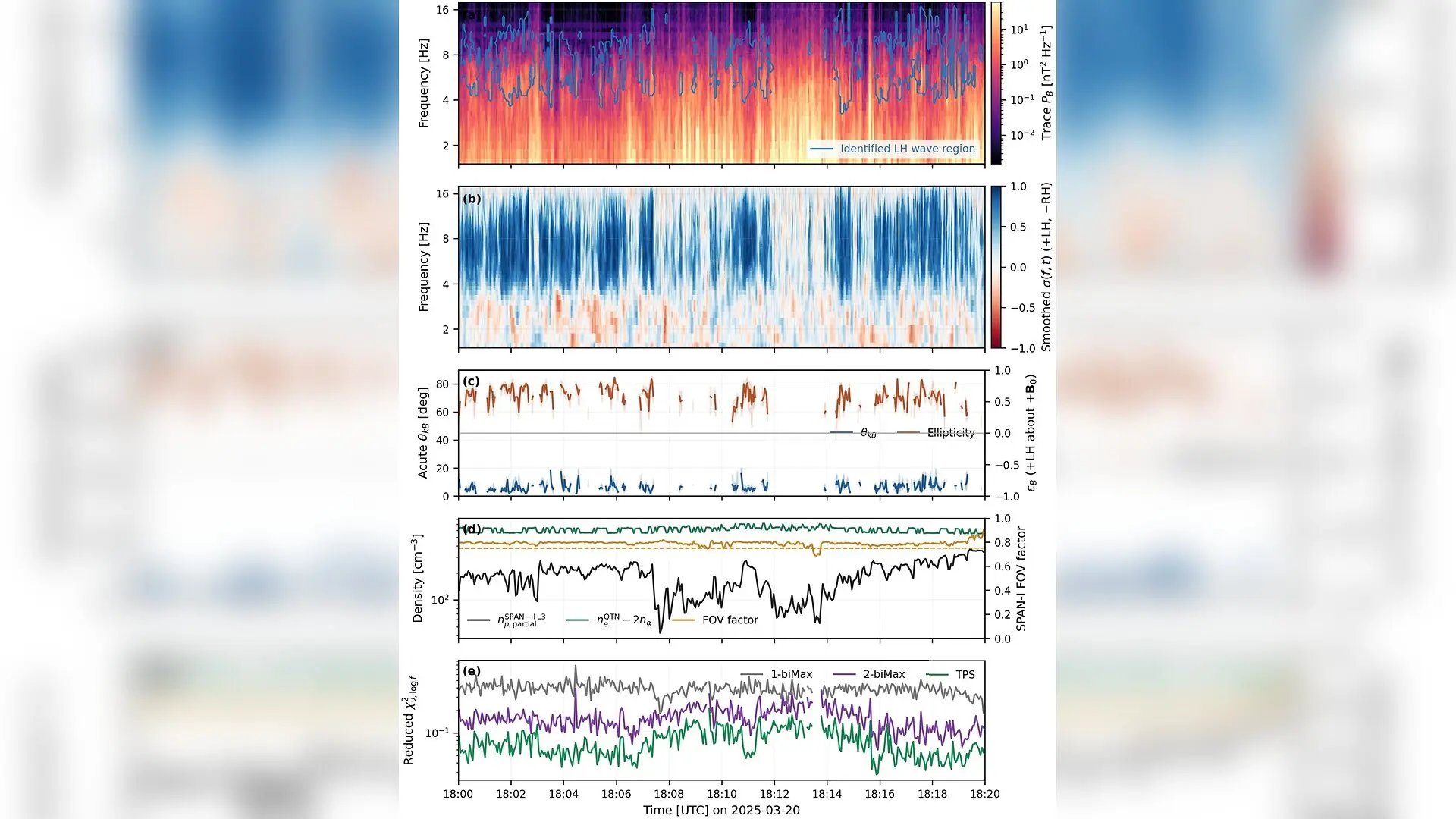
Summary of ion-cyclotron wave storm observations. (a) Trace Magnetic Field Power Spectral Density. Identified regions of coherent left-handed waves are outlined in blue. (b) Smoothed magnetic field spacecraft-frame polarization. (c) Power-weighted median presumed acute wave-normal angle θkB\documentclass[12pt]{minimal} \usepackage{amsmath} \usepackage{wasysym} \usepackage{amsfonts} \usepackage{amssymb} \usepackage{amsbsy} \usepackage{mathrsfs} \usepackage{upgreek} \setlength{\oddsidemargin}{-69pt} \begin{document}$\theta _{kB}$\end{document} and magnetic ellipticity ϵB\documentclass[12pt]{minimal} \usepackage{amsmath} \usepackage{wasysym} \usepackage{amsfonts} \usepackage{amssymb} \usepackage{amsbsy} \usepackage{mathrsfs} \usepackage{upgreek} \setlength{\oddsidemargin}{-69pt} \begin{document}$\epsilon _{B}$\end{document} within the identified left-handed wave regions; shaded bands show the corresponding interquartile ranges. (d) SPAN-I and QTN proton densities and SPAN-I FOV factor. (e Klein et al. / Solar Physics

Invisible ripples racing through the solar wind near the Sun behave in ways that standard physics equations fail to capture. Researchers analyzing data gathered by NASA’s Parker Solar Probe discovered that accounting for messy, non-standard shapes in space plasma particle speeds reveals wave activity that traditional mathematical models completely miss.

The solar wind is a continuous stream of charged particles flowing outward from the Sun at extreme speeds. Unlike gas in Earth’s atmosphere, these particles collide so infrequently that they do not settle into a neat, predictable thermal balance. Instead, they develop complex shapes in velocity space, a mathematical map showing how fast particles are moving in different directions. For decades, scientists studying these particle populations relied on smooth, idealized mathematical templates known as bi-Maxwellian distributions, which assume nice, bell-curve-like shapes.

To test whether these simplified models hold up in the harsh environment of the inner heliosphere, researchers examined a 20-minute window of wave activity recorded on March 20, 2025, when the spacecraft was sitting at a distance of 30.1 solar radii, roughly 14 million miles from the Sun. During this period, instruments detected a prolonged storm of coherent left-handed polarized ion-scale waves, specifically proton cyclotron waves. The team utilized the Arbitrary Linear Plasma Solver (ALPS), a numerical tool published in Solar Physics, which allows scientists to input the exact, messy particle velocity shapes measured directly by the spacecraft without forcing them into neat analytical equations.
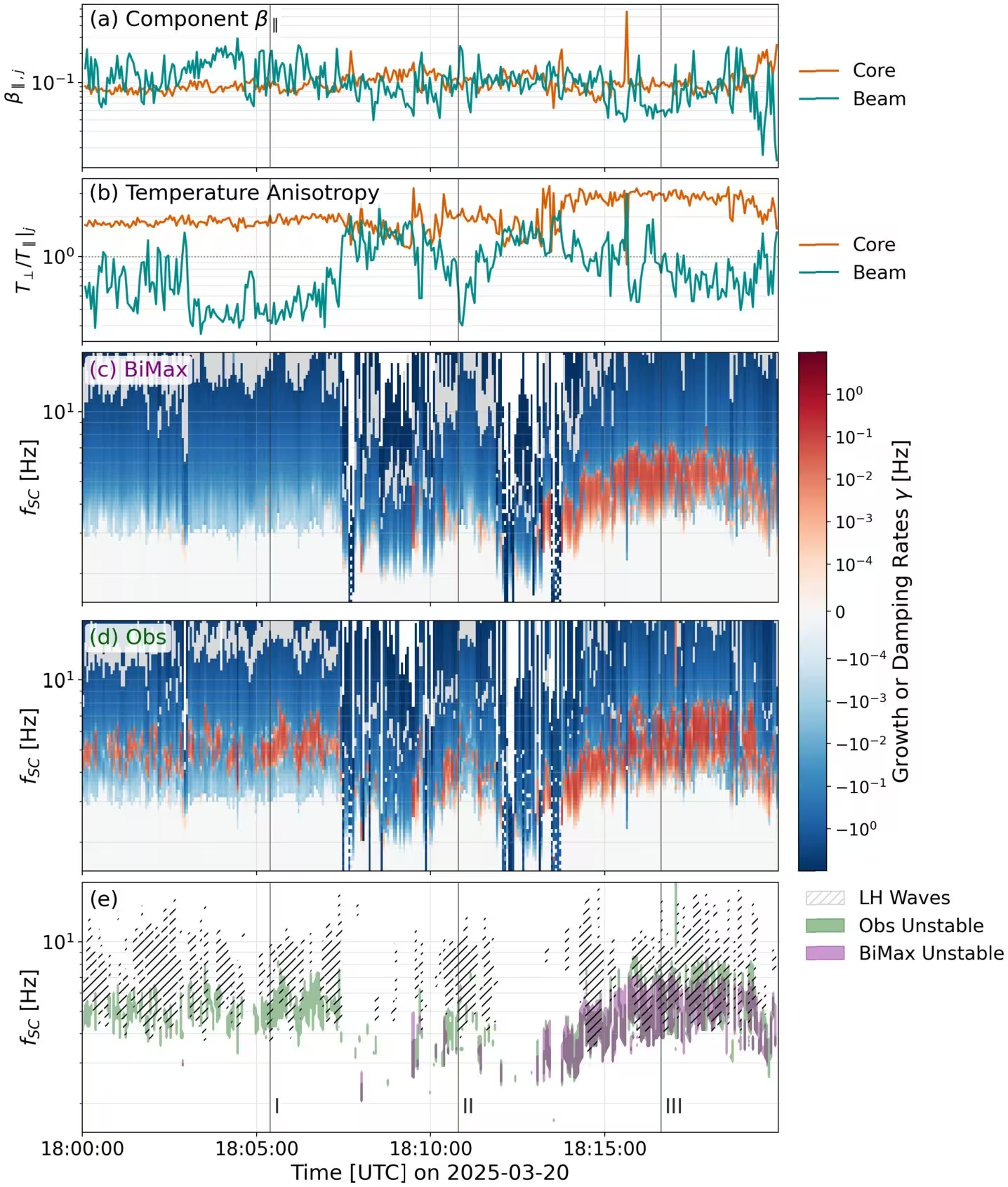
Figure 2: Fit parameters and growth and damping rates for Alfvén/proton cyclotron waves that propagate parallel to the magnetic field and into the anti-Sunward direction. (a) Plasma β∥,j\documentclass[12pt]{minimal} \usepackage{amsmath} \usepackage{wasysym} \usepackage{amsfonts} \usepackage{amssymb} \usepackage{amsbsy} \usepackage{mathrsfs} \usepackage{upgreek} \setlength{\oddsidemargin}{-69pt} \begin{document}$\beta _{\parallel ,j}$\end{document} and (b) Temperature anisotropy T⊥,j/T∥,j\documentclass[12pt]{minimal} \usepackage{amsmath} \usepackage{wasysym} \usepackage{amsfonts} \usepackage{amssymb} \usepackage{amsbsy} \usepackage{mathrsfs} \usepackage{upgreek} \setlength{\oddsidemargin}{-69pt} \begin{document}$T_{\perp ,j}/T_{\parallel ,j}$\end{document} for proton core and beam bi-Maxwellian fits. (c) Growth (red) and damping (blue) rates as calculated for the two-component bi-Maxwellian model. (d) Growth and damping rates for the observed VDF from ALPS. Grey regions indicate overdamped region
Fit parameters and growth and damping rates for Alfvén/proton cyclotron waves that propagate parallel to the magnetic field and into the anti-Sunward direction. (a) Plasma β∥,j\documentclass[12pt]{minimal} \usepackage{amsmath} \usepackage{wasysym} \usepackage{amsfonts} \usepackage{amssymb} \usepackage{amsbsy} \usepackage{mathrsfs} \usepackage{upgreek} \setlength{\oddsidemargin}{-69pt} \begin{document}$\beta _{\parallel ,j}$\end{document} and (b) Temperature anisotropy T⊥,j/T∥,j\documentclass[12pt]{minimal} \usepackage{amsmath} \usepackage{wasysym} \usepackage{amsfonts} \usepackage{amssymb} \usepackage{amsbsy} \usepackage{mathrsfs} \usepackage{upgreek} \setlength{\oddsidemargin}{-69pt} \begin{document}$T_{\perp ,j}/T_{\parallel ,j}$\end{document} for proton core and beam bi-Maxwellian fits. (c) Growth (red) and damping (blue) rates as calculated for the two-component bi-Maxwellian model. (d) Growth and damping rates for the observed VDF from ALPS. Grey regions indicate overdamped region Credit: Klein et al. / Solar Physics

Why Standard Equations Miss Hidden Plasma Waves

When the researchers ran calculations using the traditional two-component bi-Maxwellian model, the math predicted that the plasma wave storm should be entirely stable and damped out for the first nine minutes of the observation window. Yet, the spacecraft instruments clearly recorded intense, active wave power throughout that entire duration. The traditional approach failed because it smoothed over localized bumps and irregularities in the particle data.

By contrast, when the team fed the raw, unpolished velocity distribution functions directly into the numerical solver, the software successfully predicted growing, unstable wave modes across the entire twenty-minute interval. The physical origin of this discrepancy lies in how resonance works between waves and particles. Resonant interactions depend on steep gradients and small-scale features in velocity space rather than broad, low-order averages.

What Happens When Real Data Replaces Ideal Math

The raw particle maps revealed intricate pockets of energy emission where particles transfer momentum directly into the surrounding electromagnetic fields. While the standard smoothed models predicted net damping where waves lose energy and fade away, the data-driven models showed that localized patches of emission partially offset or completely overcome that absorption.
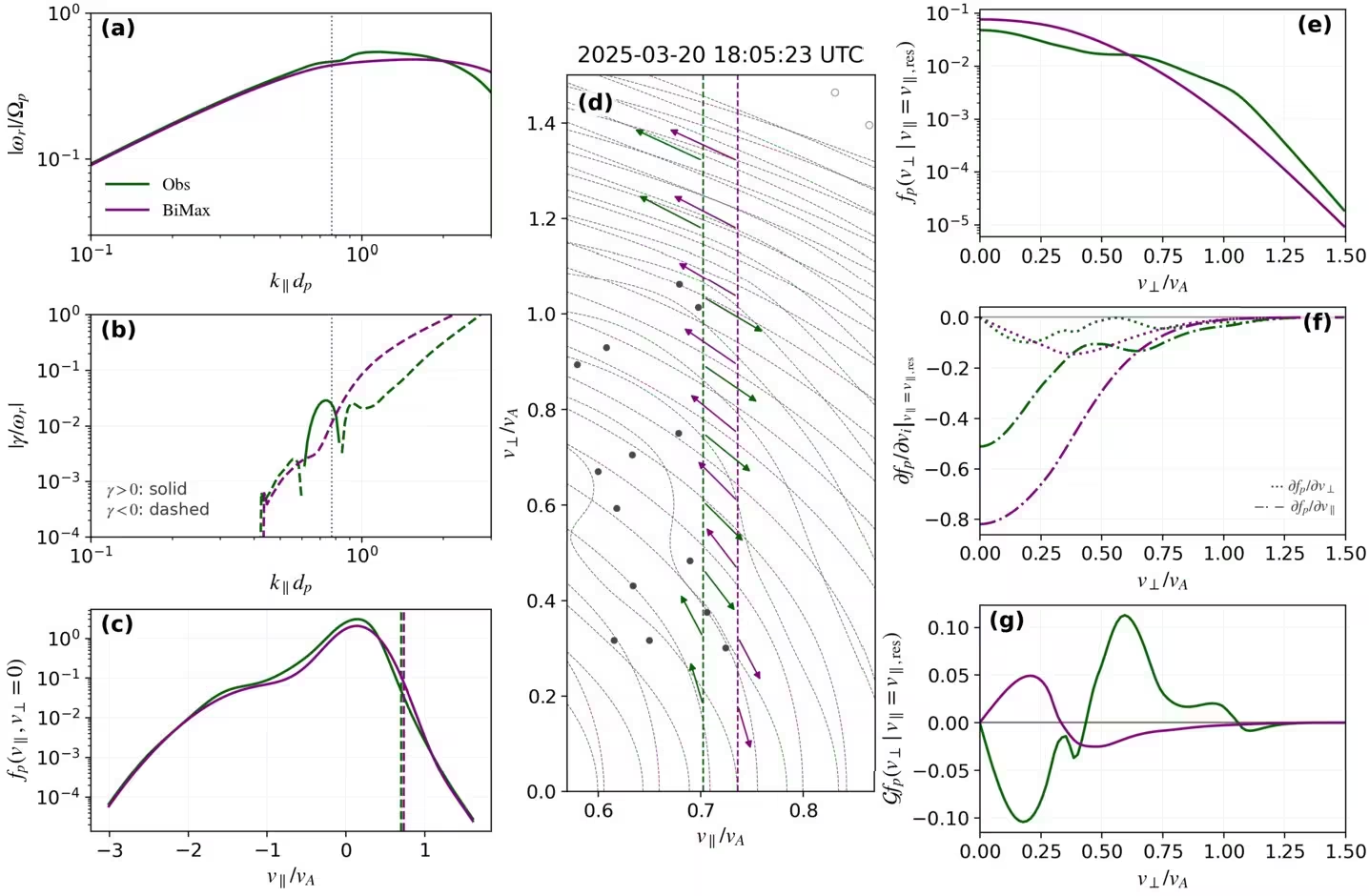
Figure 3: VDF characteristics and anti-Sunward PCW dispersion relation associated with bi-Maxwellian (purple) and observed (green) models for Interval I: a) real frequency |ωr|/Ωp\documentclass[12pt]{minimal} \usepackage{amsmath} \usepackage{wasysym} \usepackage{amsfonts} \usepackage{amssymb} \usepackage{amsbsy} \usepackage{mathrsfs} \usepackage{upgreek} \setlength{\oddsidemargin}{-69pt} \begin{document}$|\omega _{r}|/\Omega _{p}$\end{document}, b) growth (γ>0\documentclass[12pt]{minimal} \usepackage{amsmath} \usepackage{wasysym} \usepackage{amsfonts} \usepackage{amssymb} \usepackage{amsbsy} \usepackage{mathrsfs} \usepackage{upgreek} \setlength{\oddsidemargin}{-69pt} \begin{document}$\gamma >0$\end{document}) and damping (γ<0\documentclass[12pt]{minimal} \usepackage{amsmath} \usepackage{wasysym} \usepackage{amsfonts} \usepackage{amssymb} \usepackage{amsbsy} \usepackage{mathrsfs} \usepackage{upgreek} \setlength{\oddsidemargin}{-69pt} \begin{document}$\gamma <0$\end{document}), c) parallel slice f
VDF characteristics and anti-Sunward PCW dispersion relation associated with bi-Maxwellian (purple) and observed (green) models for Interval I: a) real frequency |ωr|/Ωp\documentclass[12pt]{minimal} \usepackage{amsmath} \usepackage{wasysym} \usepackage{amsfonts} \usepackage{amssymb} \usepackage{amsbsy} \usepackage{mathrsfs} \usepackage{upgreek} \setlength{\oddsidemargin}{-69pt} \begin{document}$|\omega _{r}|/\Omega _{p}$\end{document}, b) growth (γ>0\documentclass[12pt]{minimal} \usepackage{amsmath} \usepackage{wasysym} \usepackage{amsfonts} \usepackage{amssymb} \usepackage{amsbsy} \usepackage{mathrsfs} \usepackage{upgreek} \setlength{\oddsidemargin}{-69pt} \begin{document}$\gamma >0$\end{document}) and damping (γ<0\documentclass[12pt]{minimal} \usepackage{amsmath} \usepackage{wasysym} \usepackage{amsfonts} \usepackage{amssymb} \usepackage{amsbsy} \usepackage{mathrsfs} \usepackage{upgreek} \setlength{\oddsidemargin}{-69pt} \begin{document}$\gamma <0$\end{document}), c) parallel slice f Credit: Klein et al. / Solar Physics

Statistical evaluations across hundreds of individual measurement intervals showed that about 82 percent of the analyzed windows still pointed toward net damping in both models, but the damping rates predicted by the observed particle shapes were significantly weaker. Specifically, the median ratio of energy transfer dropped by more than half when using the raw data model, allowing waves to persist much longer than standard equations allow.

The authors note that these findings highlight a broader need to rethink how energy transport and particle heating are calculated in the inner heliosphere. Future research will need to test whether similar adjustments apply to helium ions and other complex wave modes, such as right-handed fast magnetosonic waves driven by extreme particle beams close to the Sun.

The research was published in Solar Physics on November 6, 2026.

Fact Checked

This article has been fact checked for accuracy, with information verified against reputable sources. Learn more about us and our editorial process.

Last reviewed on .

Article history

  • Latest version

Reference(s)

  1. Klein, Kristopher G.., et al. “Wave Emission and Absorption in a Near-Sun Proton-Cyclotron Wave Storm.” Solar Physics, vol. 301, no. 11, November 6, 2026 Springer Science and Business Media LLC, doi: 10.1007/s11207-026-02756-5. <https://doi.org/10.1007/s11207-026-02756-5>.

Cite this page:

Malhotra, Deepak. “Parker Solar Probe Reveals Hidden Plasma Waves That Standard Physics Missed.” BioScience. BioScience ISSN 2521-5760, 06 November 2026. <https://www.bioscience.com.pk/en/subject/physics/wave-emission-and-absorption-in-a-near-sun-proton-cyclotron-wave-storm>. Malhotra, D. (2026, November 06). “Parker Solar Probe Reveals Hidden Plasma Waves That Standard Physics Missed.” BioScience. ISSN 2521-5760. Retrieved November 06, 2026 from https://www.bioscience.com.pk/en/subject/physics/wave-emission-and-absorption-in-a-near-sun-proton-cyclotron-wave-storm Malhotra, Deepak. “Parker Solar Probe Reveals Hidden Plasma Waves That Standard Physics Missed.” BioScience. ISSN 2521-5760. https://www.bioscience.com.pk/en/subject/physics/wave-emission-and-absorption-in-a-near-sun-proton-cyclotron-wave-storm (accessed November 06, 2026).
End of the article