Nonlinear Gauge Fields Dictate Black Hole Phase Transitions
Physics

Nonlinear Gauge Fields Dictate Black Hole Phase Transitions

A holographic study reveals how complex Yang-Mills interactions suppress confinement in quantum boundary theories.
By Deepak Malhotra
Published:
Email this Article
Nonlinear Gauge Fields Dictate Black Hole Phase Transitions
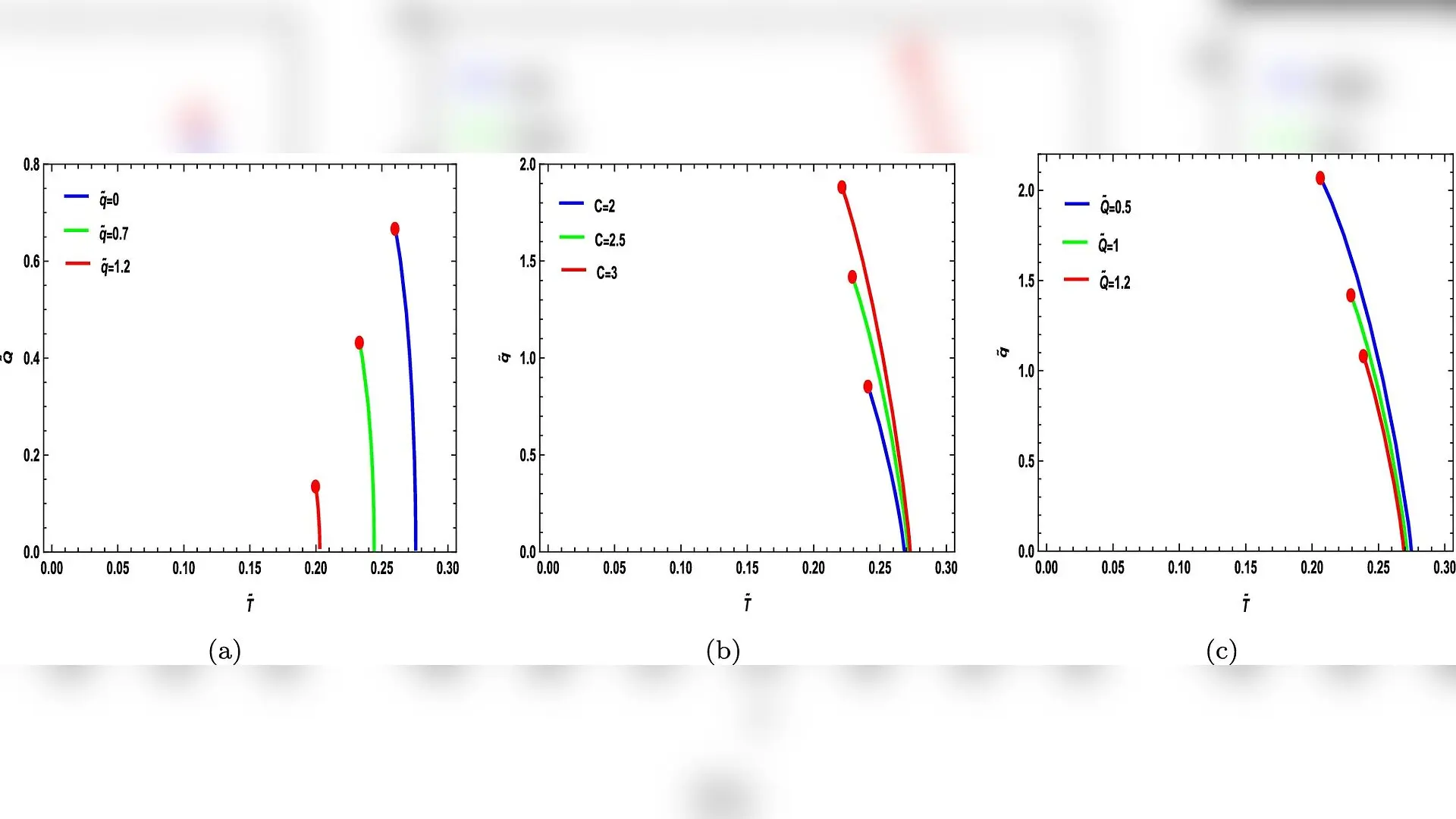
Coexistence lines for the fixed (q~,Q~,V,C)\documentclass[12pt]{minimal} \usepackage{amsmath} \usepackage{wasysym} \usepackage{amsfonts} \usepackage{amssymb} \usepackage{amsbsy} \usepackage{mathrsfs} \usepackage{upgreek} \setlength{\oddsidemargin}{-69pt} \begin{document}$$(\tilde{q},\tilde{Q}, \mathcal {V}, C)$$\end{document} ensemble. Low-entropy and high-entropy coexistence curve for CFT thermal states on aQ~-T~\documentclass[12pt]{minimal} \usepackage{amsmath} \usepackage{wasysym} \usepackage{amsfonts} \usepackage{amssymb} \usepackage{amsbsy} \usepackage{mathrsfs} \usepackage{upgreek} \setlength{\oddsidemargin}{-69pt} \begin{document}$$\tilde{Q}- \tilde{T}$$\end{document} and b, cq~-T~\documentclass[12pt]{minimal} \usepackage{amsmath} \usepackage{wasysym} \usepackage{amsfonts} \usepackage{amssymb} \usepackage{amsbsy} \usepackage{mathrsfs} \usepackage{upgreek} \setlength{\oddsidemargin}{-69pt} \begin{document}$$\tilde{q}-\tilde{T}$$\end{document} phase diagram. The parameters used he Alipour et al. / The European Physical Journal C

Black holes are far more than simple cosmic traps, acting instead as complex quantum systems holding vast microscopic secrets. Physicists have long puzzled over how to account for this internal atomic chatter, turning to holographic duality as a master key to translate the geometry of curved spacetimes into the language of ordinary quantum particles living on a boundary. A team of researchers has now pushed this correspondence further by mapping out the thermodynamic phase structure of a specific class of gravity solutions that include nonlinear gauge interactions.

Unraveling Strange Gauge Fields in Curved Spacetimes

To understand the inner workings of these gravitational wells, researchers study anti-de Sitter spacetimes, which possess a geometry shaped by a negative cosmological constant. Within these regions, black holes can carry electric charges alongside more complex non-Abelian fields, which are forces like magnetism or nuclear interactions that interact with themselves. The study, published in The European Physical Journal C, examines Einstein-Maxwell-Power-Yang-Mills gravity, an extended framework where the kinetic energy of the Yang-Mills field is raised to a power-law exponent. This nonlinearity introduces a new layer of complexity, allowing physicists to test how strong-gravity regimes behave when gauge and gravitational degrees of freedom intertwine.

By applying a holographic dictionary, the authors translated bulk gravitational properties like mass and temperature into boundary conformal field theory variables. In this dual picture, the central charge of the boundary theory, which measures the number of microscopic degrees of freedom, is treated as a dynamic thermodynamic variable. This formulation requires an extended first law of thermodynamics that incorporates boundary pressure and chemical potential.
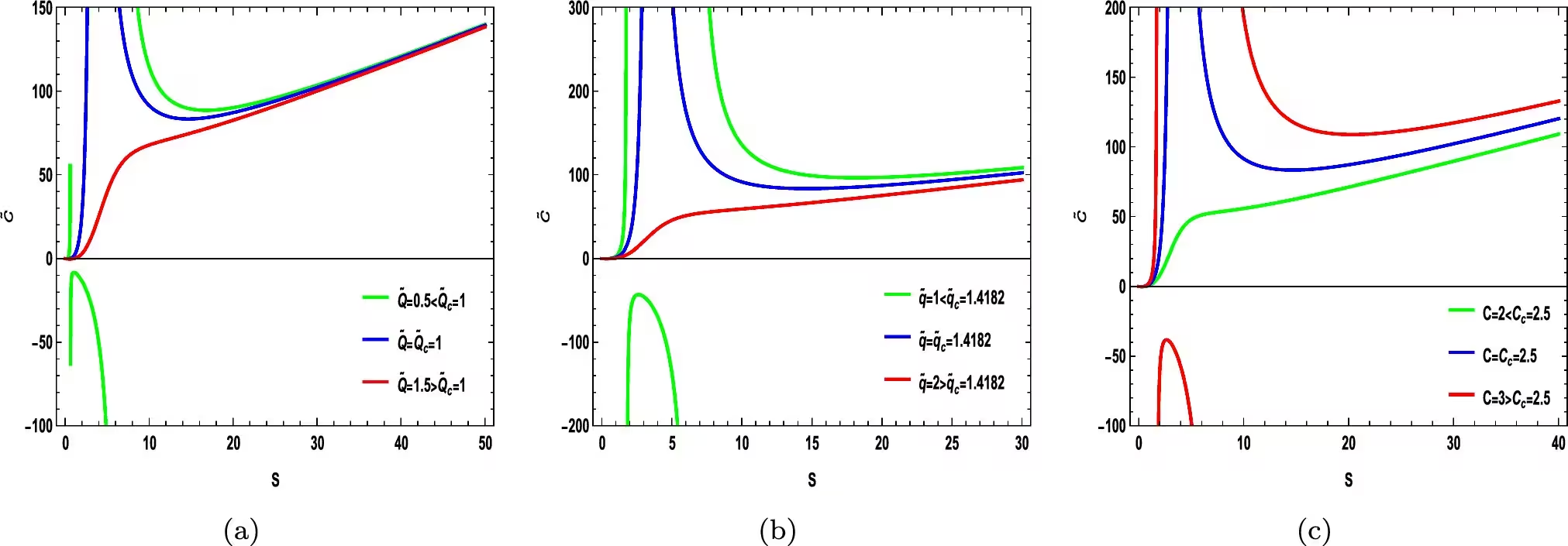
Fig. 1: Heat capacity C~\documentclass[12pt]{minimal} \usepackage{amsmath} \usepackage{wasysym} \usepackage{amsfonts} \usepackage{amssymb} \usepackage{amsbsy} \usepackage{mathrsfs} \usepackage{upgreek} \setlength{\oddsidemargin}{-69pt} \begin{document}$$\tilde{\mathcal {C}}$$\end{document} against S, with R = 1, γ=0.6\documentclass[12pt]{minimal} \usepackage{amsmath} \usepackage{wasysym} \usepackage{amsfonts} \usepackage{amssymb} \usepackage{amsbsy} \usepackage{mathrsfs} \usepackage{upgreek} \setlength{\oddsidemargin}{-69pt} \begin{document}$$\gamma =0.6$$\end{document}, and aq~=1.41820\documentclass[12pt]{minimal} \usepackage{amsmath} \usepackage{wasysym} \usepackage{amsfonts} \usepackage{amssymb} \usepackage{amsbsy} \usepackage{mathrsfs} \usepackage{upgreek} \setlength{\oddsidemargin}{-69pt} \begin{document}$$\tilde{q}=1.41820$$\end{document}, C=2.5\documentclass[12pt]{minimal} \usepackage{amsmath} \usepackage{wasysym} \usepackage{amsfonts} \usepackage{amssymb} \usepackage{amsbsy} \usepackag
Heat capacity C~\documentclass[12pt]{minimal} \usepackage{amsmath} \usepackage{wasysym} \usepackage{amsfonts} \usepackage{amssymb} \usepackage{amsbsy} \usepackage{mathrsfs} \usepackage{upgreek} \setlength{\oddsidemargin}{-69pt} \begin{document}$$\tilde{\mathcal {C}}$$\end{document} against S, with R = 1, γ=0.6\documentclass[12pt]{minimal} \usepackage{amsmath} \usepackage{wasysym} \usepackage{amsfonts} \usepackage{amssymb} \usepackage{amsbsy} \usepackage{mathrsfs} \usepackage{upgreek} \setlength{\oddsidemargin}{-69pt} \begin{document}$$\gamma =0.6$$\end{document}, and aq~=1.41820\documentclass[12pt]{minimal} \usepackage{amsmath} \usepackage{wasysym} \usepackage{amsfonts} \usepackage{amssymb} \usepackage{amsbsy} \usepackage{mathrsfs} \usepackage{upgreek} \setlength{\oddsidemargin}{-69pt} \begin{document}$$\tilde{q}=1.41820$$\end{document}, C=2.5\documentclass[12pt]{minimal} \usepackage{amsmath} \usepackage{wasysym} \usepackage{amsfonts} \usepackage{amssymb} \usepackage{amsbsy} \usepackag Credit: Alipour et al. / The European Physical Journal C

Two Distinct Ensembles Reveal Contrasting Phase Behaviors

The investigation uncovered that the boundary field theory displays drastically different phase landscapes depending on how it is constrained. In the canonical ensemble, where electric and Yang-Mills charges are held fixed, the system exhibits behavior remarkably similar to a van der Waals fluid. The temperature-entropy plots reveal characteristic S-shaped curves, leading to a swallowtail structure in the free energy diagrams. This indicates a first-order phase transition between small, low-entropy black holes and large, high-entropy configurations, terminating at a second-order critical point.

However, the behavior shifts when the system is examined in a mixed ensemble where the electric potential is fixed instead of its charge. In this setting, the boundary field theory undergoes a Hawking-Page transition, which corresponds to a confinement-deconfinement phase transition between an anti-de Sitter thermal radiation background and a large black hole.
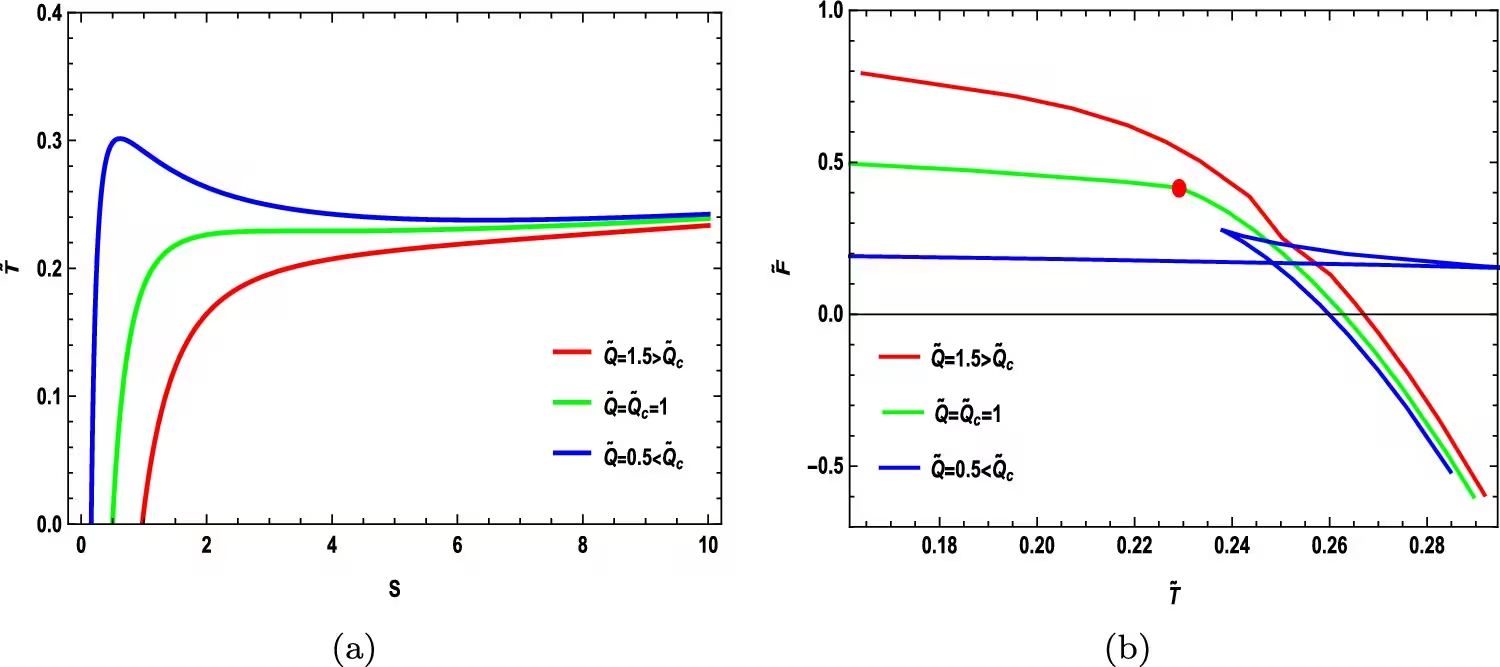
Fig. 2: a Temperature T~\documentclass[12pt]{minimal} \usepackage{amsmath} \usepackage{wasysym} \usepackage{amsfonts} \usepackage{amssymb} \usepackage{amsbsy} \usepackage{mathrsfs} \usepackage{upgreek} \setlength{\oddsidemargin}{-69pt} \begin{document}$$\tilde{T}$$\end{document} vs. entropy S. b Free energy F~\documentclass[12pt]{minimal} \usepackage{amsmath} \usepackage{wasysym} \usepackage{amsfonts} \usepackage{amssymb} \usepackage{amsbsy} \usepackage{mathrsfs} \usepackage{upgreek} \setlength{\oddsidemargin}{-69pt} \begin{document}$$\tilde{F}$$\end{document} vs. temperature T~\documentclass[12pt]{minimal} \usepackage{amsmath} \usepackage{wasysym} \usepackage{amsfonts} \usepackage{amssymb} \usepackage{amsbsy} \usepackage{mathrsfs} \usepackage{upgreek} \setlength{\oddsidemargin}{-69pt} \begin{document}$$\tilde{T}$$\end{document} plot with R=1,   γ=0.6\documentclass[12pt]{minimal} \usepackage{amsmath} \usepackage{wasysym} \usepackage{amsfonts} \usepackage{amssymb} \usepackage{amsbsy} \usepackag
a Temperature T~\documentclass[12pt]{minimal} \usepackage{amsmath} \usepackage{wasysym} \usepackage{amsfonts} \usepackage{amssymb} \usepackage{amsbsy} \usepackage{mathrsfs} \usepackage{upgreek} \setlength{\oddsidemargin}{-69pt} \begin{document}$$\tilde{T}$$\end{document} vs. entropy S. b Free energy F~\documentclass[12pt]{minimal} \usepackage{amsmath} \usepackage{wasysym} \usepackage{amsfonts} \usepackage{amssymb} \usepackage{amsbsy} \usepackage{mathrsfs} \usepackage{upgreek} \setlength{\oddsidemargin}{-69pt} \begin{document}$$\tilde{F}$$\end{document} vs. temperature T~\documentclass[12pt]{minimal} \usepackage{amsmath} \usepackage{wasysym} \usepackage{amsfonts} \usepackage{amssymb} \usepackage{amsbsy} \usepackage{mathrsfs} \usepackage{upgreek} \setlength{\oddsidemargin}{-69pt} \begin{document}$$\tilde{T}$$\end{document} plot with R=1,   γ=0.6\documentclass[12pt]{minimal} \usepackage{amsmath} \usepackage{wasysym} \usepackage{amsfonts} \usepackage{amssymb} \usepackage{amsbsy} \usepackag Credit: Alipour et al. / The European Physical Journal C

The Suppressive Role of Non-Abelian Charges

One of the most revealing quantitative findings of the study is the impact of the nonlinear Yang-Mills charge on the system’s stability. Numerical evaluations demonstrated that increasing this charge systematically lowers both the minimum temperature and the Hawking-Page transition temperature. Furthermore, it narrows the temperature window associated with the confined phase, showing that the nonlinear Yang-Mills field actively suppresses the confinement transition.

These findings suggest that non-Abelian interactions play a decisive role in shaping the thermodynamic stability of holographic systems. While the work relies on a specific Abelian-type ansatz to keep the equations tractable, it provides a robust testing ground for understanding how gauge field nonlinearities alter the fundamental architecture of quantum gravity.

The research was published in The European Physical Journal C on November 6, 2026.

Fact Checked

This article has been fact checked for accuracy, with information verified against reputable sources. Learn more about us and our editorial process.

Last reviewed on .

Article history

  • Latest version

Reference(s)

  1. Alipour, Mohammad Reza., et al. “Holographic CFT phase transitions and criticality for Einstein–Maxwell–Power–Yang–Mills AdS black holes.” The European Physical Journal C, vol. 86, no. 11, November 6, 2026 Springer Science and Business Media LLC, doi: 10.1140/epjc/s10052-026-16514-1. <https://doi.org/10.1140/epjc/s10052-026-16514-1>.

Cite this page:

Malhotra, Deepak. “Nonlinear Gauge Fields Dictate Black Hole Phase Transitions.” BioScience. BioScience ISSN 2521-5760, 06 November 2026. <https://www.bioscience.com.pk/en/subject/physics/holographic-cft-phase-transitions-and-criticality-for-einstein-maxwell-power-yang-mills-ads-black-holes>. Malhotra, D. (2026, November 06). “Nonlinear Gauge Fields Dictate Black Hole Phase Transitions.” BioScience. ISSN 2521-5760. Retrieved November 06, 2026 from https://www.bioscience.com.pk/en/subject/physics/holographic-cft-phase-transitions-and-criticality-for-einstein-maxwell-power-yang-mills-ads-black-holes Malhotra, Deepak. “Nonlinear Gauge Fields Dictate Black Hole Phase Transitions.” BioScience. ISSN 2521-5760. https://www.bioscience.com.pk/en/subject/physics/holographic-cft-phase-transitions-and-criticality-for-einstein-maxwell-power-yang-mills-ads-black-holes (accessed November 06, 2026).
End of the article