Common Polymer Additive Transforms Industrial Waste Grout to Seal Fragile Underground Rock
Adding polyvinyl alcohol to coal gangue cement slurries boosts compressive strength by nearly 24 percent and repairs unstable sandstone aquifers.
Adding a dash of a common synthetic polymer to industrial waste grouting mixtures can dramatically strengthen fragile underground rock layers, according to a study investigating sustainable mining techniques. Researchers examined how polyvinyl alcohol, a water-soluble polymer widely found in everyday glues and adhesives, alters cement slurries packed with 60 percent coal gangue, which is the rocky solid waste left over from coal mining. When injected into the crumbly, water-sensitive sandstone formations typical of western China, the modified mixture showed a remarkable ability to seal fractures and boost structural stability.
Why Fragile Sandstone Strata Pose a Major Mining Hazard
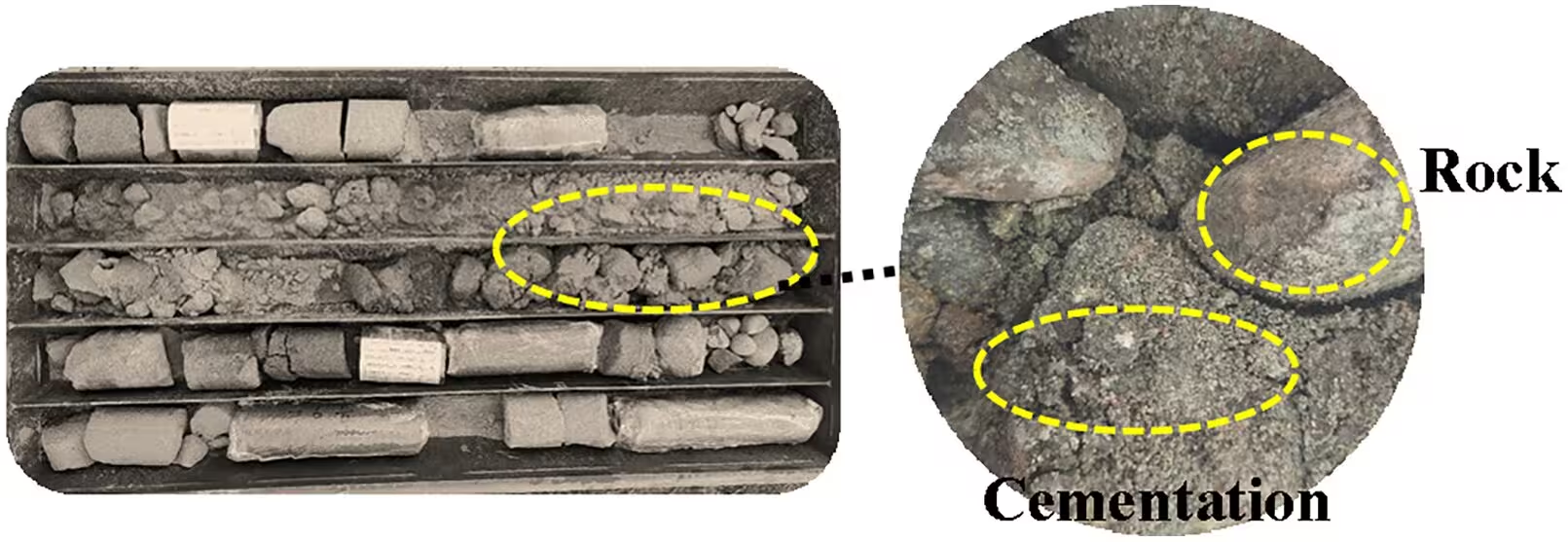
Underground mining operations in regions such as the Ordos Basin in Inner Mongolia frequently encounter weakly cemented sandstone strata. Unlike hard rock, these geological formations possess high porosity, poor natural cementation, and a tendency to disintegrate into mud when exposed to groundwater. Mining disturbances easily trigger secondary pore expansion and water channel formation, creating severe risks for regional aquifers and complicating co-mining operations where uranium ore bodies sit just beneath coal seams. To prevent catastrophic water inrushes and stabilize the overburden, engineers rely on rock mass grouting technology, pumping cement slurries deep into underground fissures to cement the broken rock back together.
Traditional grouting materials often struggle when substituting high volumes of industrial solid waste like coal gangue because the mixture suffers from low early-age hydration activity, poor water retention, and weak bonding at the slurry-rock interface. To overcome these limitations, the research team, led by Youwei Li and colleagues, introduced polyvinyl alcohol to modify the cement-gangue composite system. Their findings are published in PLOS One, detailing how polymer additives reshape the microscopic interactions between waste-based grout and porous rock.
How Polymer Additives Transform Slurry Behavior
The laboratory experiments evaluated slurries containing different polyvinyl alcohol concentrations ranging from 0.3 percent to 1.0 percent relative to the total binder mass. Without the polymer, replacing 60 percent of the cement with coal gangue significantly impaired the mixture, dropping its fluidity from 223 millimeters down to roughly 152 millimeters and sharply increasing water bleeding rates. Adding polyvinyl alcohol reversed many of these drawbacks. The polymer molecules contain an abundance of hydroxyl groups that form hydrogen bonds with water molecules, converting free water into bound water and boosting overall slurry stability. Consequently, fluid expansion increased by up to 41 percent compared to unmodified gangue slurries, while bleeding rates dropped by nearly 31 percent, making the mixture much easier to pump through narrow underground channels.
The Fine Balance Between Flexibility and Crushing Strength
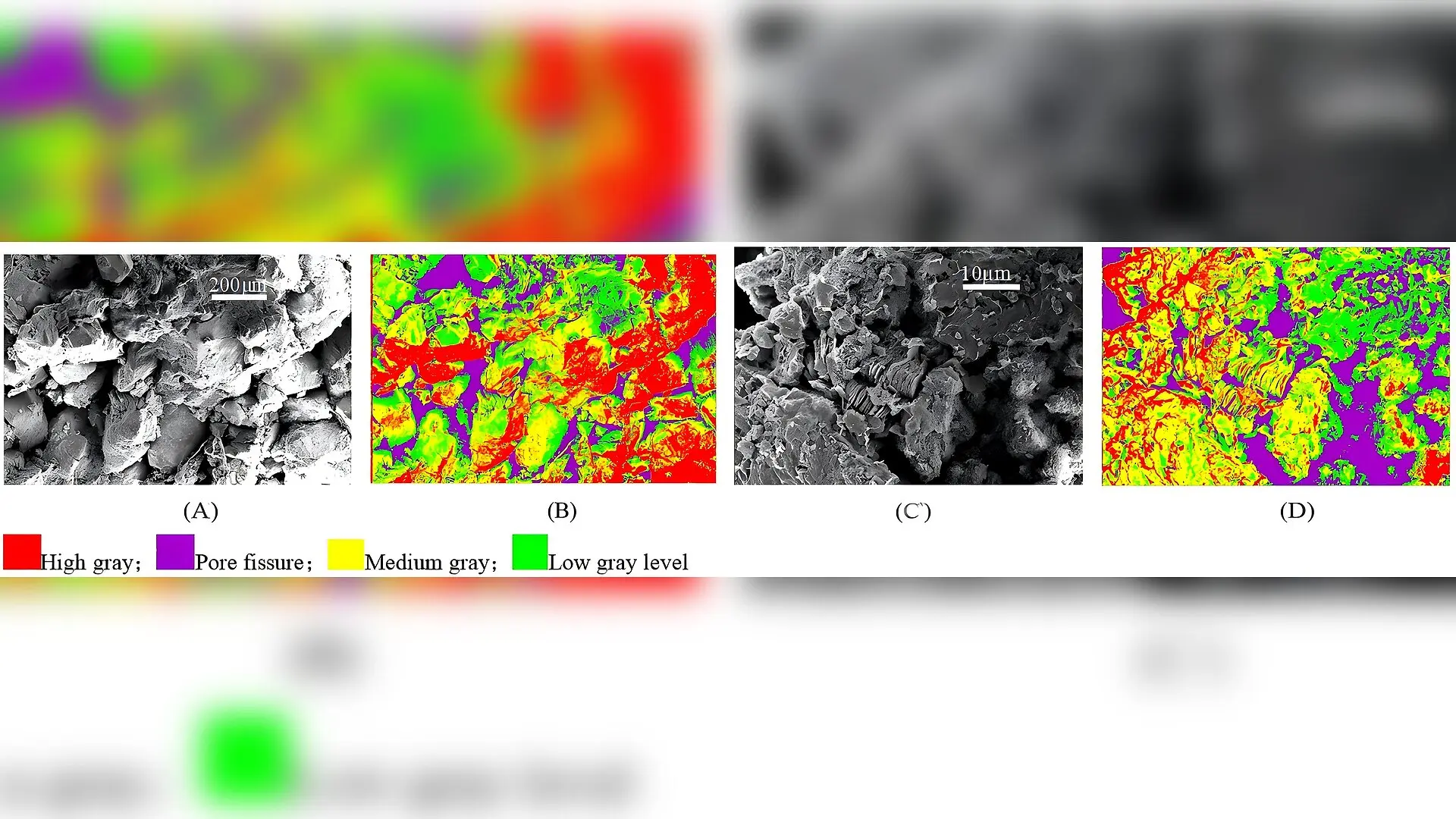
Uniaxial compression tests performed on cured grout-sandstone cylindrical specimens revealed a clear dose-dependent strength curve. Unmodified composite blocks achieved an average peak stress of 4.87 megapascals, whereas samples containing 0.6 percent polyvinyl alcohol reached an impressive 6.04 megapascals, representing a 23.7 percent strength increase. Microscopic scanning electron microscope imaging and X-ray diffraction analyses showed that an optimal amount of the polymer promotes the formation of calcium silicate hydrate gels and ettringite crystals, locking the sandstone particles tightly into a continuous matrix. However, pushing the polymer concentration to 1.0 percent produced diminishing returns. Excess polymer created thick local coatings, triggered localized crystal clustering, and reduced overall stiffness, causing the peak bearing capacity to drop. The authors conclude that controlling the polymer additive at 0.6 percent strikes the ideal balance, providing the rigidity needed to support heavy underground loads while retaining enough flexibility to absorb tectonic deformations.
The research was published in PLOS One on November 5, 2026.
This article has been fact checked for accuracy, with information verified against reputable sources. Learn more about us and our editorial process.
Last reviewed on .
Article history
- Latest version
Reference(s)
- Li, Youwei., et al. “Study on hydration cementation and enhancement mechanism of grout-rock interface of PVA modified grouting material.” PLOS One, vol. 21, no. 11, November 5, 2026, pp. e0362466 Public Library of Science (PLoS), doi: 10.1371/journal.pone.0362466. <https://doi.org/10.1371/journal.pone.0362466>.
Cite this page:
- Posted by Farah Siddiqui