Holding a Smartphone Against Your Thigh Does Not Ruin This Fitness Test
Restricting arm swing during a two-minute marching test alters movement variability slightly but leaves heart rate and step counts largely unchanged.
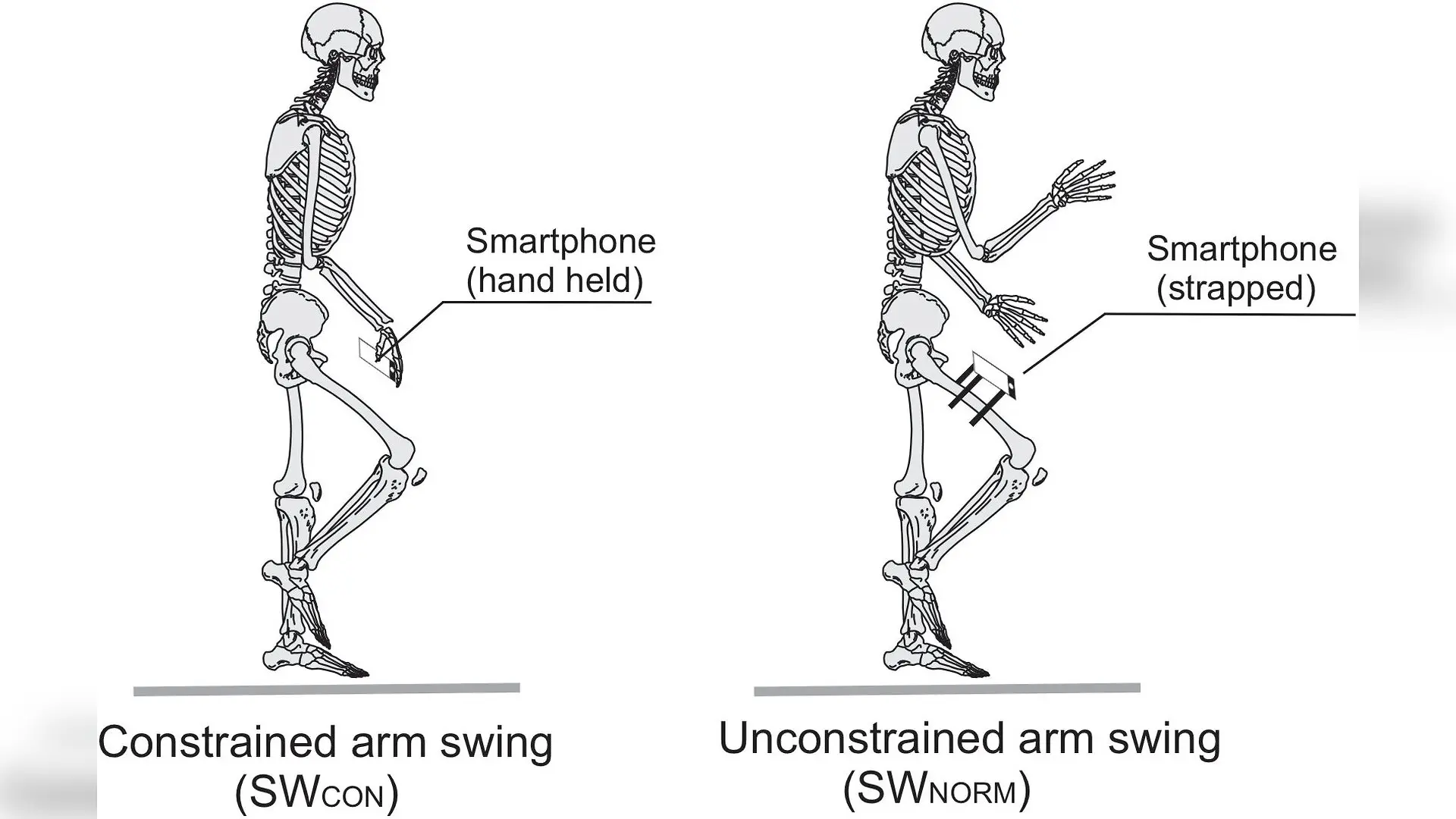
Holding a smartphone against your thigh while marching in place does not disrupt your overall movement speed or heart rate, even though it forces your arms to stay still. That is the key takeaway from a new study testing whether a convenient, low-cost way to measure physical fitness changes how people perform a standard health evaluation.
Measuring cardiorespiratory fitness usually requires bulky exercise equipment like treadmills or stationary bicycles, which are not always available in community clinics, schools, or home settings. To bypass this, researchers often use the Two-Minute Step Test, a simple assessment where individuals march in place as fast as possible for 120 seconds while lifting their knees to a specific height. While counting steps by hand is prone to human error and motion capture systems require expensive laboratory setups, recent technology allows a standard smartphone attached to the thigh to automatically track movement using its built-in gyroscopic sensors.
To see whether holding the device directly with one hand—rather than strapping it to the leg with an elastic pouch—alters the test, researchers evaluated 45 healthy young adults. The detailed results were published in PLOS One by Gustavo de Oliveira Hoffmann and his colleagues at the Federal University of Paraná.
How Arm Movement Affects Stationary Marching
During normal overground walking, humans swing their arms back and forth to counteract the rotational forces of the torso and pelvis, keeping their heads stable and minimizing energy loss. Restricting that natural arm swing during forward walking typically drives up oxygen consumption and heart rate by up to 34 percent because the body has to work harder to maintain balance.
However, marching in place is mechanically quite different from walking forward. Because there is no forward momentum, the body does not experience the same twisting forces from the pelvis. The researchers wanted to find out if holding a smartphone against the thigh—which locks one arm in place and restricts the other—would alter performance or cardiovascular stress during the two-minute test.
Testing Unrestricted Versus Restricted Arm Swing
The 45 participants, consisting of 27 men and 18 women with an average age of 19.5 years, completed the Two-Minute Step Test under two different conditions in a counterbalanced order. In the unconstrained condition, the smartphone was secured to the right thigh using an adjustable elastic pouch, allowing participants to swing their arms freely. In the constrained condition, participants held the smartphone against the exact same spot on their right thigh with their right hand, while placing their left hand against the opposite thigh.
The team analyzed 11,385 individual step cycles using gyroscope data processed through a machine learning calibration model. They tracked multiple metrics, including total step count, average thigh peak angular velocity, cycle duration, rate of change in speed, and heart rate responses measured via chest straps.
Surprising Stability Despite Minor Variability
The data revealed that constraining arm movement did not meaningfully disrupt core physical performance. Participants completed an average of 131.4 step cycles in the constrained condition and 127.4 cycles when their arms were free, a difference that was not statistically significant. Furthermore, mean thigh peak angular velocity, cycle duration, and overall heart rate responses showed no reliable differences between the two testing setups.
Cardiorespiratory stress remained nearly identical, with participants reaching roughly 66 percent of their age-predicted maximum heart rate in both trials. These findings indicate that, unlike forward walking, the lack of forward progression in stationary marching minimizes the need for energetic counter-rotation from the arms.
Nevertheless, the experiment did uncover two subtle differences. Participants exhibited higher variability in their thigh peak angular velocity when their arms were restricted, likely due to the unfamiliarity of holding the device or mild soft-tissue movement interference. Additionally, self-reported ratings of perceived exertion on the Borg scale were slightly higher in the constrained trial, ticking up by about 0.7 units. However, this minor elevation stayed well below the statistical threshold for a clinically meaningful change, suggesting it may reflect the novelty of the task rather than true physical exhaustion.
What This Means for Fitness Tracking
These findings support the feasibility of deploying streamlined, smartphone-based fitness assessments without requiring extra accessories like specialized straps or harnesses. By demonstrating that holding a phone against the leg yields comparable primary step metrics, the study opens new doors for affordable, rapid health screenings in home and community environments.
The research was published in PLOS One on November 5, 2026.
This article has been fact checked for accuracy, with information verified against reputable sources. Learn more about us and our editorial process.
Last reviewed on .
Article history
- Latest version
Reference(s)
- Hoffmann, Gustavo de Oliveira., et al. “The influence of arm swing constraint on thigh kinematics, heart rate response, and perceived exertion during the two-minute step test.” PLOS One, vol. 21, no. 11, November 5, 2026, pp. e0361590 Public Library of Science (PLoS), doi: 10.1371/journal.pone.0361590. <https://doi.org/10.1371/journal.pone.0361590>.
Cite this page:
- Posted by Farah Siddiqui