Hollow Atomic Tubes Emit Single Photons Across Visible Spectrum
Boron nitride nanotubes bypass the limits of flat materials, offering ultra-fast quantum light sources protected by thin oxide coatings.
Tiny hollow tubes made of boron and nitrogen can spit out individual particles of light at room temperature across the entire visible color spectrum, offering a fresh way to build advanced quantum communication networks. Researchers studying these cylindrical structures found they can host multiple glowing defects that act as reliable single photon sources, functioning much faster than similar flat materials while remaining compact enough to pack densely inside microscopic photonic circuits.
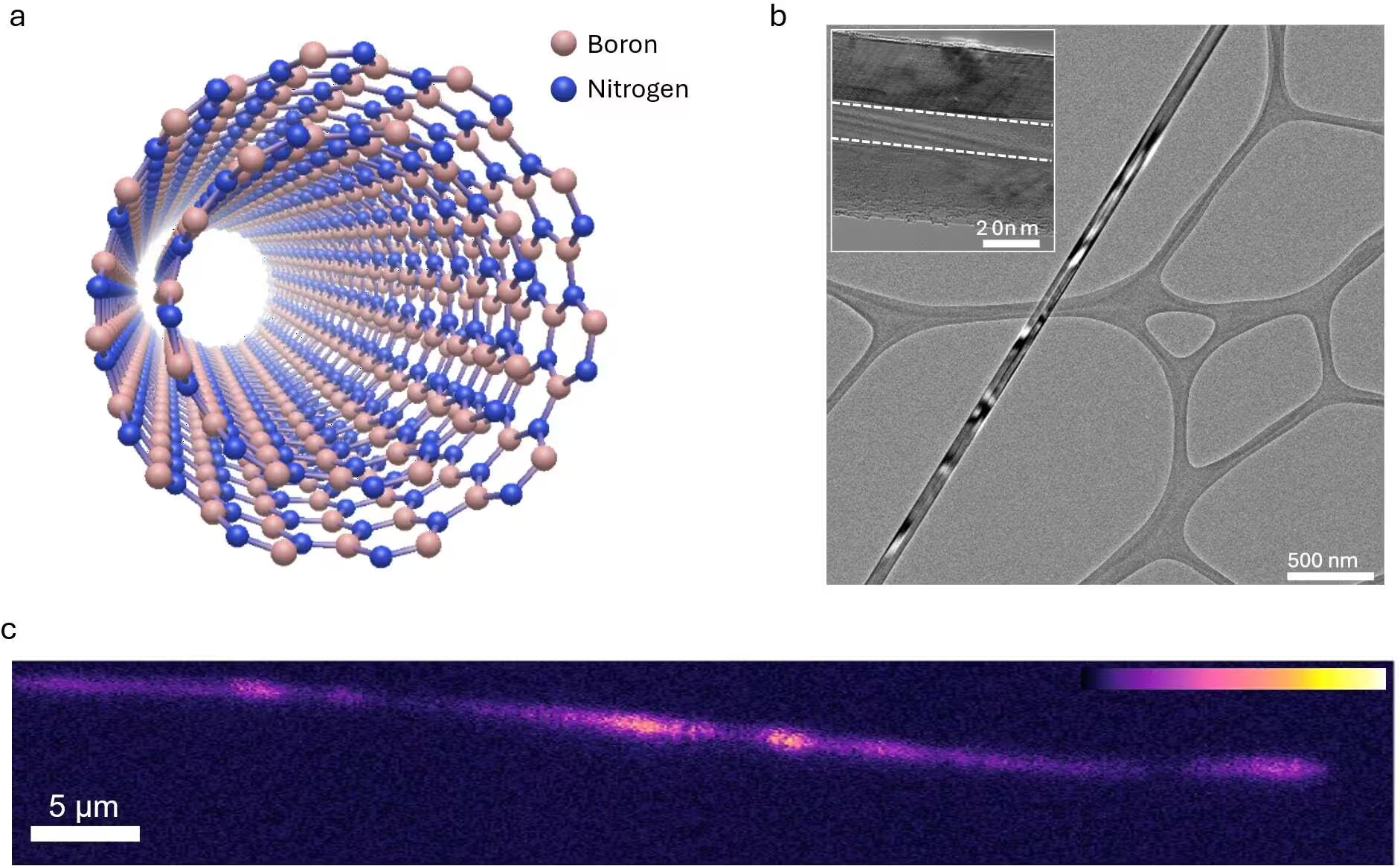
Quantum technologies like ultra-secure data encryption and quantum computers rely heavily on bright, dependable sources that emit one particle of light, known as a photon, at a time. For years, scientists have focused heavily on flat, two-dimensional sheets of hexagonal boron nitride to host these quantum emitters, but working with flat sheets brings tricky manufacturing hurdles when trying to align them precisely with tiny on-chip optical pathways. To bypass this geometric headache, a team of researchers investigated hollow, one-dimensional cylinders known as boron nitride nanotubes, or BNNTs, which measure roughly 60 nanometers across and feature multi-layered walls separated by a tiny distance of about 0.33 nanometers. The detailed investigation was published on the arXiv preprint server, detailing how these rolled-up atomic tubes handle room-temperature quantum emission.
How One-Dimensional Tubes Outperform Flat Atomic Sheets
Using advanced confocal photoluminescence microscopy, which uses focused laser light to map glowing spots on microscopic samples, the authors discovered that individual nanotubes contain numerous defect sites capable of emitting single photons across a broad wavelength range spanning from 430 to 760 nanometers. Unlike flat sheets, which often leave stubborn spectral gaps where no emitters can be found, these tubular structures host emitters continuously across the visible spectrum, including a cluster of short-wavelength sources between 450 and 550 nanometers that are largely absent in traditional two-dimensional setups. Each individual tube acts as a multiwavelength host, meaning a single microscopic thread can contain multiple independent color centers operating at different frequencies along its length.
The speed at which these photons are generated also surpassed expectations, determined by measuring the decay lifetime of the excited states. The team observed decay times as fast as 0.53 nanoseconds, which is roughly twice as fast as the transition lifetimes typically recorded in flat hexagonal boron nitride flakes. This rapid relaxation pathway directly translates to higher brightness and faster data bitrates, making the tubular emitters far more attractive for high-speed quantum communication links. Furthermore, a specific defect emitting at 706 nanometers exhibited a saturation intensity of roughly 150,000 counts per second under 1.45 milliwatts of laser excitation power, while autocorrelation measurements confirmed true single-photon behavior with clear antibunching dips.
Overcoming Environmental Instability With Sapphire Coatings
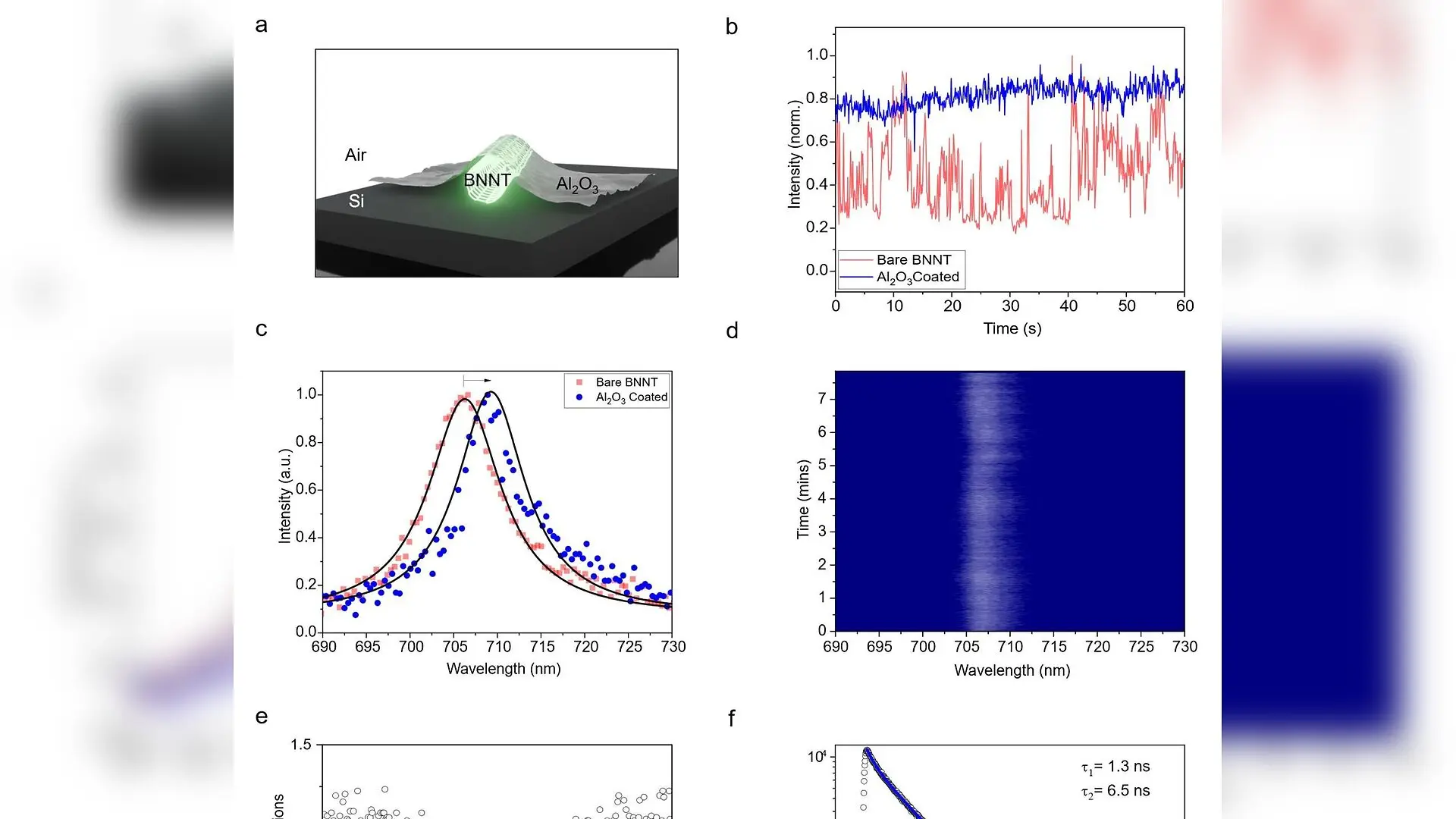
Solid-state quantum emitters frequently suffer from a frustrating flaw known as photo-blinking, where the light source randomly flickers between bright and dark states due to nearby electrical charge traps, dangling chemical bonds, or stray oxygen molecules. To calm this erratic flickering, the researchers applied an atomic layer deposition technique to wrap the nanotube hosting the 706 nanometer emitter inside a ultra-thin 1.5-nanometer layer of aluminum oxide, essentially encasing the quantum source in a protective sapphire-like shell. This chemical isolation successfully stamped out the disruptive blinking behavior, producing a steady, reliable stream of light over long observation periods.
Encapsulating the nanotube also subtly shifted the emission wavelength from 706 nanometers to 709 nanometers, a phenomenon known as a Stark shift caused by changes in the local electrostatic environment created by the oxide coating. This environmental shielding reduced unwanted multi-photon emission pathways, improving the single-photon purity while extending the excited state lifetimes to roughly 1.3 nanoseconds and 6.5 nanoseconds. By providing a slender architecture that is easy to position physically while maintaining tight control over light emission, these coated nanotubes point toward a future where multiple quantum signals can travel through a single microscopic waveguide without crosstalk.
The study was posted to the arXiv preprint server on November 5, 2026.
This article has been fact checked for accuracy, with information verified against reputable sources. Learn more about us and our editorial process.
Last reviewed on .
Article history
- Latest version
Reference(s)
- Peter, Ke-Sean. “Room-Temperature Quantum Emission from Boron Nitride Nanotubes.” arXiv.org <http://arxiv.org/abs/2611.08460v1>.
Cite this page:
- Posted by Farah Siddiqui