Exotic Quantum State Transitions Directly Into a Topological Superconductor
Numerical simulations reveal a direct path from fractional insulators to unconventional superconductivity without a standard Fermi surface.
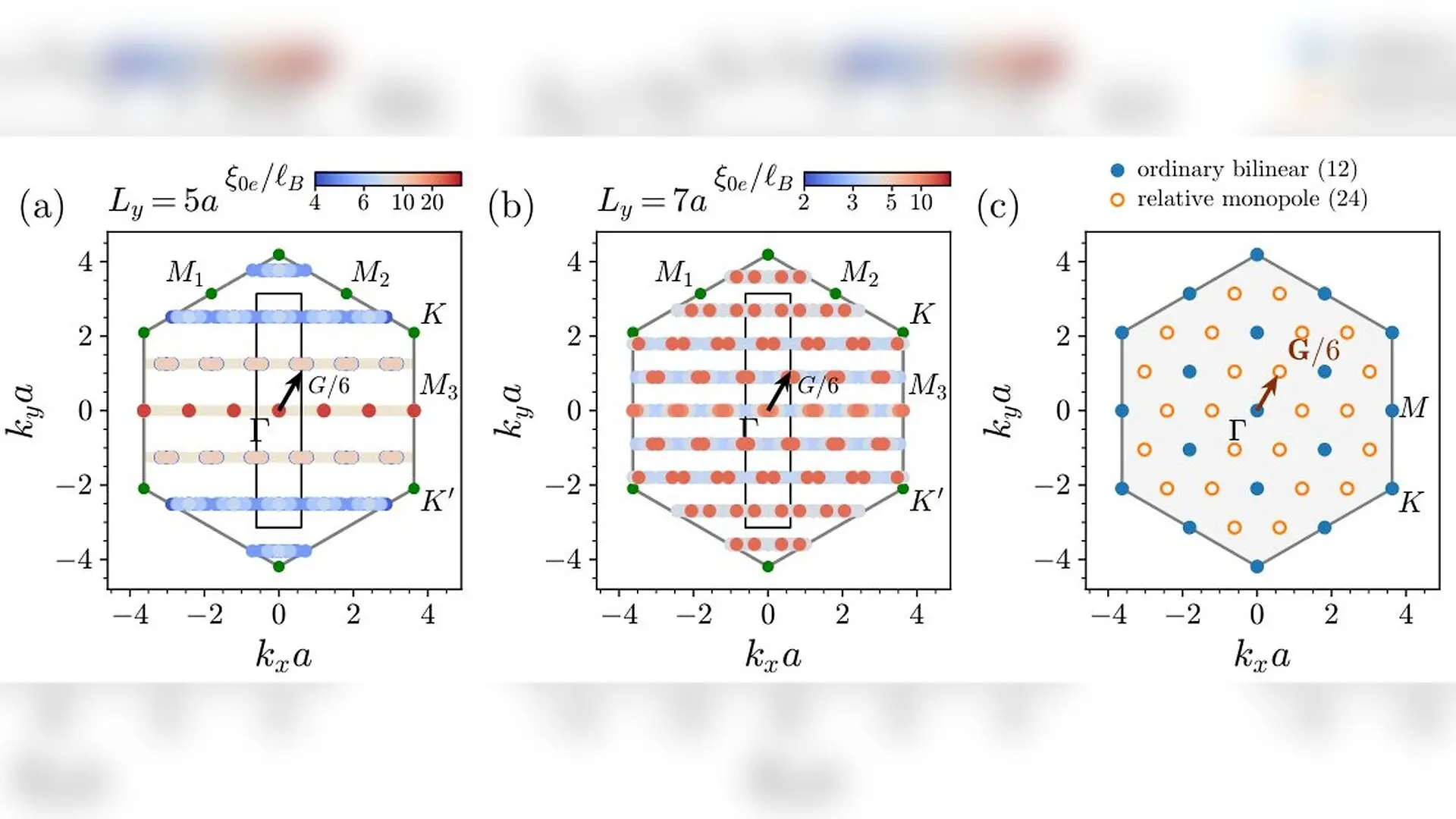
Physicists have uncovered a direct, continuous phase transition linking a fractional Chern insulator to a topological superconductor without relying on a traditional metal state. The study reveals how exotic quantum states of matter can transform directly from one another when electronic bandwidth is tuned in a repulsively interacting system.
Direct Quantum Transformation Without a Fermi Surface
For decades, standard superconductivity has been understood through electrons pairing up near a Fermi surface, which is the boundary separating occupied and unoccupied electronic momentum states at absolute zero. The new research, published on the arXiv preprint server, suggests that unconventional superconductivity can bypass this standard route entirely. The authors report numerical evidence from quantum many-body calculations that increasing bandwidth at a fractional filling of one-third drives a continuous transition directly from a Laughlin fractional Chern insulator to a topological superconductor with a chirality assignment of three-halves.
At the exact critical point of the transition, the correlation length of the electrons diverges at specific momenta sitting away from the reference Fermi surface. This behavior indicates that the resulting superconducting state emerges directly from the fractionalized particles inhabiting the insulator, rather than from conventional electronic instabilities. The findings offer fresh theoretical backing for the idea that exotic superconductivity can originate directly from fluids of fractionally charged quasiparticles known as anyons.
Decoding Non-Abelian Vortices
To understand how this transition functions mathematically, the researchers developed a generalized theory based on the proliferation of superconducting vortices. In ordinary superfluids, condensing elementary vortices restores charge conservation and results in a trivial insulator. However, at fractional filling, spatial constraints prevent the system from remaining featureless and translation symmetric without additional mechanisms.
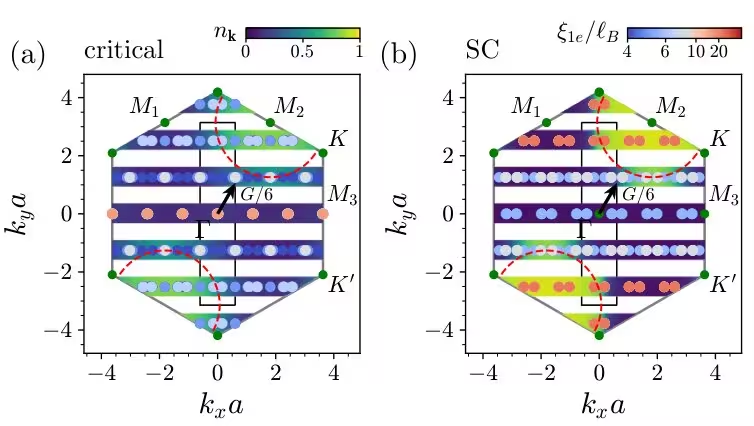
The team found that magnetic translation organizes the non-Abelian vortices of the topological superconductor into six distinct valleys. Preserving spatial translation across these valleys requires additional statistical gauge fields, which ultimately reproduces the momentum structure observed in the numerical simulations. When the system is doped away from the commensurate one-third filling, this vortex framework generates a superconducting dome in the phase diagram.
Testing the Theory in Layered Materials
Realizing these exotic transitions experimentally requires flat electronic bands with non-zero topological character. Twisted bilayer transition metal dichalcogenides, such as moiré MoTe2 structures, provide a prime platform where fractional quantum anomalous Hall states and unconventional superconductivity appear within the same experimental setups. Rhombohedral pentalayer graphene offers another promising laboratory setting.
The authors point out that modern experimental tools could soon put these predictions to the test. Scanning tunneling spectroscopy can map local differential conductance across the tuning parameter to watch the tunneling gap edge vanish at the critical point. Meanwhile, quantum twisting microscopy can resolve the single-electron spectrum in both energy and momentum, allowing researchers to verify whether the electronic gap truly closes at isolated critical momenta instead of along a continuous Fermi surface.
The study was posted to the arXiv preprint server on November 5, 2026.
This article has been fact checked for accuracy, with information verified against reputable sources. Learn more about us and our editorial process.
Last reviewed on .
Article history
- Latest version
Reference(s)
- Wang, Taige. “Direct transition from a fractional Chern insulator to a topological superconductor.” arXiv.org <http://arxiv.org/abs/2611.08475v1>.
Cite this page:
- Posted by Farah Siddiqui