Physicists Reveal How A Black Hole Could Theoretically Split In Two
Theoretical models suggest a rapidly rotating black hole could split into two, a phenomenon researchers are now investigating despite no observed evidence.
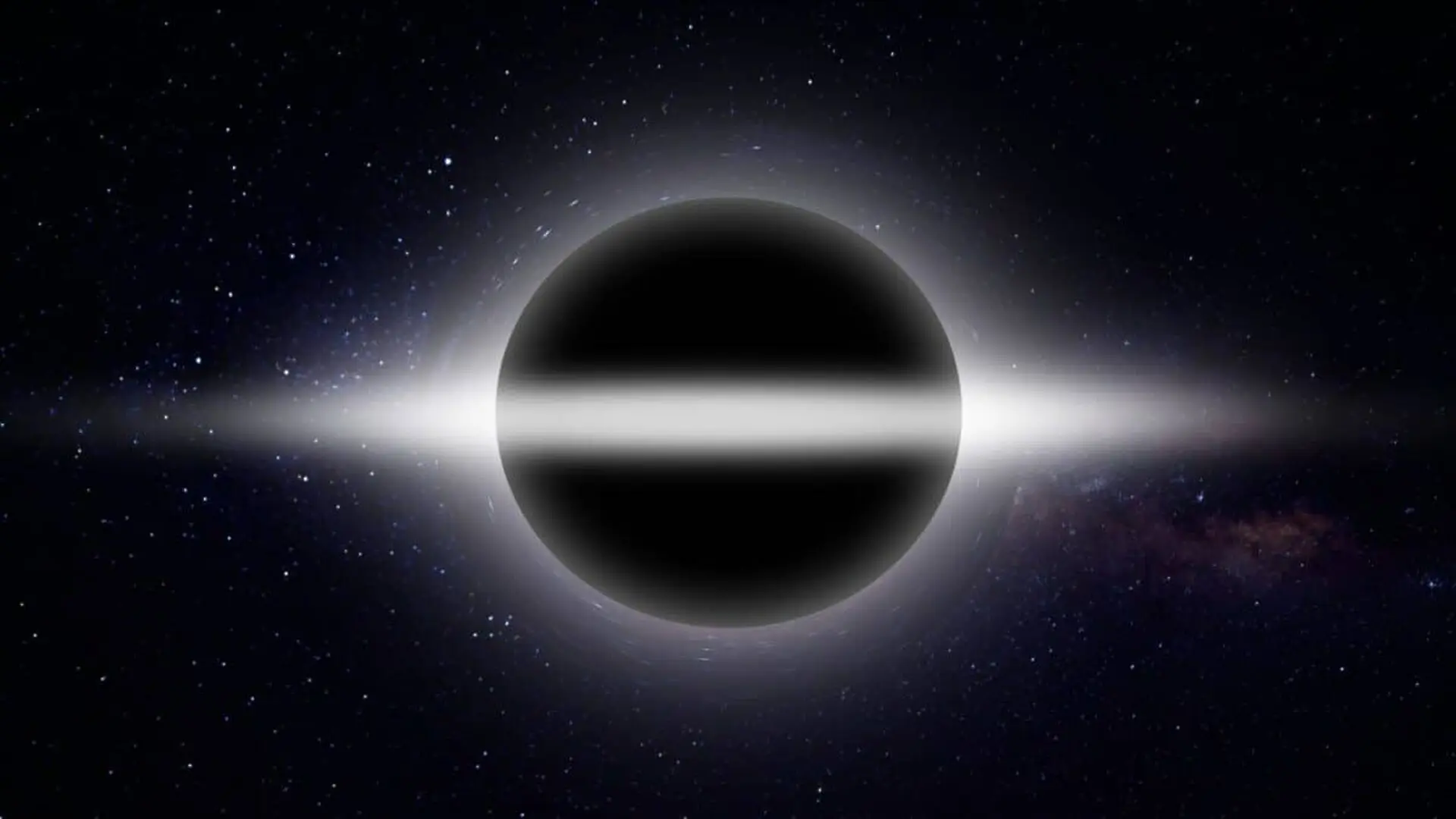
The cosmic dance of black holes is typically depicted as a one-way street of consumption and collision. While astronomers have extensively documented the violent merger of two black holes into a single, larger entity, the theoretical possibility of the reverse process—a black hole spontaneously fracturing into two—has long been dismissed by the standard laws of physics. A new study published in Physical Review D, titled “When Black Holes Admit Pair-of-pants Topologies,” is now challenging that assumption by probing whether extreme rotational speeds or alternative gravitational frameworks could facilitate such a split.
At the heart of the resistance to black hole fragmentation is the second law of thermodynamics, which dictates that the total entropy of an isolated system must never decrease. For a black hole, entropy is intrinsically linked to the surface area of its event horizon. Calculations suggest that for a non-rotating black hole, dividing into two smaller entities would result in a net loss of total surface area, thereby violating thermodynamic principles. Because of this, nature seemingly forbids the spontaneous fission of a static black hole.
The Role of Angular Momentum
The narrative shifts, however, when extreme rotation is introduced. A rapidly spinning black hole possesses lower entropy than its non-rotating counterpart of equivalent mass, potentially narrowing the thermodynamic gap that prevents division. The researchers found that if a portion of a black hole’s rotational energy were converted into the orbital angular momentum of two smaller, newly formed fragments, the combined entropy of the resulting system might theoretically satisfy the requirements of thermodynamics.
Yet, thermodynamic permission is not synonymous with physical reality. Even if a split were energy-neutral or favorable, the fragments would need sufficient kinetic energy to escape one another’s gravitational grip rather than immediately collapsing back into a single unit. Francesco Sannino, a co-author of the study based at the University of Naples Federico II and the University of Southern Denmark, notes that these stringent requirements largely negate the possibility for most black holes, leaving only those spinning at near-maximum theoretical limits as potential candidates.
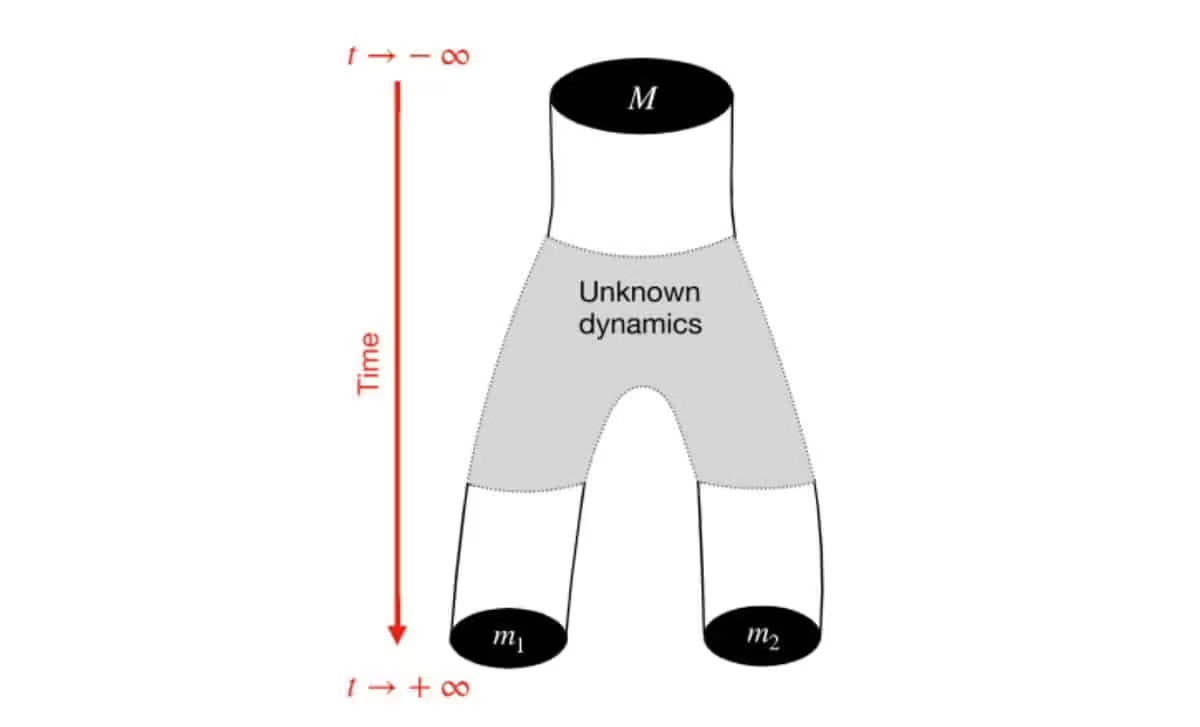
The team utilized the geometric concept of a “pair-of-pants topology” to model this transition, where the single event horizon of a parent black hole forks into two distinct branches as it evolves through spacetime. While the math permits this configuration under specific constraints, it remains a far cry from a confirmed physical mechanism.
Beyond General Relativity
To move further into the unknown, the authors explored models extending beyond Einstein’s general relativity, particularly those involving higher-dimensional spacetime. In these theories, structures such as black strings—extended, horizon-bearing objects—are prone to the Gregory–Laflamme instability, where small perturbations grow until they fundamentally alter the geometry of the object. Similar instabilities could theoretically afflict rotating black holes in higher dimensions.
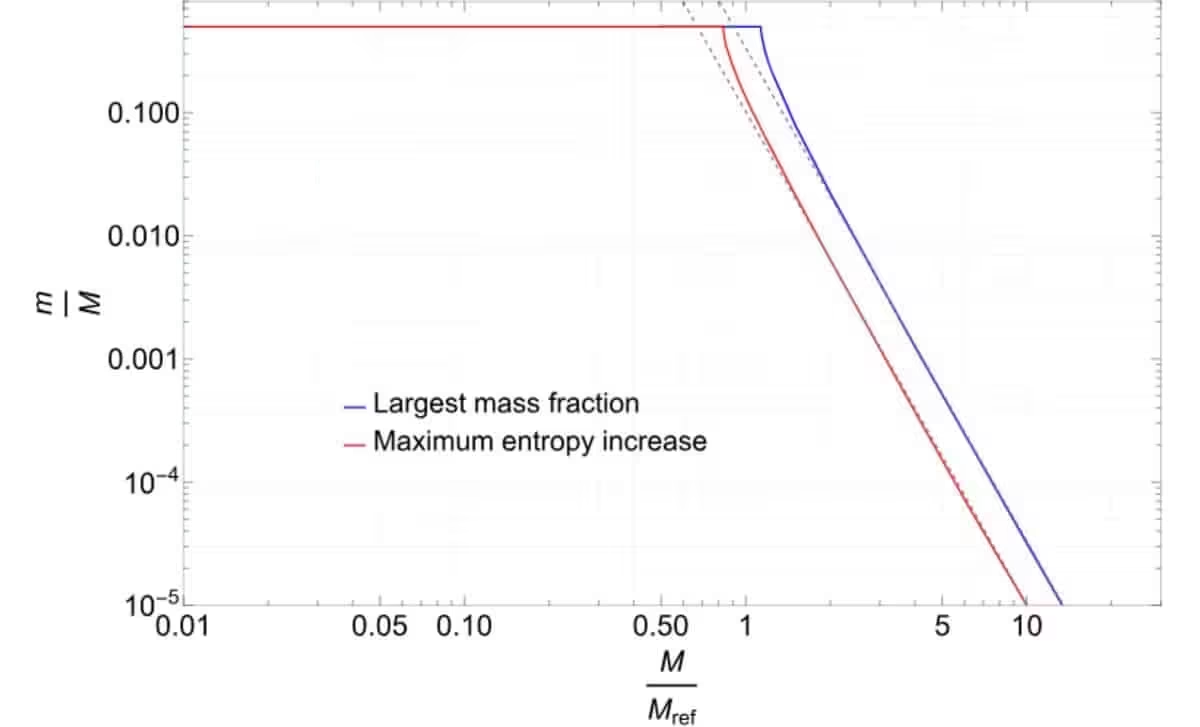
Under these modified gravitational theories, the team found that fragmentation can become thermodynamically favorable, especially if the resulting fragments are of highly asymmetric sizes. However, Sannino cautions that such findings are speculative and heavily dependent on the specific nature of gravity at the quantum scale, which remains poorly understood. He suggests that the most promising avenue for observational verification lies in high-energy astrophysics, where instruments like the Fermi Large Area Telescope could potentially detect unique gamma-ray signatures from the remnants of primordial black hole fission.
For now, the concept of a splitting black hole remains a fascinating mathematical exercise. While no empirical evidence supports the existence of such a phenomenon, the research opens a new front in our understanding of how the most dense objects in the universe might behave when pushed to their absolute limits.
This article has been fact checked for accuracy, with information verified against reputable sources. Learn more about us and our editorial process.
Last reviewed on .
Article history
- Latest version
Cite this page:
- Posted by Farah Siddiqui