Astronomers Discover Mysterious Cosmic Explosion That Remained Active For 27 Days
Astronomers are puzzled by an extraordinary, mysterious signal from a cosmic explosion that defies current scientific explanation.
Astronomers have identified a record-breaking cosmic event that challenges current models of stellar death. The explosion, designated GRB 220706A, exhibited intense X-ray activity 27 days after its initial detection, a duration that far exceeds the observed behavior of typical gamma-ray bursts.
First recorded on July 6, 2022, this event is categorized as an ultra-long gamma-ray burst. These phenomena are traditionally linked to the collapse of massive stars, which often culminate in supernovae and the creation of dense, compact stellar remnants. However, the sustained energy output observed in this instance has left researchers struggling to reconcile the event with established astrophysical frameworks.
A Persistent Signal Shatters Previous Records
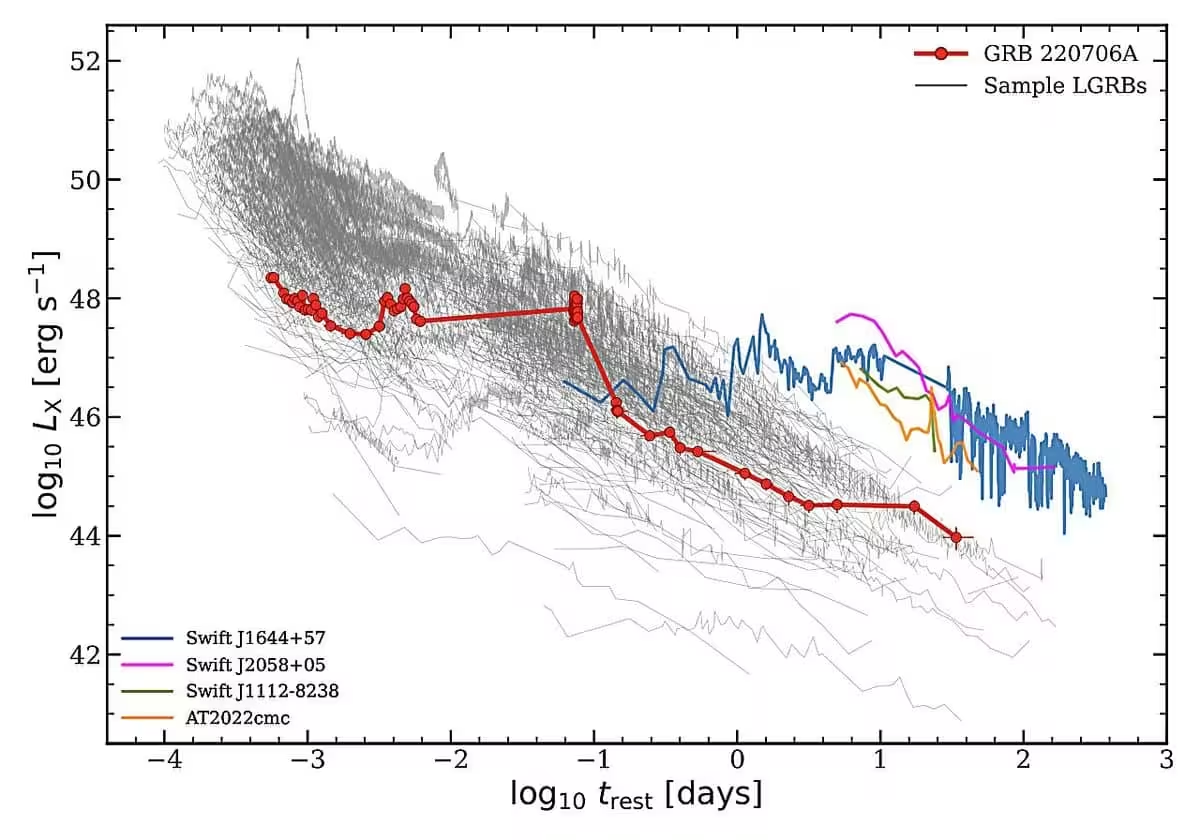
Gamma-ray bursts (GRBs) generally release massive quantities of energy in short, violent pulses. While long-duration bursts are typically attributed to the death of massive stars and shorter ones to neutron star mergers, GRB 220706A defied these conventions. The X-ray flaring detected nearly a month later in the source’s rest frame marks a significant departure from previous records, where similar post-burst activity typically faded within six days, according to findings detailed via arXiv.
“The fact that we see flaring at around 27 days in the GRB’s rest frame tells us that there’s an ongoing active process, and that’s unprecedented in the known population,” said Benjamin Gompertz, a researcher at the University of Birmingham involved in the study.
Decoding the Engine Behind the Flare
The prolonged activity suggests that the “central engine” powering the event remained active far longer than current theories account for. One prominent hypothesis involves the birth of a magnetar—a highly magnetized neutron star capable of injecting consistent energy into the surrounding debris. This scenario draws parallels to the 2011 event GRB 111209A, which was linked to the unusually bright supernova SN 2011kl, widely believed to be powered by a central magnetar.
Alternatively, the sustained radiation could result from the interaction between the explosion’s jet and dense shells of gas expelled by the progenitor star during its final days. Estimates of the progenitor’s scale suggest a radius approximately 1,000 times that of the Sun, pointing toward a blue supergiant. Such a massive progenitor would be significantly larger than the Wolf-Rayet stars typically linked to these events, potentially explaining the extended duration of the collapse and subsequent energy release.
Observational Hurdles in High-Energy Astronomy
Capturing these prolonged events is inherently challenging. Many monitoring satellites orbit in low Earth orbit, where they lose sight of target sources roughly every 90 minutes. While this is acceptable for short, intense bursts, it hinders the ability to track long-term activity. Furthermore, these events are often more distinct in X-ray wavelengths than in gamma rays, placing them outside the focus of traditional gamma-ray detectors. Experts anticipate that the Einstein Probe, a satellite specifically designed to scan for transient X-ray phenomena, will play a critical role in detecting and characterizing similar events in the future.
The mystery of GRB 220706A leaves astrophysicists with an enduring question: what specific mechanism allows a collapsing star to fuel such a high-energy display weeks after the initial catastrophic event?
This article has been fact checked for accuracy, with information verified against reputable sources. Learn more about us and our editorial process.
Last reviewed on .
Article history
- Latest version
Reference(s)
- Sfaradi, Itai. “An Off-Nuclear Tidal Disruption Event Discovered At Late Times: The Case Of TDE 2023mfm.” arXiv.org <https://arxiv.org/abs/2609.35998>.
- “Dr Benjamin Gompertz.” University of Birmingham <https://www.birmingham.ac.uk/staff/profiles/physics/gompertz-benjamin>.
- “Magnetars - NASA.” NASA <https://www.nasa.gov/universe/stars/neutron-stars/magnetars/>.
Cite this page:
- Posted by Farah Siddiqui