Physicists Propose a Hidden Fifth Dimension Could Explain the Mystery of Dark Energy
Researchers have discovered a link between cosmic expansion and hidden dimensions within string theory, potentially reshaping our understanding of the universe.
Dark energy remains one of the most persistent mysteries in modern physics. While it is intrinsically linked to the accelerating expansion of our universe, the values observed by astronomers are orders of magnitude smaller than what standard theoretical models predict. This glaring discrepancy hints at a fundamental misunderstanding of how the universe functions on its largest scales compared to the subatomic world.
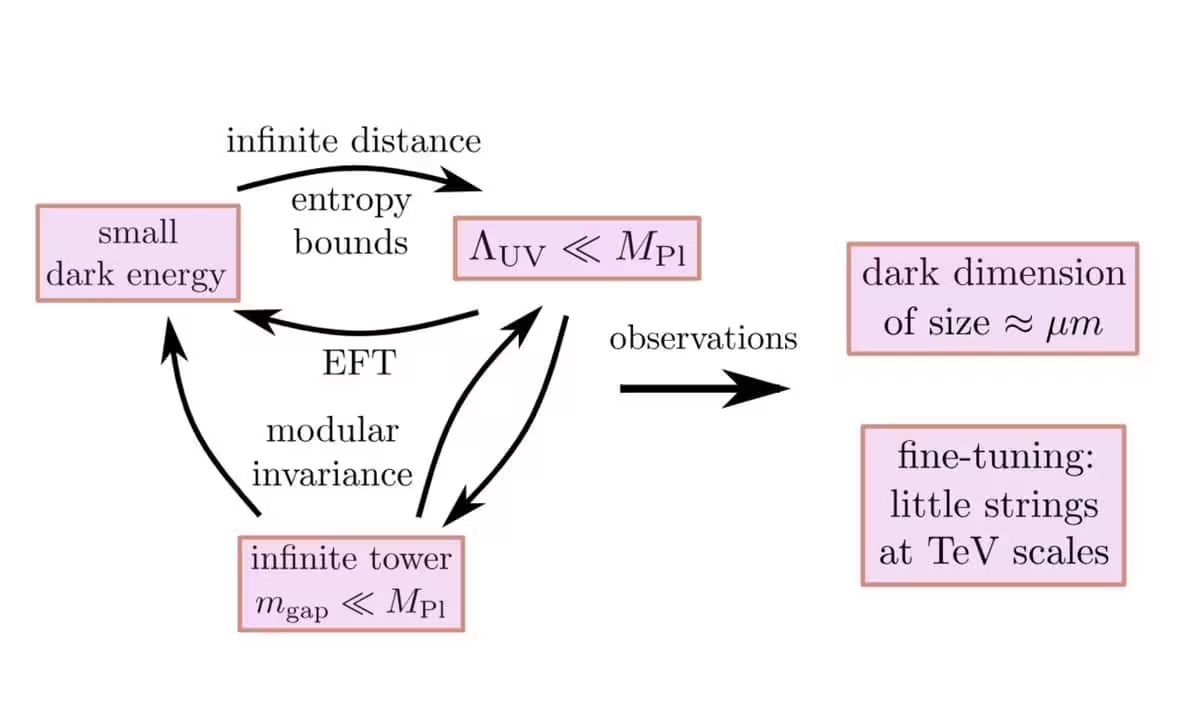
A new theoretical framework, proposed by Ignatios Antoniadis of Sorbonne University and Dieter Lüst of the Max Planck Institute, suggests a radical solution: the answer may lie in an additional spatial dimension. By utilizing weakly coupled string theory, the researchers have developed what they call the Dark Dimension scenario, an approach that aims to solve the dark energy puzzle without relying on the highly precise fine-tuning of parameters that has frustrated physicists for decades.
Expanding the Geometry of the Universe
String theory often posits that the universe contains more dimensions than the four we experience—three of space and one of time. These extra dimensions are typically assumed to be “compactified,” curled up into such infinitesimally small spaces that they remain hidden from observation. However, the model proposed by Antoniadis and Lüst challenges this convention.
The team suggests that one of these hidden dimensions is significantly larger than previously anticipated. Their calculations point to a size of approximately one micron, or one-millionth of a meter. While this is invisible to the human eye, it is remarkably large compared to the subatomic scales where extra dimensions are usually theorized to exist; in fact, it is roughly the size of a common bacterium.
In this framework, our familiar four-dimensional spacetime acts as a membrane within a larger five-dimensional space. One intriguing consequence of this configuration is that gravity might not be confined solely to our dimensions. If gravity “leaks” into the fifth dimension, it could provide a physical explanation for why it is observed to be so much weaker than the other fundamental forces of nature.
Bridging the Gap Between Quantum and Cosmic Scales
The core motivation for this research, detailed in recent findings on arXiv, is the bridge between ultraviolet (UV) physics—which governs the subatomic world of high energies—and infrared (IR) physics, which describes the vast, low-energy landscape of the universe. In traditional physics, these regimes are often siloed, but the researchers argue that in the context of quantum gravity, they are inextricably linked.
By examining string worldsheets—the geometric paths traced by strings through space—the researchers found that the small, observed value of dark energy might be a natural consequence of the geometry of this fifth dimension. Rather than viewing the minuscule energy value as a cosmic error, the model treats it as a structural property of spacetime. This “top-down” approach suggests that the dark energy scale is tied to the size of the hidden dimension, potentially removing the need for artificial adjustments to theoretical models.
Testing the Invisible
While the theory remains purely mathematical for now, it offers testable predictions. If a fifth dimension exists at the micron scale, gravity should deviate from standard Newtonian behavior at those incredibly short distances. Scientists are already employing high-precision experiments to probe gravity at these ranges, and any detected anomaly could serve as a potential signal of the Dark Dimension.
Additionally, the theory predicts a “tower” of light, unknown particles that emerge from the extra dimension. Finding evidence of these particles would represent a major discovery, signaling physics beyond the Standard Model. Although current observations regarding gravity and dark energy do not confirm the existence of this hidden realm, the proposal provides a compelling new avenue for researchers to investigate why our universe behaves the way it does.
This article has been fact checked for accuracy, with information verified against reputable sources. Learn more about us and our editorial process.
Last reviewed on .
Article history
- Latest version
Reference(s)
- “Dark dimension with (little) strings attached.” <https://arxiv.org/html/2409.12231v1>.
Cite this page:
- Posted by Farah Siddiqui