Astronomers Spot Third Dark‑Matter‑Free Galaxy Hinting at Violent Dwarf Collision
Astronomers spot a galaxy missing a key universal component, joining a rare class of objects that defy expectations and could reshape a major mystery.
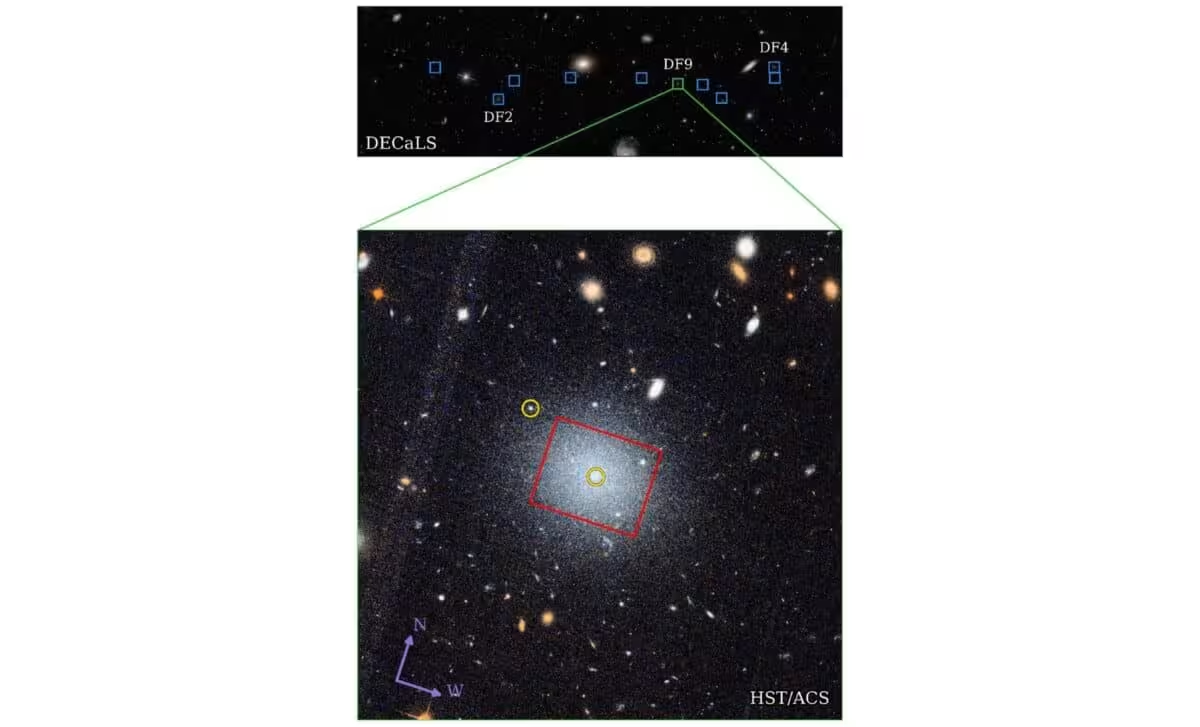
A faint galaxy called NGC 1052-DF9, located about 67 million light‑years from Earth, has been identified as part of a linear arrangement of dim galaxies that appear to lack the invisible mass usually required to hold them together. The finding challenges the prevailing view that dark matter is essential for galaxy formation.
Chain of Galaxies With Little Dark Matter
The anomaly was first spotted in 2018 when Yale astrophysicist Pieter van Dokkum and his team reported a dwarf galaxy named DF2 that seemed to contain far less dark matter than theoretical models predict. A follow‑up study a year later revealed a second object, DF4, with similar properties and situated in the same region of the sky.
Further analysis showed that DF2 and DF4 belong to a tightly knit filament of roughly a dozen ultra‑low‑luminosity galaxies surrounding the massive elliptical NGC 1052. In 2025, a study led by astrophysicist Michael Keim demonstrated that the members of this filament move in a coordinated fashion, hinting at a shared origin . The researchers identified DF9 as the next best candidate matching DF2 and DF4 in size, brightness, and globular‑cluster population, prompting targeted observations.
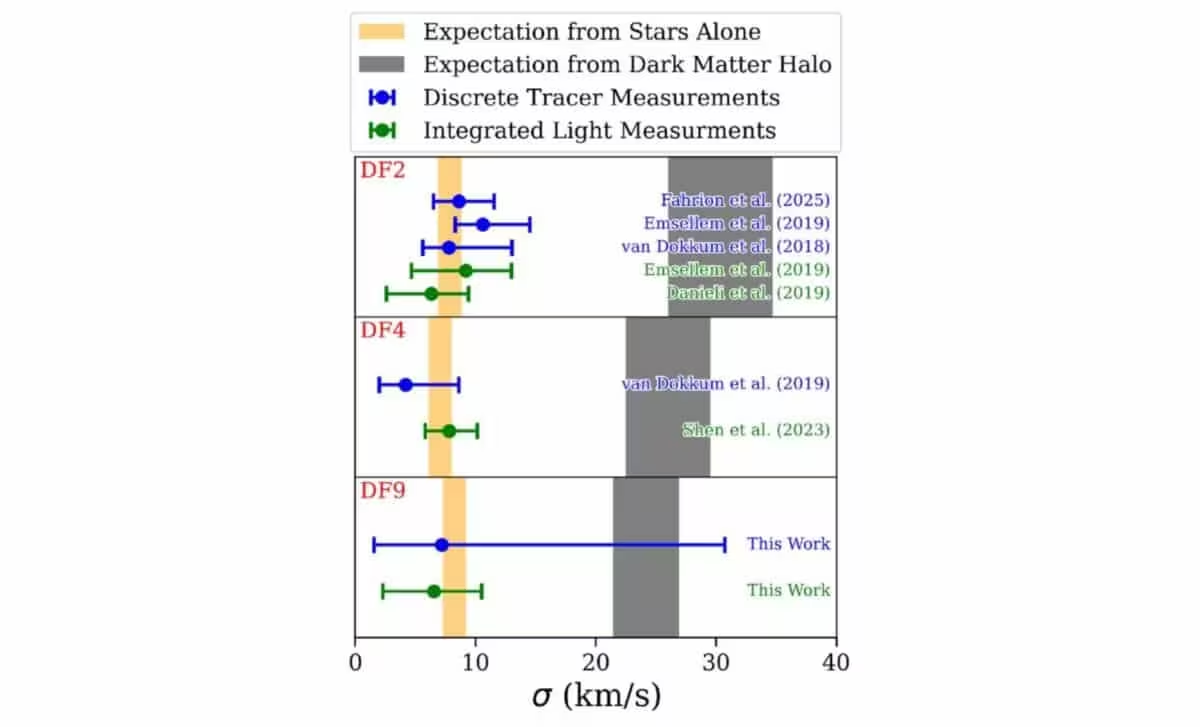
Using the Keck Cosmic Web Imager in Hawaii, the team measured how fast stars move inside DF9. This velocity‑dispersion technique estimates the total gravitational pull acting on the galaxy. The results, published in The Astrophysical Journal, showed a dispersion consistent with the mass of the visible stars alone, eliminating the need for a surrounding dark‑matter halo. If a typical halo were present, the stars would have displayed a much higher velocity spread.
Bullet‑Dwarf Collision as a Possible Explanation
The researchers propose that a rare, high‑speed collision between two dwarf galaxies—sometimes described as a “bullet dwarf” event—could account for the observed mass deficit. In such a head‑on encounter, the sparsely spaced stars would largely pass through each other unchanged, while dark matter, presumed to be collisionless, would also continue on its trajectory.
Unlike stars, the gas clouds in each dwarf would slam together, become trapped at the impact site, and later cool to form new, compact systems composed almost entirely of ordinary matter. Simulations suggest that these gas‑rich remnants could evolve into galaxies like DF9 that possess little or no dark matter.
Van Dokkum emphasized that the observations provide strong evidence that dark matter behaves as a tangible substance rather than an artifact of modified gravity theories—a debate that has persisted especially at dwarf‑galaxy scales. Moreover, DF9 marks the third confirmed member of a continuous chain lacking dark matter, extending the phenomenon beyond isolated cases.
The team plans to target the remaining, fainter members of the filament despite the challenges posed by their low brightness. Future observations will also search for residual gas at the inferred collision site, which could further substantiate the bullet‑dwarf scenario. For now, DF9 stands as a compelling example of a galaxy that appears to have formed almost entirely without the dark matter that dominates most cosmic structures.
This article has been fact checked for accuracy, with information verified against reputable sources. Learn more about us and our editorial process.
Last reviewed on .
Article history
- Latest version
Reference(s)
- “Pieter van Dokkum | Department of Physics.” <https://physics.yale.edu/people/pieter-van-dokkum>.
- Keim, Michael A.., et al. “A Third Galaxy Missing Dark Matter along a Trail of Galaxies in the NGC 1052 Field.” The Astrophysical Journal, vol. 1004, no. 2, June 16, 2026, pp. 210 American Astronomical Society, doi: 10.3847/1538-4357/ae6b8d. <https://iopscience.iop.org/article/10.3847/1538-4357/ae6b8d>.
Cite this page:
- Posted by Farah Siddiqui