Japan’s Luna Ring Plan: Building a 11,000‑km Solar Belt on the Moon to Beam Power to Earth
Japan aims to encircle the Moon’s equator with a massive solar power belt, a bold sci‑fi‑style plan to harvest lunar energy.
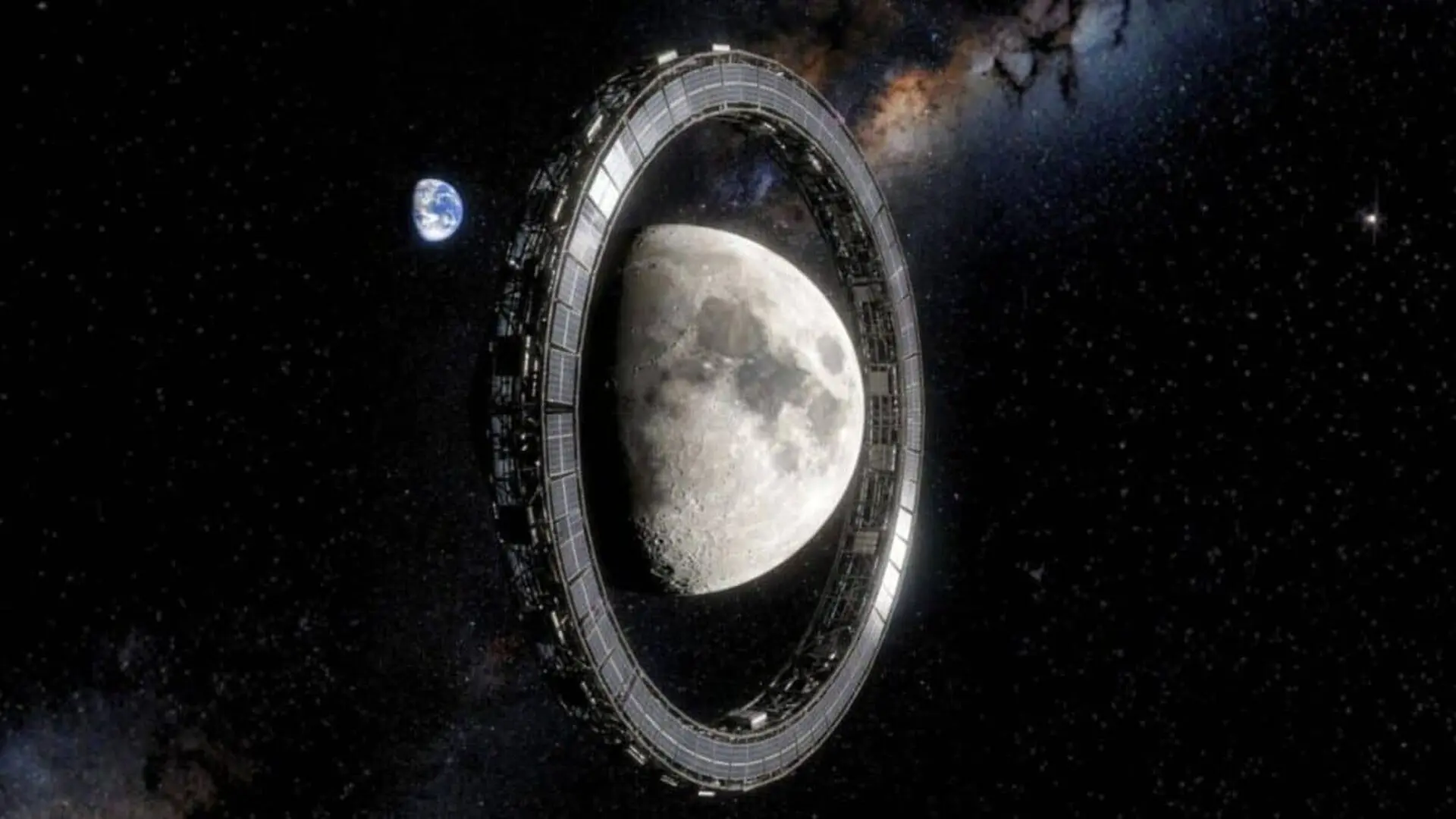
A proposed lunar solar array would encircle the Moon’s equator for roughly 11,000 kilometers (6,800 miles), expanding in certain sections to as much as 400 kilometers. Energy harvested by the panels would be beamed to Earth via microwave and laser transmitters.
Japanese engineering firm Shimizu Corporation has branded the vision as the Luna Ring. The plan envisions solar modules on the Moon, power‑distribution cables, transmission hubs, Earth‑based receiving stations, and autonomous construction robots.
Details of the Luna Ring proposal and its accompanying project brochure outline a phased development schedule that targets the commencement of construction in 2035. The concept was first disclosed by Tetsuji Yoshida, then president of Shimizu’s space‑consulting subsidiary CSP Japan, in a 2011 interview with ABC News.
A Continuous Solar Ribbon Around the Moon
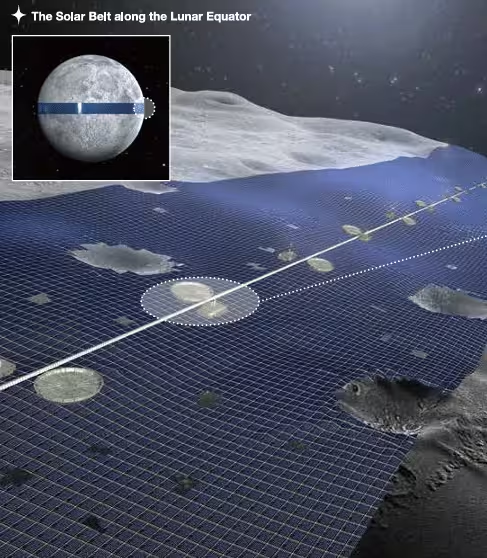
The design calls for solar panels to line the Moon’s equatorial ridge, forming a belt that varies from a few kilometers in width to a maximum of 400 kilometers. Power cables would run parallel to the panels, channeling electricity to transmission stations on the Moon’s near side—the hemisphere that constantly faces Earth.
From those stations, energy would be sent to the planet using two parallel methods. Microwave antennas, each about 20 kilometers in diameter, would direct beams toward Earth under the guidance of ground‑based beacons. A complementary laser system would rely on a separate Earth beacon to maintain precise alignment.
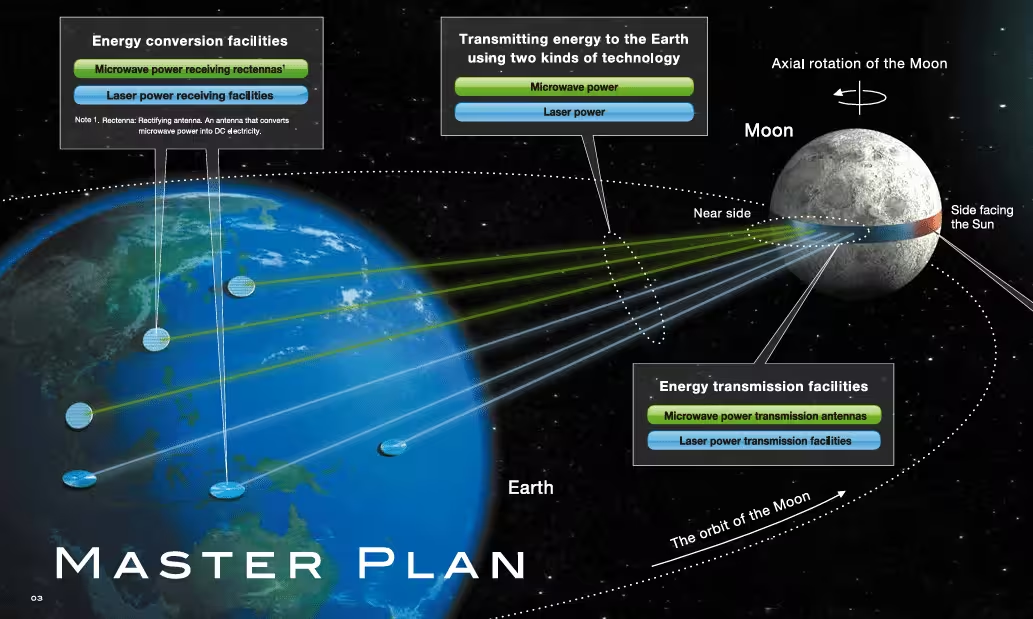
On Earth, rectennas would capture microwave energy and convert it to direct‑current electricity, while dedicated laser receivers would perform a similar conversion for the laser beams. Shimizu suggests the harvested power could be fed directly into national grids or used to generate hydrogen for storage and fuel.
Yoshida noted in 2011 that terrestrial photovoltaic farms produce roughly one‑twentieth the output of comparable space‑based systems, owing to constant illumination and the absence of atmospheric interference in orbit.
Robotic Builders and In‑Situ Resources
The proposal relies on extracting lunar regolith to fabricate ceramics, concrete, glass, solar cells, oxygen, and water. Imported hydrogen would support processes that convert lunar material into water.
Robots operating under Earth‑based control would conduct most of the construction work, from site preparation to excavation. A limited crew of astronauts would collaborate with the machines on the lunar surface.
Additional hardware would be launched from Earth, assembled in orbit, and then lowered onto the Moon. Shimizu envisions a transport corridor along the equator, with power cables buried beneath it. Self‑propelled manufacturing units would travel this route, producing solar panels from local resources and installing them autonomously.
According to the brochure, research and technology demonstrations were slated for the 2010s, with pilot projects on Earth and the Moon scheduled for the 2020s. Preparatory work for full‑scale construction was assigned to the 2030s, leading to the targeted 2035 start date.
Financial Uncertainty and Strategic Debate
In the 2011 ABC News interview, Yoshida acknowledged that no definitive cost estimate or detailed schedule had been finalized. He indicated that construction could proceed by 2035 if sufficient financing were secured.
Masanori Komori of Japan’s Institute of Energy Economics raised concerns about the economic viability of lunar solar generation, suggesting that Japan should prioritize more immediately realizable alternatives. “The problem with lunar solar energy is that it’s still in the research phase,” Komori told ABC News.
Interest in the Luna Ring surged after the March 11 2011 earthquake and tsunami, which forced the shutdown of several reactors at Fukushima Daiichi. At that time, Japan operated 54 nuclear plants supplying roughly 30 % of its electricity, many of which were offline for safety reasons. Yoshida reported that the lunar concept attracted heightened attention in the ensuing year.
The published design specifies an equatorial solar belt approximately 11,000 kilometers long, with widths ranging from a few kilometers up to 400 kilometers. Transmission would rely on 20‑kilometer‑diameter microwave antennas and a complementary laser system aimed at Earth‑based receiving stations.
This article has been fact checked for accuracy, with information verified against reputable sources. Learn more about us and our editorial process.
Last reviewed on .
Article history
- Latest version
Reference(s)
- “LUNA RING, Solar Power Generation on the Moon | Topics | Shimizu Corporation.” <https://www.shimz.co.jp/en/topics/dream/content02/>.
- “Lunaring E.” <https://www.shimz.co.jp/en/topics/dream/content02/pdf/lunaring_e.pdf>.
Cite this page:
- Posted by Karan Das