48-Jupiter-Mass Brown Dwarf Transits Brightest Massive Star Known to Host One
A 48‑Jupiter‑mass brown dwarf orbiting an old giant star challenges how astronomers define the line between massive planets and low‑mass stars.
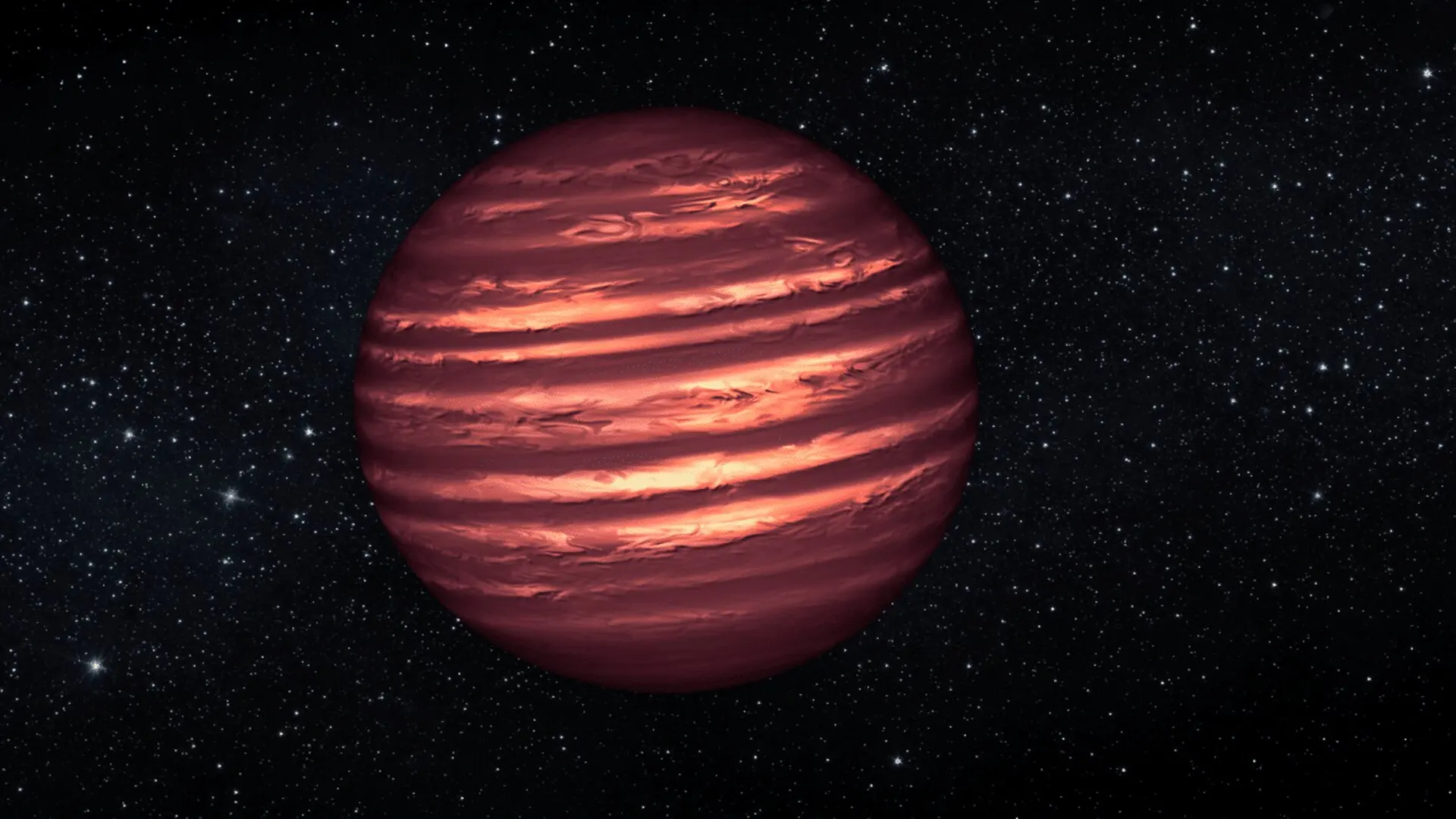
A team of astronomers has precisely measured a brown dwarf weighing roughly 48 times the mass of Jupiter as it eclipses a luminous, evolved star, offering a rare benchmark for testing competing ideas about how objects that sit between planets and stars are born. The companion, designated HIP 61637 b, was first flagged by NASA’s Transiting Exoplanet Survey Satellite (TESS) and later examined in a study posted on arXiv. Its well‑determined mass, orbital characteristics, stellar host, and age place it in a sparsely populated region of parameter space where formation models can be directly compared with observations.
A Brown Dwarf in the “Desert” of Close Orbits
Objects with masses between those of giant planets and the lightest stars occupy a gray zone in astrophysics: they are too massive to be called planets, yet they never sustain the core hydrogen fusion that defines true stars. HIP 61637 b falls squarely in this interval, but its mass alone does not reveal whether it formed like a star or like a planet. Adding to the intrigue, the companion resides in the so‑called brown‑dwarf desert—a pronounced shortage of brown dwarfs in tight orbits around stars—making each thoroughly characterized example especially valuable for probing formation and migration pathways.
The analysis was spearheaded by Nino Ephremidze of Harvard University, who combined TESS transit photometry with high‑resolution spectroscopy. TESS identifies periodic dips in stellar brightness when an orbiting body passes in front of its star, providing the orbital period and, when paired with stellar parameters, an estimate of the object’s size. Spectroscopic data capture the subtle wobble induced in the host star, enabling a direct measurement of the companion’s mass. Together, these techniques yielded an unusually precise portrait of HIP 61637 b for a system residing in the desert.
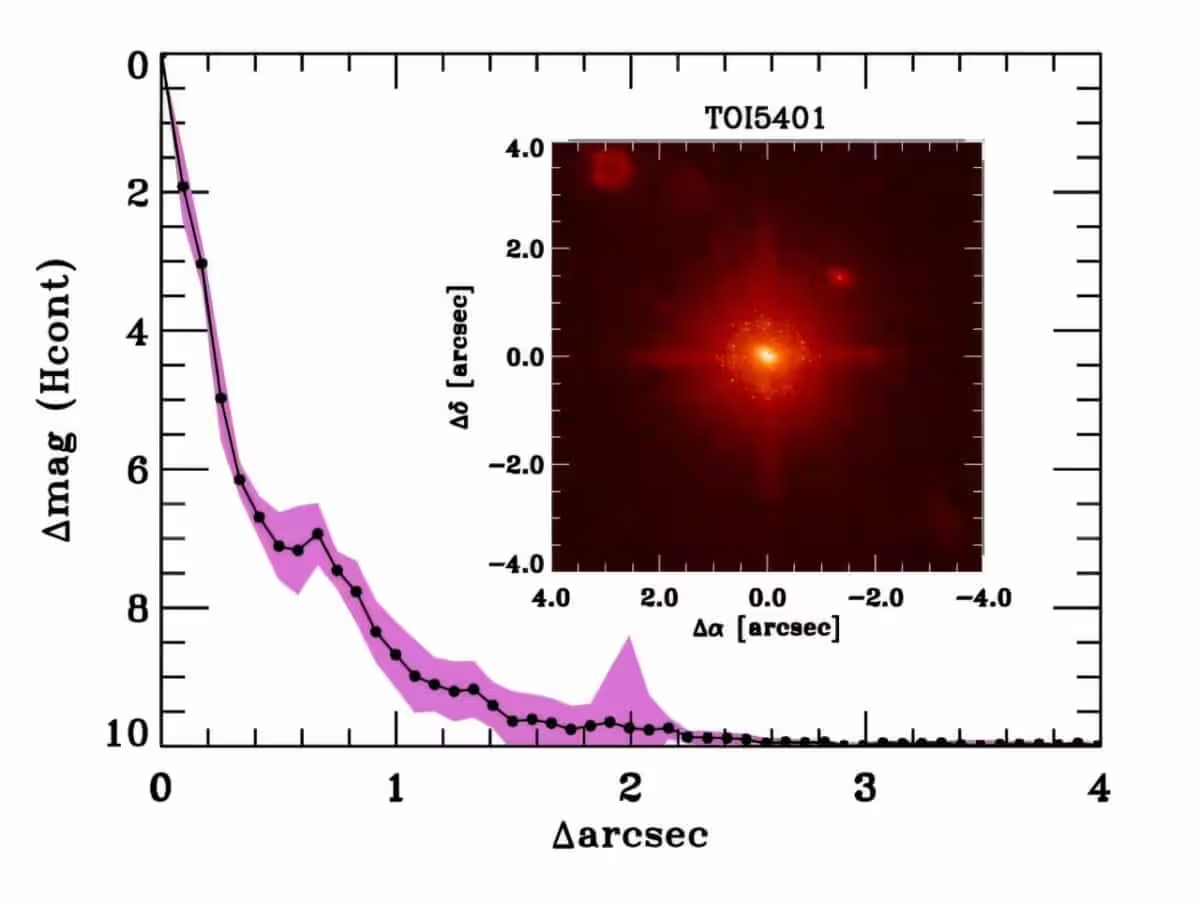
An Unusually Massive A‑Type Host Star
The brown dwarf orbits an aging A‑type star whose mass is close to three times that of the Sun, making it the most massive and luminous star known to host a transiting brown dwarf. A‑type stars consume their nuclear fuel at a rapid rate, so despite being much younger than our 4.6‑billion‑year‑old Sun, this star is already nearing the end of its hydrogen‑burning phase.
Because the star’s evolutionary stage can be tightly constrained, the researchers estimate the entire system’s age at roughly 396 million years. Establishing an independent age is critical for brown‑dwarf science, as these objects cool and contract over time, causing their observable radius and temperature to depend strongly on how long they have existed. With a reliable age, HIP 61637 b joins a short list—only the seventh—of brown dwarfs whose ages are known with confidence, providing a valuable calibration point for evolutionary models.
Competing Formation Scenarios Leave Distinct Traces
The central question surrounding HIP 61637 b is whether all brown dwarfs share a common origin. Traditional classifications rely on mass alone, yet nature may produce objects in this mass range through fundamentally different routes. One possibility mirrors star formation: a dense pocket of gas and dust collapses under gravity, creating an object that never gathers enough material to ignite sustained hydrogen fusion. A second route resembles planet formation, with the body growing inside the protoplanetary disk that encircles a young star.
These pathways can imprint different orbital characteristics. Objects formed by direct collapse often emerge on eccentric, elongated trajectories reflecting chaotic fragmentation dynamics. In contrast, disk‑grown companions typically settle into near‑circular, co‑planar orbits aligned with the surrounding disk. However, tidal interactions between a close‑in brown dwarf and its host star can gradually erase eccentricities, meaning a presently circular orbit does not unambiguously indicate a disk origin.
Size, Mass, and Formation Tension
When the measured radius, age, and host‑star properties of HIP 61637 b are combined, they hint that the companion may have accreted material within a circumstellar disk, a process more commonly associated with giant planets. If true, the system would exemplify how far planet‑like growth mechanisms can extend into the brown‑dwarf mass regime.
The companion’s heft—about 48 Jupiter masses—poses a significant challenge for standard disk‑accretion models, which typically struggle to assemble such massive bodies before the surrounding disk is depleted or disrupted. Conversely, a formation scenario based on gravitational collapse can more readily achieve high masses, but it must still reconcile the observed orbital and physical properties of the system.
Rather than delivering a decisive verdict, the study frames HIP 61637 b as a critical data point for probing the blurry boundary between star‑like and planet‑like formation channels. The paper, accessible via arXiv, calls for advanced modeling of massive circumstellar disks and the discovery of additional age‑constrained systems to determine whether disk processes can routinely spawn companions approaching 50 Jupiter masses.
This article has been fact checked for accuracy, with information verified against reputable sources. Learn more about us and our editorial process.
Last reviewed on .
Article history
- Latest version
Cite this page:
- Posted by Karan Das