Why Slow‑Spinning Worlds May Become Venus‑Like Infernos
Planetary rotation could explain why some worlds turn into extreme greenhouse planets while others stay habitable.
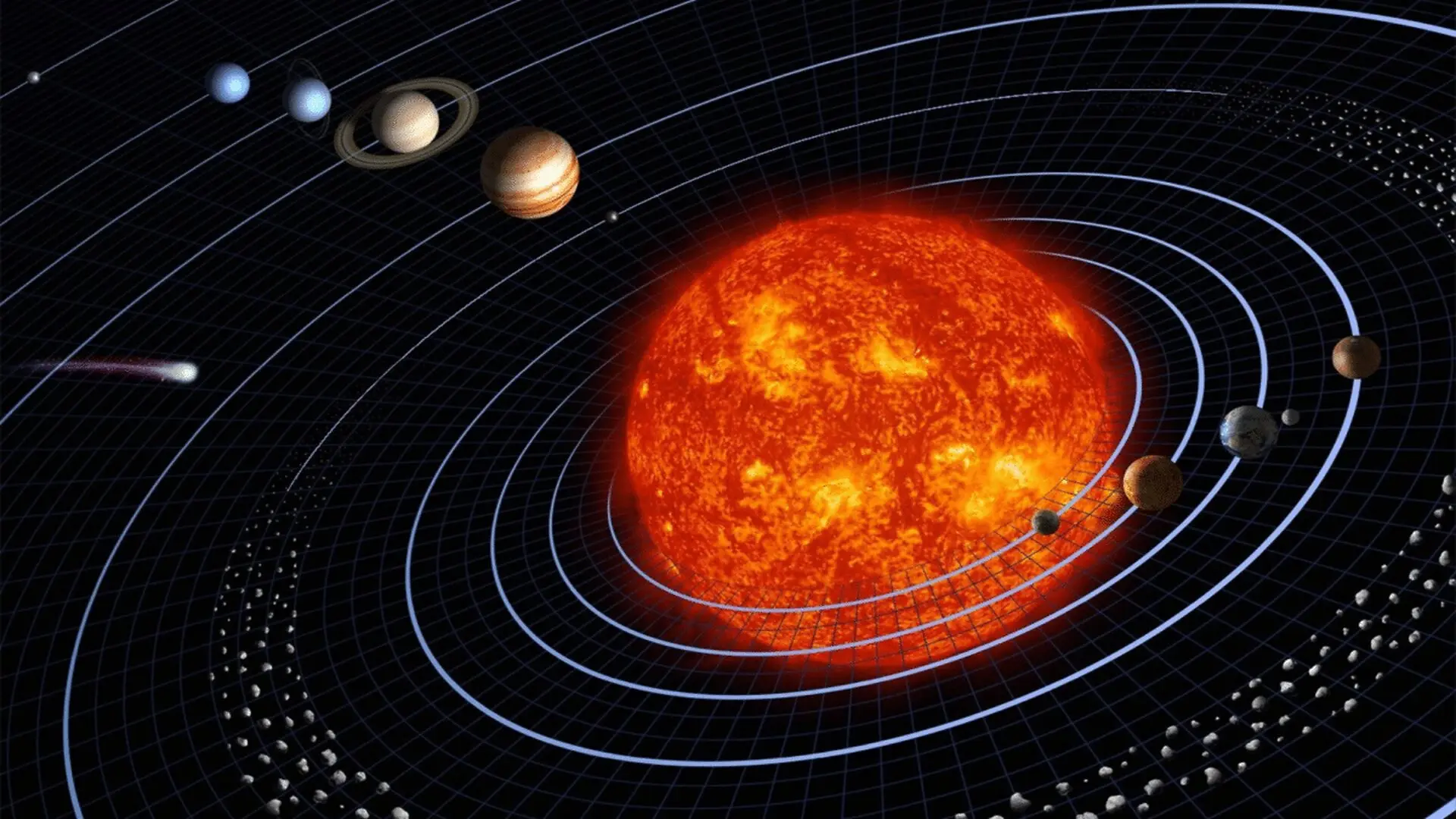
New research accepted by the Astronomical Journal highlights planetary rotation as a missing factor in the habitability equation, suggesting that a sluggish spin may predispose worlds to runaway greenhouse states akin to Venus.
How Spin Shapes Climate on Far‑Flung Planets
A planet’s rotation determines how stellar energy is redistributed across its atmosphere, influencing weather patterns, temperature gradients, and long‑term climate stability. Because distant worlds cannot be imaged directly, astronomers must infer rotational speed from subtle changes in atmospheric signals.
“People tend to overlook planetary rotation, but it is absolutely key to understanding a planet’s climate,” said Stephen Kane, a planetary astrophysicist at the University of California, Riverside.
Distinguishing the motion of a planet’s atmosphere from its true spin is notoriously difficult. On a world with ferocious winds, the apparent rotation derived from spectral shifts can differ dramatically from the solid body’s actual period.
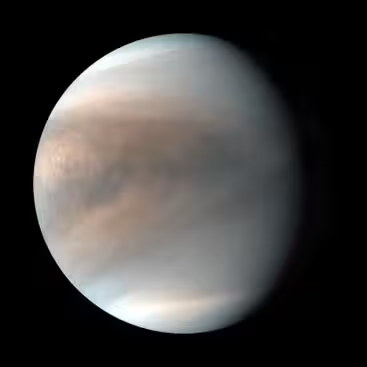
Venus provides a stark illustration: its surface rotates once every 243 Earth days, yet its upper atmosphere whirls around the planet in roughly four days.
“This is what people originally thought about Venus,” Kane said. “If you just look at the atmosphere of a planet like Venus, you’d think it rotates once every four days, and you’d be wrong by almost two orders of magnitude.”
The implication is clear: future exoplanet surveys must disentangle atmospheric dynamics from planetary spin before drawing conclusions about climate regimes. Misreading this signal could lead to flawed habitability assessments.
Venus’s Turbulent Atmosphere Warns of Misreading Exoplanet Data
Although Earth and Venus share comparable sizes and bulk compositions, their climates diverged dramatically, with Venus evolving a dense carbon‑dioxide envelope and surface temperatures capable of melting lead. Researchers suspect that rotation, by governing heat transport, played a pivotal role in this divergence.
Kane’s team recommends a multi‑wavelength strategy—particularly infrared observations—to probe different atmospheric layers. By mapping wind speeds at various altitudes, astronomers can infer the underlying rotation period more reliably.
Combining signals from multiple atmospheric depths, the study argues, will produce a cleaner picture of planetary motion and enable a systematic comparison of spin rates among worlds that exhibit extreme greenhouse effects.
A refined understanding of rotation could also help identify whether slow‑spinning planets consistently correlate with hostile climates, offering a new diagnostic for habitability surveys.
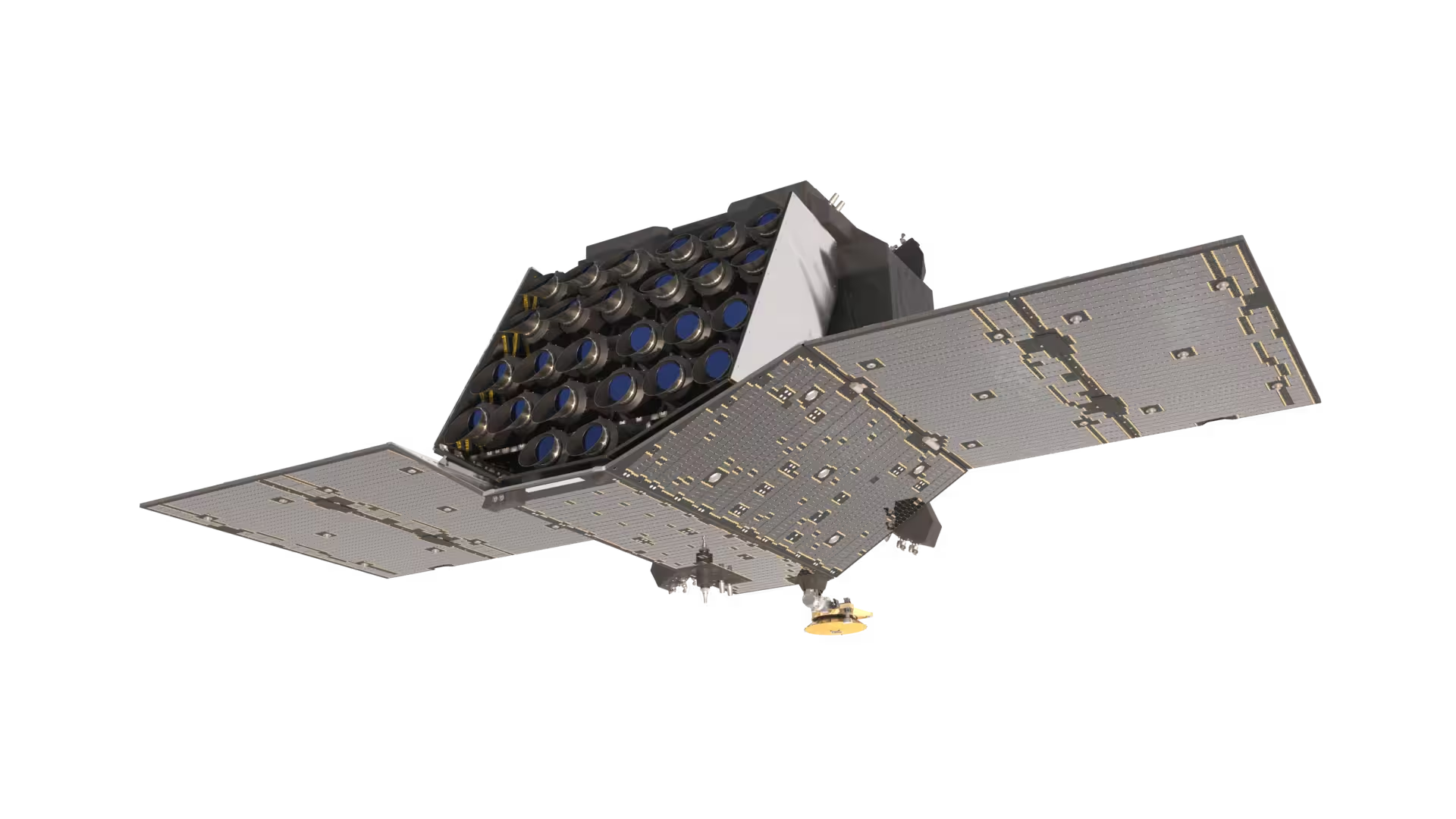
ESA’s PLATO Mission Aims to Unveil Hundreds of Venus Analogs
The European Space Agency’s upcoming PLATO spacecraft, slated for launch in March 2027, will monitor thousands of stars for transiting planets, emphasizing long‑term observations that can reveal rotation‑related signatures.
Scientists anticipate that PLATO will catalog a sizable population of Venus‑like exoplanets, providing the statistical sample needed to test whether slow rotation is a common trait among worlds that develop runaway greenhouse atmospheres.
“We’ve learned a lot about Venus itself, but there is still so much we don’t understand about its history,” said Emma Miles, co‑author of the Astronomical Society paper and a UCR doctoral student. “Exo‑Venus candidates, which are Venus‑like planets in other solar systems, are going to play a huge role in filling in that knowledge gap.”
Beyond planet detection, PLATO will also characterize host stars, delivering ages and activity levels that place each exoplanet within a broader evolutionary context.
Miles added that PLATO’s ability to pinpoint stellar ages will let researchers map where each exo‑Venus falls on its planet’s life‑track, sharpening the search for habitability thresholds.
Spin Rate May Hold the Key to Planetary Evolution
Comparing Earth’s rapid 24‑hour day with Venus’s languid rotation underscores how spin influences energy distribution, atmospheric circulation, and ultimately climate stability—factors that have allowed life to thrive on Earth for billions of years.
If surveys of dozens or hundreds of Venus analogs reveal a pattern of slow rotation, the community could link this trait to the emergence of extreme greenhouse conditions. Conversely, a wide spread of spin periods would prompt investigations into alternative drivers of atmospheric change.
Accurately measuring exoplanet spin could become a cornerstone of habitability assessments, enabling scientists to interpret atmospheric spectra with greater confidence and to identify worlds where life‑supporting climates might endure.
“Venus is a giant mystery,” Kane said. “To understand it, we need to see Venuses in other systems and see how they changed through time. Rotation is a huge piece of that puzzle, and we need to be careful that what we think we’re measuring is really the rotation of the planet.”
As next‑generation observatories expand the exoplanet inventory, planetary spin is poised to become a decisive metric for decoding the histories of distant worlds and for pinpointing the most promising candidates for life beyond Earth.
This article has been fact checked for accuracy, with information verified against reputable sources. Learn more about us and our editorial process.
Last reviewed on .
Article history
- Latest version
Reference(s)
- “Slow spin could explain why planets become hellish.” News <https://news.ucr.edu/articles/2026/08/10/slow-spin-could-explain-why-planets-become-hellish>.
Cite this page:
- Posted by Karan Das