Nickel Isotope Study Reveals Rare Origin of Dinosaur‑Killing Asteroid
Scientists have long known the size, speed and impact location of the dinosaur‑killing asteroid, but its exact composition remained a mystery.
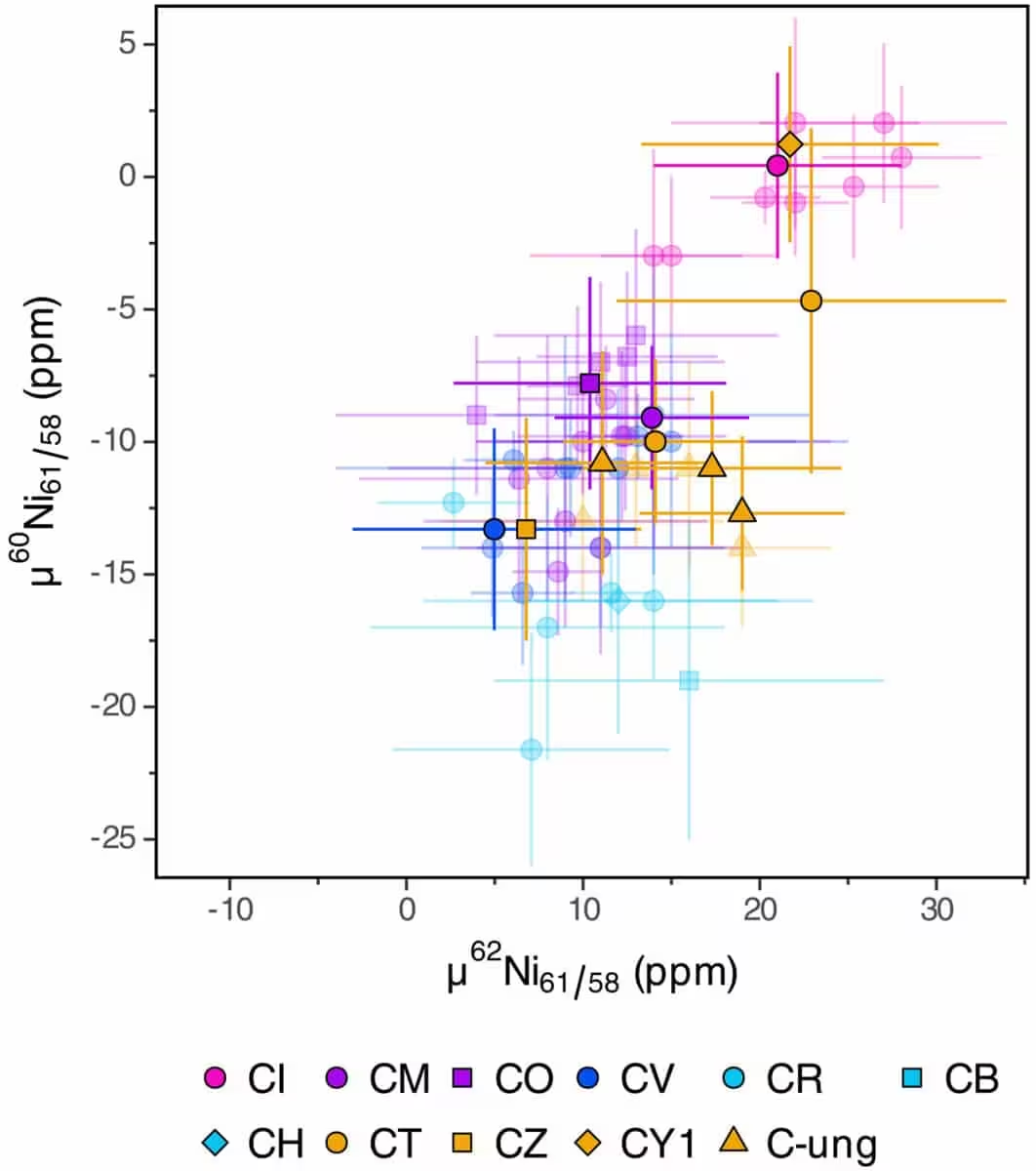
New isotopic analysis has revealed that the mass that created the Chicxulub crater belonged to an uncommon class of meteorites known as CO carbonaceous chondrites, indicating that the catastrophic impact that erased the non‑avian dinosaurs originated from a distinct corner of the solar system.
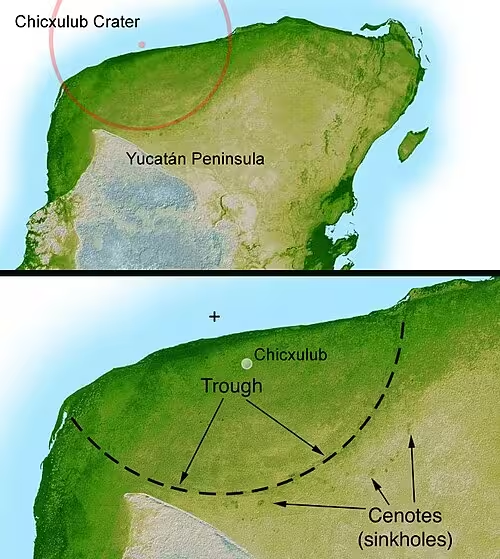
Researchers examined nickel‑isotope ratios trapped in the thin, globally distributed layer of impact debris that settled 66 million years ago after the asteroid slammed into what is now the Yucatán Peninsula. By comparing these signatures with a catalog of known meteorite families, they pinpointed the chemical fingerprint of the impactor.
Chicxulub Impactor Matches Rare CO Carbonaceous Chondrite Signature
The high‑precision measurements aligned most closely with the Ornans subgroup of carbonaceous chondrites, a category that makes up only a few percent of all meteorites recovered on Earth. Because CO chondrites are among the most primitive solar‑system materials, their identification reshapes our view of the object that triggered the mass extinction.
“These are definitely not like the typical meteors you find in museum collections,” said Professor Philippe Claeys, a researcher at Vrije Universiteit and the University of British Columbia.
According to Claeys, CO chondrites retain some of the earliest solar‑system material and are depleted in volatiles such as carbon, zinc, water and especially sulfur, compared with more common meteorite types.
Atmospheric Fallout, Not Sulfur, Drove Global Collapse
The findings, published in Science Advances, reinforce the link between the impact and the end‑Cretaceous ecosystem collapse while shifting focus away from sulfur released by the asteroid itself. Because CO chondrites contain relatively little sulfur, the element is now considered a secondary factor.
“It doesn’t alter our theory of what caused the extinction event, but it makes it less likely that sulfur contained in the impactor was the smoking gun,” Professor Claeys said.
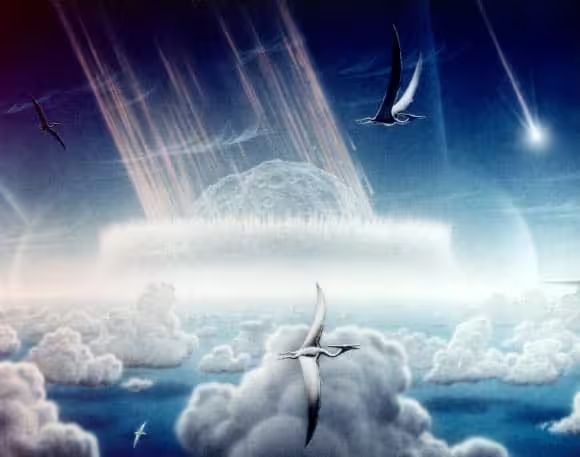
The researchers argue that the massive cloud of fine particles lofted into the atmosphere by the impact was the dominant driver of climate disruption. The kinetic energy of the collision vaporized almost the entire asteroid, leaving only trace amounts preserved in the global impact layer.
Possible Provenance of the Rare Projectile
While the meteorite class is now identified, the asteroid’s birthplace remains speculative. It could have originated from the distant, debris‑rich outskirts of the solar system or from the outer regions of the main asteroid belt near Jupiter.
The encounter represents an extraordinarily low‑probability event: a primitive body from a remote zone traversed the inner solar system and struck Earth, carving a crater that today lies beneath the Yucatán Peninsula. Professor Claeys added:
“Being impacted by such a rare, distant projectile really underscores how unlucky the dinosaurs were.”
This article has been fact checked for accuracy, with information verified against reputable sources. Learn more about us and our editorial process.
Last reviewed on .
Article history
- Latest version
Reference(s)
- “Philippe Claeys.” Vrije Universiteit Brussel <https://researchportal.vub.be/en/persons/philippe-claeys/>.
- Makhatadze, Georgy V.., et al. “The origin of Cretaceous-Palaeogene impactor revealed by nickel isotopes.” Science Advances, vol. 12, no. 29, July 17, 2026 American Association for the Advancement of Science (AAAS), doi: 10.1126/sciadv.aef4858. <https://www.science.org/doi/10.1126/sciadv.aef4858>.
Cite this page:
- Posted by Karan Das