Hidden JWST Galaxy Misidentified As Ancient Until Archive Reanalysis Reveals True Distance
A hidden galaxy uncovered in JWST data highlights both the telescope’s discovery power and the measurement challenges within its growing public archive.
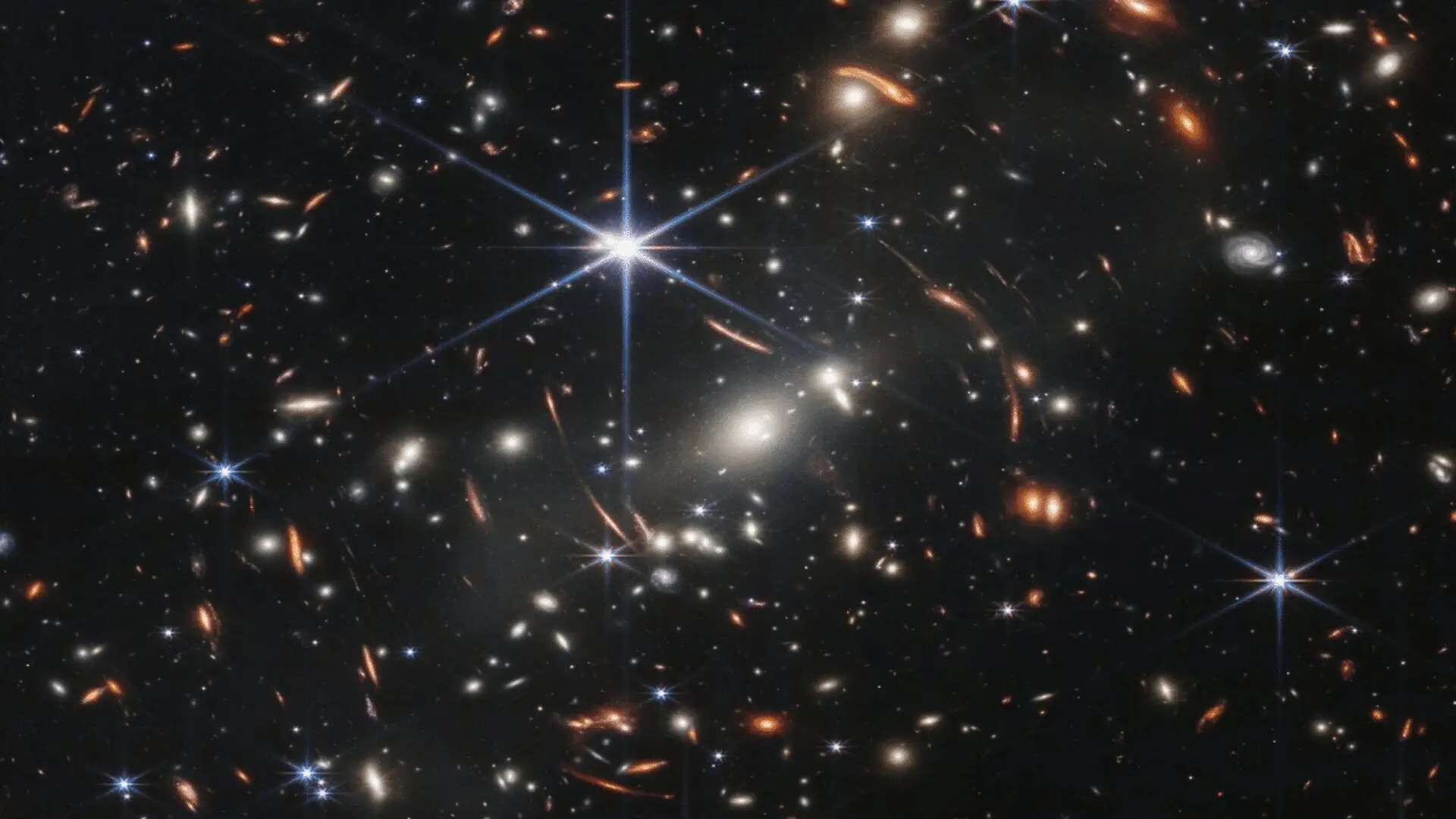
Analysis of public data from the James Webb Space Telescope has revealed a highly stretched galaxy whose light has been bent by a massive foreground cluster, underscoring how hidden gems can still be uncovered in already‑available observations.
New Gravitational Arc Identified in JWST Imaging
While reviewing images from the Near‑Infrared Camera (NIRCam) collected under General Observer program GO‑5293, astronomer Homer Dávila Gutierrez sifted through 54 public fields and more than 1,500 potential candidates before a striking elongated source, labeled A1, stood out.
The object’s morphology—a length‑to‑width ratio of about 6.5 and a tangential alignment relative to the cluster’s centre—matched the classic signature of a background galaxy whose light is being stretched by a massive lens.
“Second, its brightness: it is the brightest of the highly elongated sources at that radius, which made it measurable. And third, its absence from every catalog: it does not appear in the published strong‑lensing inventory of this cluster, nor in SIMBAD, NED, or VizieR.” That absence led him to check directly with the observing team. “When I contacted the GO‑5293 team, they confirmed it did not overlap with the systems they were analyzing. A real, bright, uncataloged arc‑like source in a massive Planck–selected cluster—that is what made it worth pursuing.”
Redshift Revision Alters the Object’s Cosmic Age
Initial photometric analysis using the EAZY code suggested a redshift near z ≈ 4.4, which would have placed A1 within the first 1.5 billion years after the Big Bang. However, the galaxy’s extended shape caused standard aperture photometry to miss a substantial fraction of its light, skewing the colour measurements that drive redshift estimates.
After re‑measuring the flux with apertures tailored to the object’s morphology, the inferred redshift dropped to approximately z ≈ 1.4, corresponding to a look‑back time of roughly 9 billion years.
“With the corrected photometry, A1 is a galaxy at z ≈ 1.4—we see it as it was roughly 9 billion years ago—lying behind the cluster MACS J0308.9+2645 (z = 0.356), one of the most massive clusters known. Its light passed close to the cluster on its way to us, and the working interpretation, shared by the program team’s lensing experts, is that it is a singly lensed image: stretched and modestly magnified by the cluster’s gravity, but not multiply imaged.”
The updated distance eliminates the possibility that A1 belongs to the universe’s earliest galaxy population, but it still serves as a valuable probe of the cluster’s mass distribution.
Cluster Mass Acts as a Natural Telescope
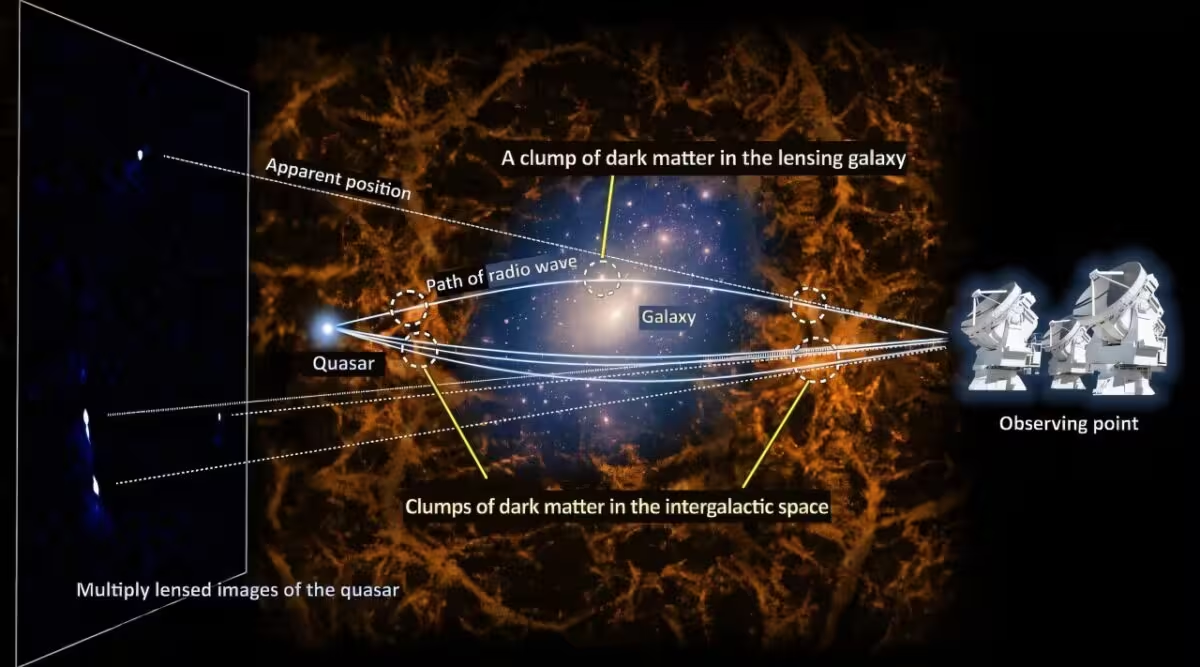
Einstein’s theory of general relativity predicts that massive structures warp spacetime, bending the trajectories of passing photons. Galaxy clusters, which combine dark matter, hot gas, and countless galaxies, generate some of the strongest gravitational lenses in the cosmos. When a distant galaxy aligns behind such a cluster, its image can be magnified, elongated, or split into multiple copies.
MACS J0308.9+2645, sitting at redshift z = 0.356, provides the requisite gravitational field. A1 lies about 51 arcseconds from the cluster’s X‑ray centre, and its tangential stretch matches expectations for a single, magnified image produced by the cluster’s potential.
“Its projected position, about 51 arcseconds from the cluster’s X‑ray center, and its tangential elongation are consistent with that picture. The definitive test—an updated lens model of the cluster built from the new JWST data—is in progress.”
A robust lens model will verify whether the observed geometry and inferred magnification align with the underlying mass distribution.
Fainter Companion Raises Additional Questions
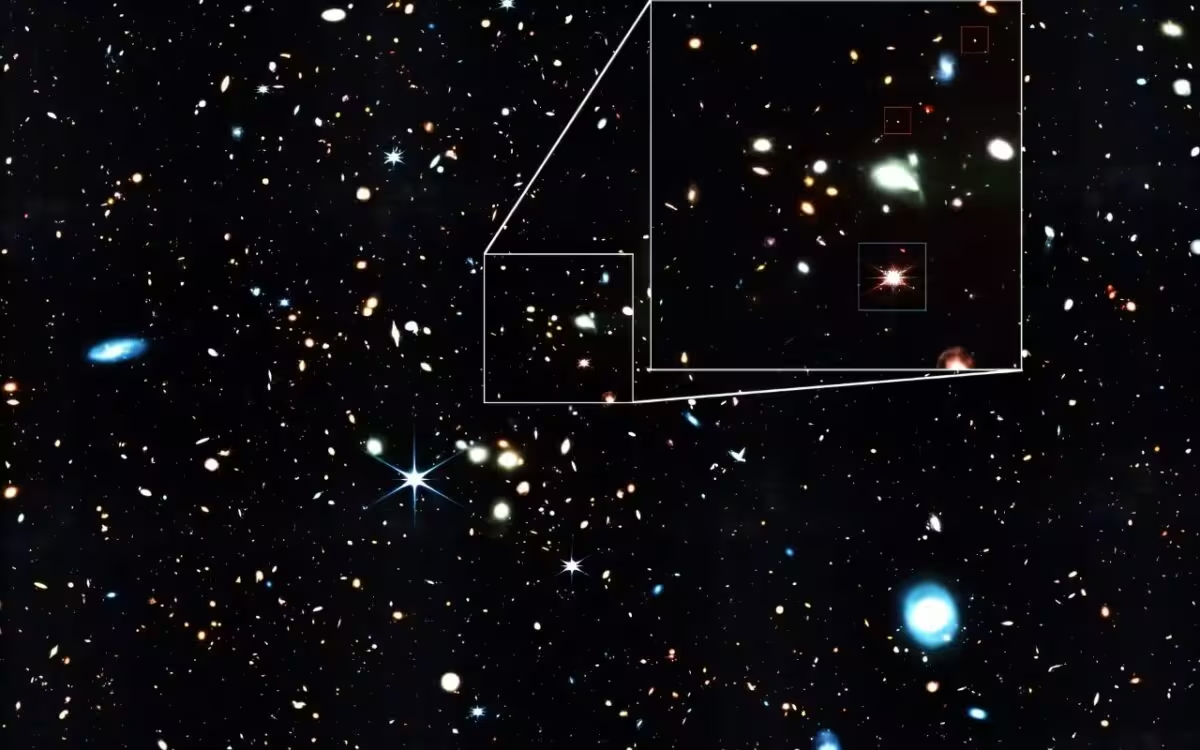
A second source, labeled A2, displays a similarly tangential alignment but is considerably dimmer and smaller than A1. Its faintness makes photometric measurements more vulnerable to the same aperture‑bias problem that affected A1’s initial redshift estimate.
Because automated catalogues often miss extended flux, colour‑based redshift techniques can yield misleading results for such objects. Gutierrez therefore refrains from assigning a definitive distance to A2 until a comparable re‑analysis of its photometry can be performed.
“And that matters: the photometric issue that affected A1’s original redshift estimate—catalog aperture magnitudes that capture only a small fraction of an extended source’s light—applies even more strongly to a faint source like A2. So I treat its nature and redshift as open questions pending the same corrected reanalysis I applied to A1,” Gutierrez said.
Until such analysis is completed, A2 remains a candidate lens rather than a confirmed background galaxy.
Public JWST Archive Enables Fresh Discoveries
Since its scientific operations began in 2022, JWST’s archive has amassed a growing collection of deep‑infrared observations. After proprietary periods end, these datasets become openly accessible, allowing researchers outside the original teams to search for phenomena unrelated to the initial proposals.
The detection of A1 illustrates how systematic re‑examination of archival images can uncover objects that escaped earlier catalogues, while also highlighting the need for careful photometric treatment before drawing astrophysical conclusions.
Future Lens Modeling to Confirm the Arc’s Nature
To solidify the interpretation of A1 as a singly lensed galaxy at z ≈ 1.4, a detailed reconstruction of MACS J0308.9+2645’s mass profile—including both visible matter and dark matter—is required. Matching the predicted lensing geometry with the observed arc will either confirm the current scenario or prompt further revision.
Gutierrez emphasises the collaborative nature of this effort: “The most rewarding part of this process has been exactly that: the GO‑5293 team responded generously, confirmed the object was uncataloged, and we are now working with their updated lens model to establish A1’s nature definitively. Independent researchers and program teams collaborating over public data—that is Webb’s archive working exactly as intended.”
This article has been fact checked for accuracy, with information verified against reputable sources. Learn more about us and our editorial process.
Last reviewed on .
Article history
- Latest version
Cite this page:
- Posted by Karan Das