How A 5‑Foot Meteor Unleashed A 300‑Ton TNT Sonic Boom
A rare daytime meteor burst over the northeastern US, creating a sonic boom and releasing energy comparable to hundreds of tons of TNT.
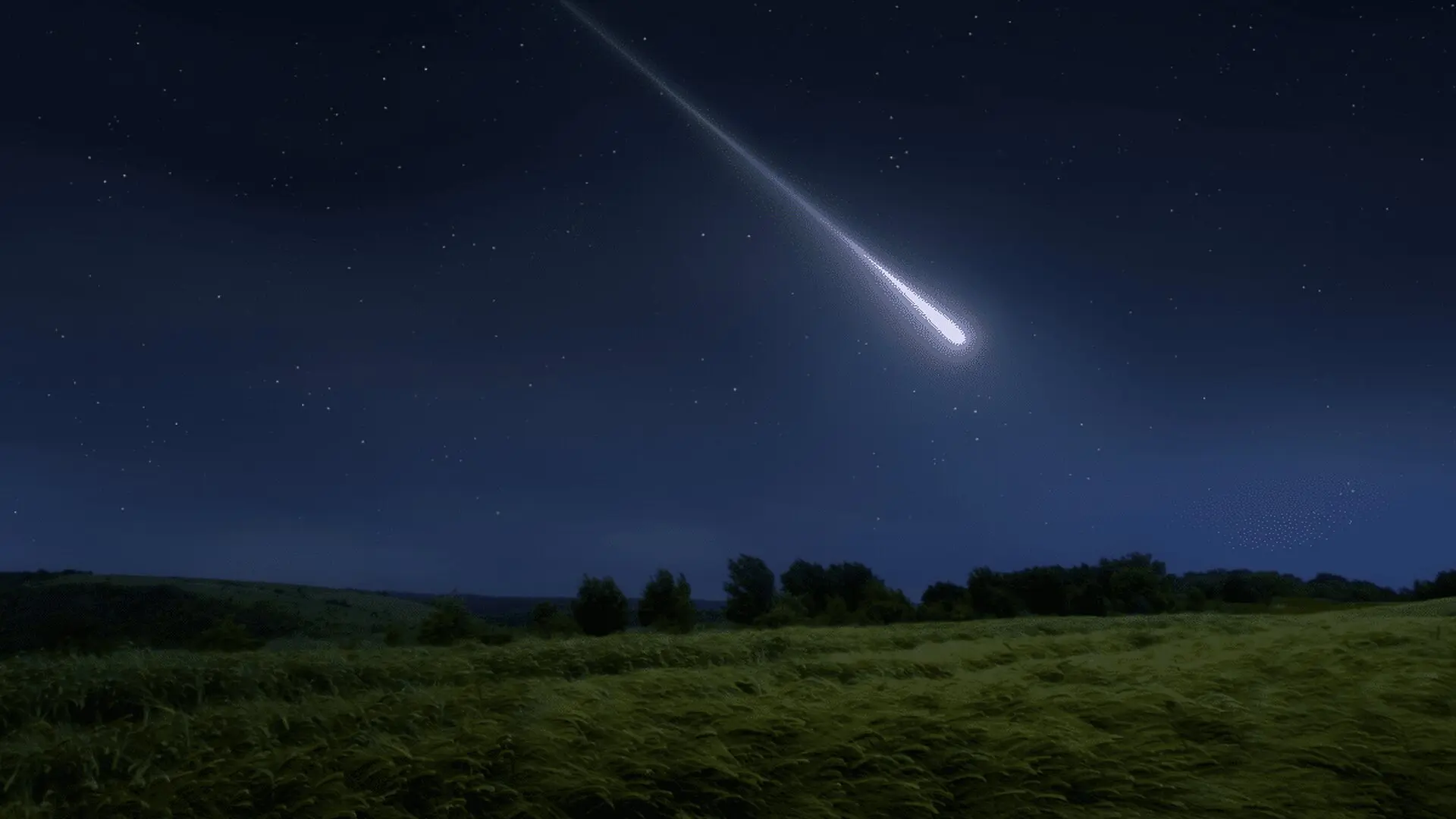
In late May a meteoroid only a few feet across detonated high above the northeastern United States, producing a startling sonic boom that rippled across several states. An analysis in The Conversation estimates that the burst released energy comparable to about 300 tons of TNT, underscoring how even modest space rocks can unleash tremendous power when they strike Earth’s atmosphere.
Why a Tiny Rock Yielded Such a Huge Explosion
The key factor is speed. NASA calculations show the object entered the atmosphere at roughly 42,000 miles per hour (68,000 kilometers per hour). At those velocities, even a rock only three to five feet wide carries an immense amount of kinetic energy.
As the meteoroid descended into denser layers of air, friction and rapid compression heated its surface to extreme temperatures. About 40 miles above the ground the combined pressure and heat caused the body to break apart, creating a bright fireball and releasing a concentrated burst of energy into the surrounding atmosphere.
UPDATE: @NASA can confirm a fireball over New England at 2:06 p.m. EDT on Saturday, May 30, 2026. The meteor was about 5 feet (1.6 meters) in diameter with a mass of 5.6 metric tons and entered Earth’s atmosphere at roughly 42,000 mph.
— NASA Space Alerts (@NASASpaceAlerts) June 1, 2026
The meteor traveled through the atmosphere… https://t.co/GLeF68Q7NG
The resulting shock wave outran the speed of sound, producing the booming sound heard by residents throughout the region. Most of the released energy was absorbed by the atmosphere, and the remaining fragments are believed to have fallen harmlessly into Cape Cod Bay, leaving no ground‑level damage.
How the Atmosphere Shields Our Planet
Every day the Earth’s gaseous envelope acts as a formidable barrier against space debris. Earth’s atmosphere incinerates countless particles that originate from the solar system’s formation, ensuring that most never reach the surface.
Even relatively large objects tend to disintegrate before they can cause serious harm. The May 2026 fireball illustrated this protective process perfectly: despite possessing enough energy for a blast equivalent to hundreds of tons of TNT, the meteoroid never survived to impact the ground.
Scientists often describe the atmosphere as the planet’s first line of defense against extraterrestrial material. Without this shield, meteoroid impacts would occur far more often and with far greater consequences. Instead, the atmosphere slows, heats, and ultimately destroys the overwhelming majority of incoming objects.
The spectacular fireballs that occasionally light up the night sky are essentially visual proof of this defense in action. What appears as a dramatic celestial display is frequently the atmosphere successfully averting a much larger threat.
A Busy Year for Meteors
The New England event was part of a series of notable fireballs recorded in 2026, according to The Conversation. Scientists and amateur observers have documented several striking encounters so far.
In March, a string of bright fireballs illuminated the skies over Northern Europe. Subsequent analysis linked recovered fragments to Vesta, one of the largest asteroids in the main belt, providing fresh material for study from a body that has changed little since the early Solar System.
A separate incident on March 17 saw a roughly six‑foot‑wide asteroid plunge into the atmosphere above Lake Erie. Traveling at about 45,000 miles per hour, it produced a daytime flash and released energy comparable to 250 tons of TNT. Rapid trajectory reconstruction allowed meteorite hunters to locate and collect fragments in Ohio shortly after the event.
Days later, a smaller body crossed Texas skies, delivering an explosion on the order of 26 tons of TNT. One piece even pierced a house roof, offering a rare reminder that fragments of the solar system can occasionally survive their fiery descent.
Chelyabinsk: The Modern Reference Point
While recent airbursts are impressive, they remain modest compared with the most famous recent impact: the Chelyabinsk meteor of February 15, 2013.
That event involved a body roughly 60 feet across and weighing an estimated 10,000 tons. It detonated about 18 miles above Russia, unleashing energy thought to be about 30 times the yield of the Hiroshima atomic bomb.
The resulting shock wave shattered windows across a vast region and injured nearly 1,500 people, mostly from flying glass. Seismic instruments even recorded the blast as a measurable tremor, highlighting both the protective role and the limits of Earth’s atmospheric shield.
Researchers frequently cite Chelyabinsk as a benchmark for planetary‑defense studies because it demonstrated that even when an object never reaches the surface, its atmospheric explosion can still produce significant effects.
Human Risk Remains Negligible
Despite eye‑catching headlines, the chance that a person is directly struck by a meteorite is vanishingly small. Statistically, such an occurrence ranks among the rarest possible events for any individual.
The most widely documented case occurred in 1954 when Ann Hodges of Alabama was hit after a meteorite crashed through her roof, bounced off a radio, and struck her. She sustained a bruise but escaped serious injury.
These incidents are exceedingly uncommon because Earth’s surface is largely uninhabited—covered by oceans, forests, deserts and remote regions—so most surviving meteorites land far from people.
For scientists, recovered meteorites are far more valuable than they are sensational. Each fragment offers a direct sample of material that predates Earth, providing clues about planetary formation and the early history of the Solar System that span more than 4.5 billion years.
This article has been fact checked for accuracy, with information verified against reputable sources. Learn more about us and our editorial process.
Last reviewed on .
Article history
- Latest version
Reference(s)
- “https://twitter.com/NASASpaceAlerts/status/2060854183155106193.” <https://t.co/GLeF68Q7NG>.
- Laatsch, Shawn. “Sonic booms from meteors can release the energy of hundreds of tons of TNT – here’s how they work.”, June 15, 2026 The Conversation, doi: 10.64628/AAI.aqrgdjcxk. <https://theconversation.com/sonic-booms-from-meteors-can-release-the-energy-of-hundreds-of-tons-of-tnt-heres-how-they-work-284923>.
Cite this page:
- Posted by Karan Das