Could Cosmic Acceleration Be an Illusion New Study Links Dark Energy Debate to Local Bulk Flow
Study links the Universe’s apparent acceleration to vast cosmic motion, challenging the idea of a universal dark energy effect.
A recent study published in the Monthly Notices of the Royal Astronomical Society challenges the notion that cosmic acceleration is a uniform property of the Universe. By re‑examining the influence of our local cosmic environment, the researchers propose that the apparent speeding up of expansion could be partially shaped by the motion of nearby structures.
For over twenty years, observations of distant Type Ia supernovae have underpinned the idea of an accelerating Universe, a phenomenon usually linked to dark energy. The new analysis asks whether the signal attributed to acceleration might instead reflect our position inside a large‑scale flow of matter.
Reassessing Supernova Distances in Light of Cosmic Flows
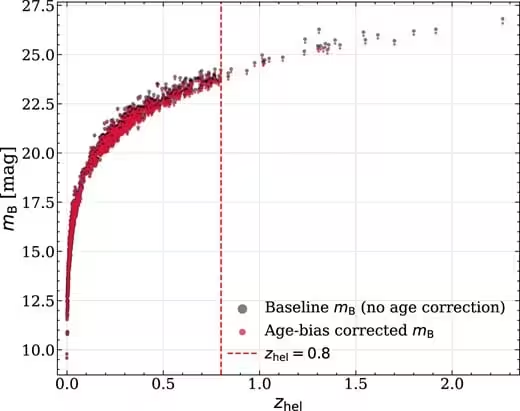
Type Ia supernovae serve as standard candles because their intrinsic brightness follows a well‑defined pattern, allowing astronomers to trace the history of cosmic expansion. The authors revisited the supernova catalogues, probing whether the distribution and motion of nearby galaxies introduce a directional bias in distance estimates.
Their work considers the possibility that Earth resides within a bulk flow, which could tilt the observed expansion signal toward certain regions of the sky.
“It has been suggested that the cosmic acceleration inferred from Type Ia supernovae could be illusory, due to our being ’tilted’ observers embedded in a bulk [cosmic] flow,” Sarkar wrote in a study recently published in Monthly Notices of the Royal Astronomical Society. “The inferred acceleration should then be directed mainly along the local bulk flow,” and die out at a certain distance.
If local motions exert a stronger effect than previously assumed, the foundational principle of cosmology—that the Universe appears statistically uniform on the largest scales—may need revision. Refining techniques to separate nearby flow effects from the true expansion of space could become a priority.
The study contributes to an ongoing debate about whether current cosmological models fully capture the nuances revealed by modern data sets.
Dark Energy Under Scrutiny
Accelerated expansion has long been attributed to dark energy, an unseen component thought to dominate the Universe’s energy budget. While dark energy remains the prevailing explanation, the new analysis highlights that additional, locally driven factors might be influencing the observational evidence.
The authors do not claim that dark energy is absent; rather, they emphasize that the data supporting acceleration could be contaminated by effects linked to the surrounding cosmic web.
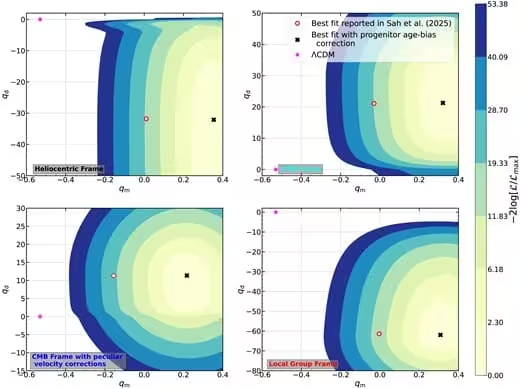
A key part of the investigation examined whether variations in the ages of progenitor stars could affect the supernova brightness trend. Even after adjusting for these age‑related differences, the directional signal persisted.
“It is notable that correcting for [progenitor age] leaves [the local dipole] unchanged within uncertainties,” the authors wrote. “There is thus no evidence for isotropic accelerated expansion of the Universe.”
The persistence of this anisotropic pattern suggests that larger supernova samples and more precise distance measurements will be essential to untangle the contributions of local cosmic flows from any genuine universal acceleration.
This article has been fact checked for accuracy, with information verified against reputable sources. Learn more about us and our editorial process.
Last reviewed on .
Article history
- Latest version
Cite this page:
- Posted by Zara Tariq