New Mathematical Trick Simplifies Quantum Wave Equations
A novel first-order reformulation of a foundational physics equation allows researchers to simulate complex quantum waves and shock phenomena with unprecedented geometric flexibility.
A team of applied mathematicians has figured out how to rewrite a notorious quantum wave equation into a simpler first-order format, paving the way for easier computer simulations of everything from water ripples to laser beams. The nonlinear Schrödinger equation, which is a foundational formula used to model wave behavior in fiber optics and superfluids, has long frustrated researchers because its high-order terms create severe computational bottlenecks on complex grids.
To overcome this hurdle, researchers Carlos Muñoz-Moncayo, Abhijit Biswas, David I. Ketcheson, and Manvendra Rajvanshi developed a multidimensional hyperbolic approximation of the equation, available on the arXiv preprint server. By adding a small relaxation parameter to smooth out the mathematical stiffness, the authors transformed the traditional system into a set of first-order wave equations that computers can solve much faster and with greater geometric flexibility.
How Transforming Wave Equations Unlocks Hidden Stability Rules
At the heart of the new approach is a technique called hyperbolization, which turns complex higher-order derivatives into a system resembling standard fluid acoustics. The authors proved that this modified system strictly conserves analogues of mass, momentum, and energy just like the original nonlinear Schrödinger equation. However, the introduction of the relaxation parameter brings subtle changes to how waves behave under pressure.
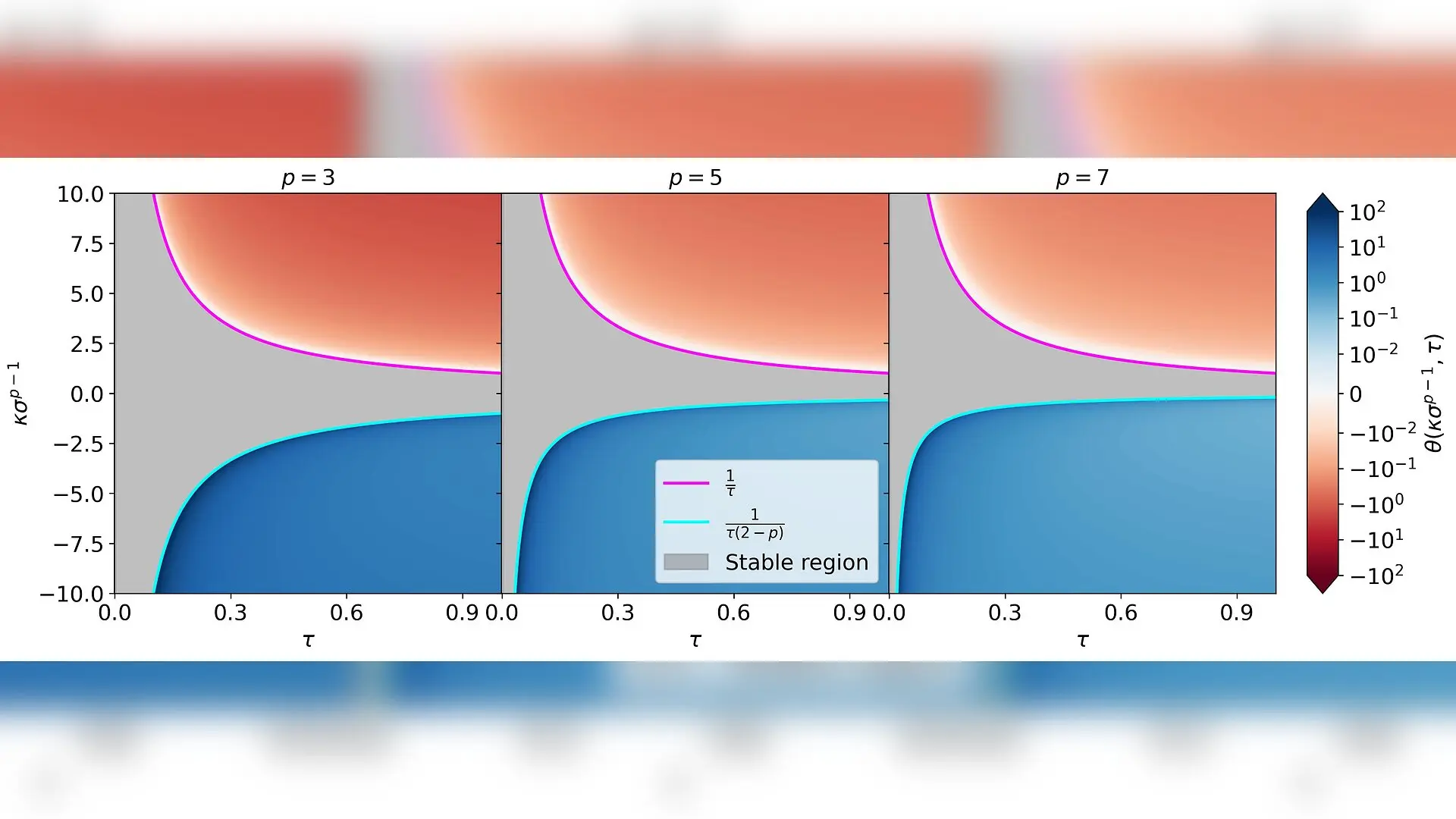
Through a rigorous stability analysis, the team discovered that the approximation acts on wave instabilities in two distinct ways. For low-frequency waves, the transformation shrinks the focusing instability band, eventually matching classical behavior as the relaxation parameter approaches zero. Unexpectedly, the model also introduces a brand-new high-frequency instability band that has no counterpart in the traditional equation. The authors showed that this secondary instability can be completely suppressed as long as the relaxation parameter stays below a specific threshold dictated by the strength of the system nonlinearity.
Testing Complex Quantum Fluids and Shock Waves on Grids
To demonstrate the practical power of their framework, the researchers implemented an explicit finite volume solver capable of handling adaptive mesh refinement and complex boundaries. This allowed them to simulate challenging physical scenarios that usually break standard spectral solvers, which require uniform grids and periodic boundaries.
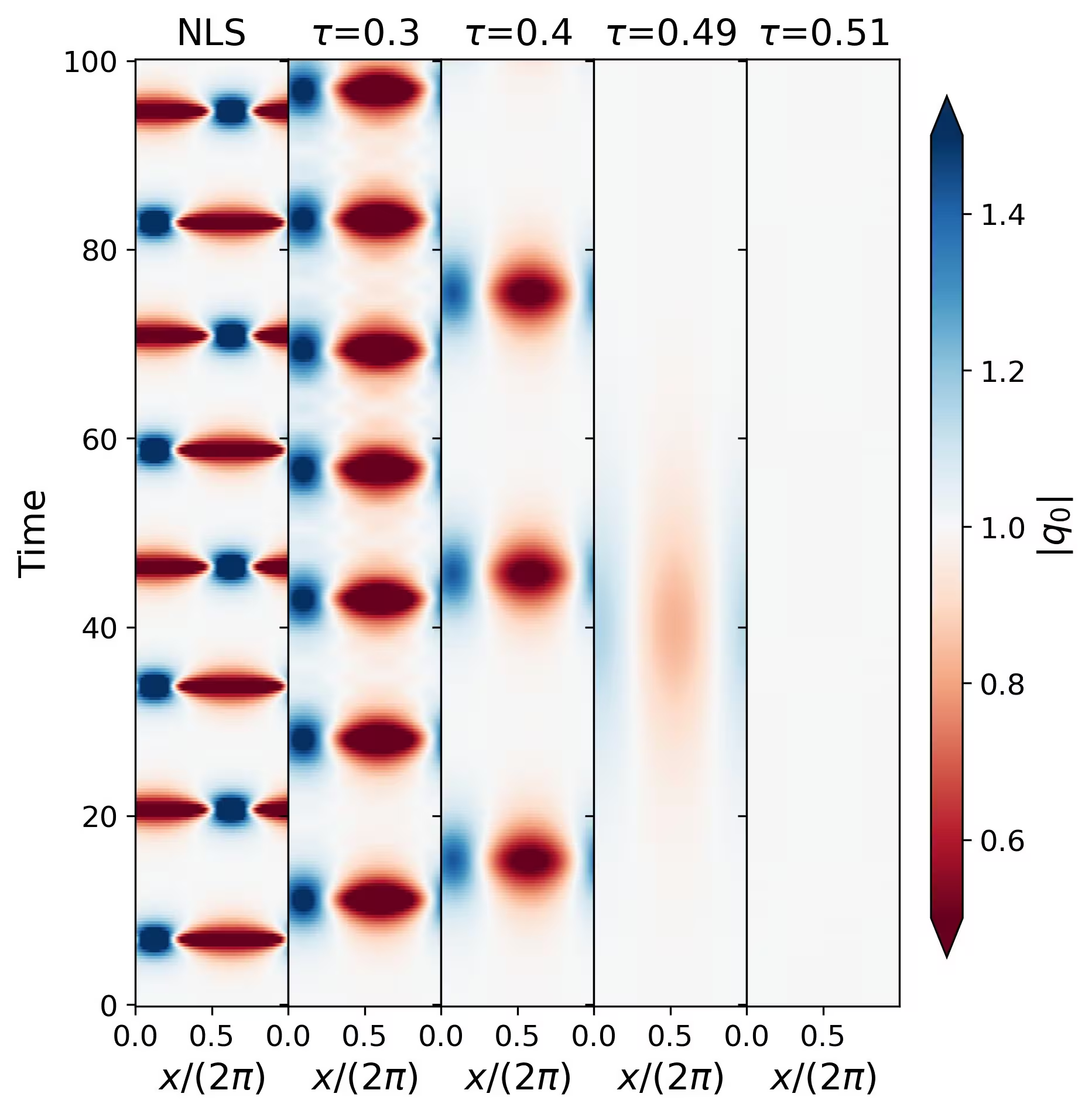
The numerical experiments successfully captured intricate phenomena such as gray soliton reflections off slanted walls, transverse instabilities causing bright solitons to break into filaments, and radially expanding dispersive shock waves. Furthermore, the team simulated superfluid flow past an impenetrable cylinder, observing realistic vortex shedding in the wake of the obstacle when using appropriate boundary conditions. These tests confirmed that the hyperbolic approximation maintains high fidelity to the original physics while offering a robust toolkit for studying sharp gradients in arbitrary spatial dimensions.
The study was posted to the arXiv preprint server on November 2, 2026.
This article has been fact checked for accuracy, with information verified against reputable sources. Learn more about us and our editorial process.
Last reviewed on .
Article history
- Latest version
Reference(s)
- Muñoz-Moncayo, Carlos. “A hyperbolic nonlinear Schrödinger system in multiple spatial dimensions: structure, convergence, and numerical discretization.” arXiv.org <http://arxiv.org/abs/2611.03642v1>.
Cite this page:
- Posted by Rabia Shah