China Revives Cold War Orbital Missile Threat, US Generals Sound Alarm
China’s alleged orbital weapon test reignites Cold War fears, revealing a U.S. missile‑defense shortfall that may prove hard to fix before rollout.
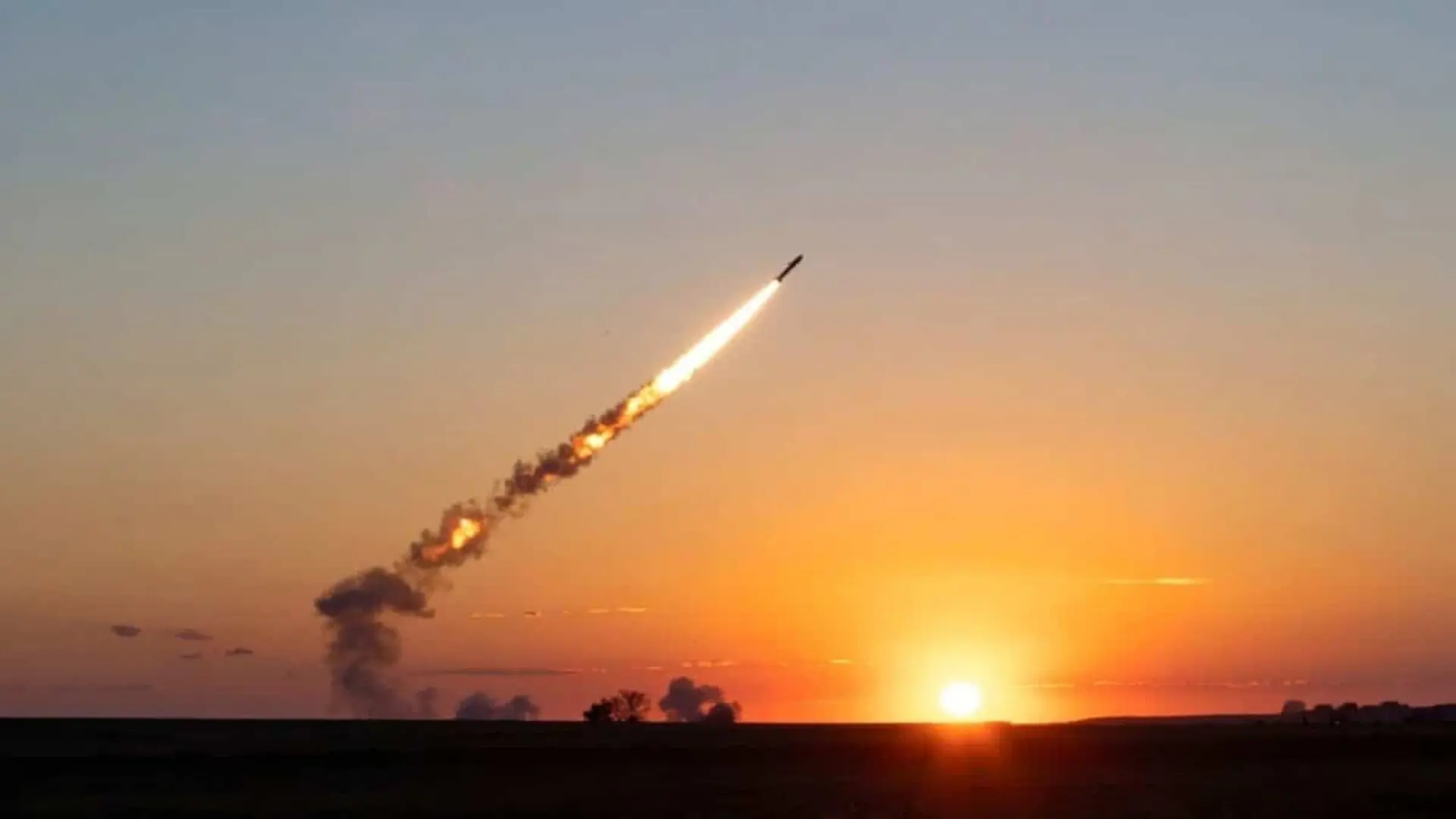
In August 2021, a Chinese flight test is reported to have placed a nuclear‑capable hypersonic glide vehicle into low‑Earth orbit before the vehicle re‑entered the atmosphere on a trajectory toward its intended target, echoing a Cold‑War weapons concept originally fielded by the Soviet Union.
According to the Congressional Research Service, the launch vehicle was a Long March rocket configured as a fractional orbital bombardment system (FOBS). Unlike a traditional ballistic missile, a FOBS places its payload on a partial orbit and then steers it back to Earth, a flight profile that could grant China a global strike option while compressing the warning interval before impact.
Beijing denied that the event involved a weapon system. A spokesperson for the Chinese Foreign Ministry described the August launch as a spacecraft mission rather than a missile test, as noted in a 2022 Association of the United States Army paper. The same study indicated that U.S. officials did not accept the denial and that the glide vehicle missed its intended impact point by roughly two dozen miles.
Merging Fractional Orbit and Hypersonic Glide Technology
A FOBS is engineered to travel only a segment of a full orbital path before descending back toward the planet. An analysis by Space Review describes a typical trajectory as reaching an altitude of about 100 miles (160 km) before exiting orbit prior to completing a revolution. By contrast, a conventional intercontinental ballistic missile follows a higher, more predictable arc before its warhead re‑enters.

A hypersonic glide vehicle adds another layer of complexity. CRS defines hypersonic weapons as maneuverable systems that travel at speeds of at least five times the speed of sound. While launched by a rocket, a glide vehicle can alter its course during descent, making detection more difficult and shortening the window for interception.
The combination does not render a strike invisible, and analysts differ on its strategic impact. CRS notes that some experts view the compressed decision timeline and uncertain flight path as potential triggers for miscalculation or escalation, while others argue that existing intercontinental missiles already give China and Russia the ability to reach the United States, and that hypersonic glide vehicles do not fundamentally shift the balance of power.
Soviet Fractional‑Orbit Weapon Designed to Exploit Radar Gaps
The Soviet Union began work on fractional‑orbit weapons in 1962 to take advantage of the geographic limitations of early American missile‑warning radars, which were oriented toward detecting attacks arriving over the polar region.
A FOBS warhead could instead approach the United States from the Southern Hemisphere, bypassing the coverage zones of the first generation of U.S. early‑warning systems, according to the Air Power Australia history of the Soviet program.
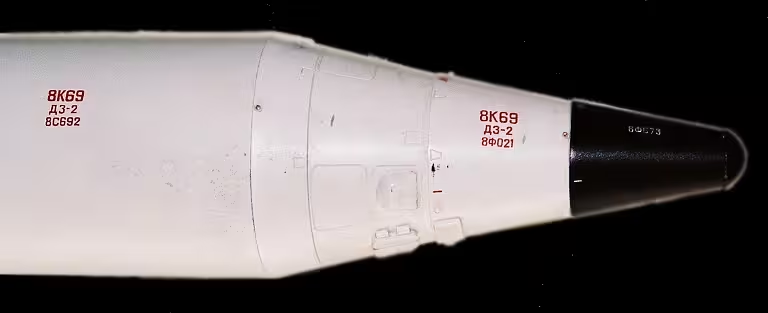
The Soviet design that entered service was the R‑36‑O (also known as 8K69 or SS‑9). Its flight sequence included boost, orbital, braking and re‑entry phases, with a de‑orbit engine slowing the payload and directing it back into the atmosphere.
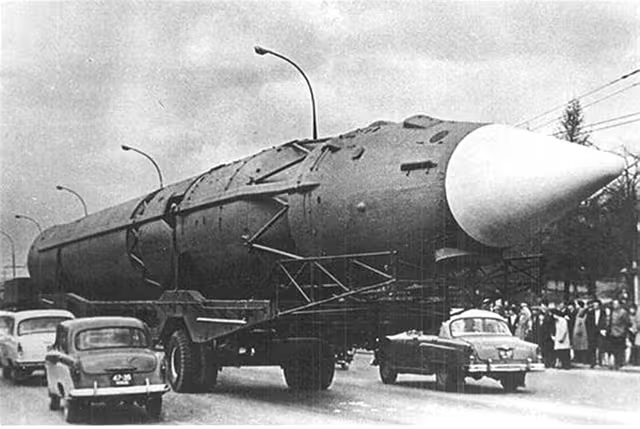
The R‑36‑O became operational on 19 November 1968, with eighteen silos at Baikonur eventually equipped with the system. It remained active until 1 January 1983, when it was retired under the SALT II agreement.
By the early 1980s, the system’s strategic advantage had eroded. Satellite‑based early‑warning sensors could detect launch signatures, and expanded radar networks reduced the likelihood that a fractional‑orbit strike could arrive without notice. Although the weapon retained long‑range capability, the element of surprise that originally justified its development had largely vanished.
Space‑Law Treaties and the Ambiguity of Orbital Nuclear Weapons
Two Cold‑War treaties address activities relevant to weapons in orbit, but they focus on different aspects of space conduct.
The Limited Test Ban Treaty, signed by the United States, United Kingdom and Soviet Union on 5 August 1963, prohibited nuclear explosions in the atmosphere, underwater and in outer space. The treaty entered into force on 10 October 1963, as documented by the National Archives.
Soviet FOBS tests quickly forced U.S. officials to grapple with how the treaty language applied to a system that entered orbit but returned before completing a full revolution.
In 1967, Defense Secretary Robert McNamara concluded that the Soviet tests did not breach the Outer Space Treaty. His assessment rested on the lack of evidence that the test vehicles carried nuclear warheads and his interpretation that the treaty was intended to prevent the permanent stationing of nuclear weapons in orbit, not to forbid testing delivery systems capable of carrying them.
Within the Johnson administration, Edward Welsh, executive secretary of the National Aeronautics and Space Council, argued that an object that reaches orbital altitude and speed qualifies as an orbital object regardless of whether it completes a full orbit, and that an early de‑orbit does not alter its status. Nonetheless, McNamara’s view prevailed as official U.S. policy.
The debate remains pertinent to contemporary discussions of FOBS. The AUSA paper cited earlier determined that a fractional‑orbit test like the one alleged for China does not violate the Outer Space Treaty, yet the potential nuclear role of the vehicle continues to raise questions about its payload and intended deployment.
“Golden Dome” Concept and the Challenge of Detection
U.S. planners envision a response that goes beyond kinetic interceptors. The proposed “Golden Dome” missile‑defense architecture emphasizes a network of sensors, early‑warning systems, command and control links, and the ability to track weapons arriving via unconventional trajectories.
During an October 2025 discussion hosted by the Mitchell Institute for Aerospace Studies, retired Air Force General Kevin “Chili” Chilton warned that the United States must be capable of detecting when a FOBS vehicle enters orbit, following its path, and providing sufficient warning to national leaders and defensive forces. He described the concept as “a very dangerous weapon and very dangerous approach,” while acknowledging that mitigations are possible.
The same forum cautioned against treating Golden Dome as an all‑encompassing shield. Heather “Lucky” Penney of the Mitchell Institute noted that a system capable of instantly destroying every object that enters U.S. airspace is neither technically achievable nor financially sustainable. Retired General Glen Van Herck added that integration of space‑based and ground‑based sensors through a unified data network would be essential, with defensive assets positioned to protect critical infrastructure rather than blanket the entire nation.
A separate analysis from the Center for Strategic and International Studies argued that Golden Dome could lower the risk of nuclear conflict if it fosters renewed arms‑control dialogue, positioning missile defense as both a potential source of tension and a possible avenue for negotiation.
As of the October 2025 Mitchell Institute briefing, General Chilton reiterated that China had not yet fielded an operational FOBS weapon, but he stressed that the United States must still define the warning, tracking and defensive capabilities required should such a system become operational in the future.
This article has been fact checked for accuracy, with information verified against reputable sources. Learn more about us and our editorial process.
Last reviewed on .
Article history
- Latest version
Reference(s)
- <https://www.congress.gov/crs-product/R45811>.
- <https://www.ausa.org/publications/hypersonic-weapons-development-china-russia-and-united-states-implications-american>.
- “The Space Review: FOBS, MOBS, and the reality of the Article IV nuclear weapons prohibition.” <https://www.thespacereview.com/article/4466/1>.
- Gyűrösi, Miroslav. “The Soviet Fractional Orbital Bombardment System Program.”, January 2, 2010, pp. 1-1. <https://www.ausairpower.net/APA-Sov-FOBS-Program.html>.
- “Test Ban Treaty (1963).”, September 30, 2021 National Archives <https://www.archives.gov/milestone-documents/test-ban-treaty>.
- “Air and Missile Defense: The Imperative for Golden Dome.”, October 11, 2025 Mitchell Institute for Aerospace Studies <https://www.mitchellaerospacepower.org/podcast/air-and-missile-defense-1/>.
- Swope, Clayton. “Does the Golden Dome Create Strategic Instability or an Opportunity with China and Russia?.” <https://www.csis.org/analysis/does-golden-dome-create-strategic-instability-or-opportunity-china-and-russia>.
Cite this page:
- Posted by Zara Tariq