Divers Retrieve 460 Soviet Gold Bars From Sunken WWII Cruiser In Arctic Depths
A daring deep‑sea salvage in the Barents Sea pierced a WWII war grave 800 ft down, retrieving Stalin’s long‑lost wartime cargo.
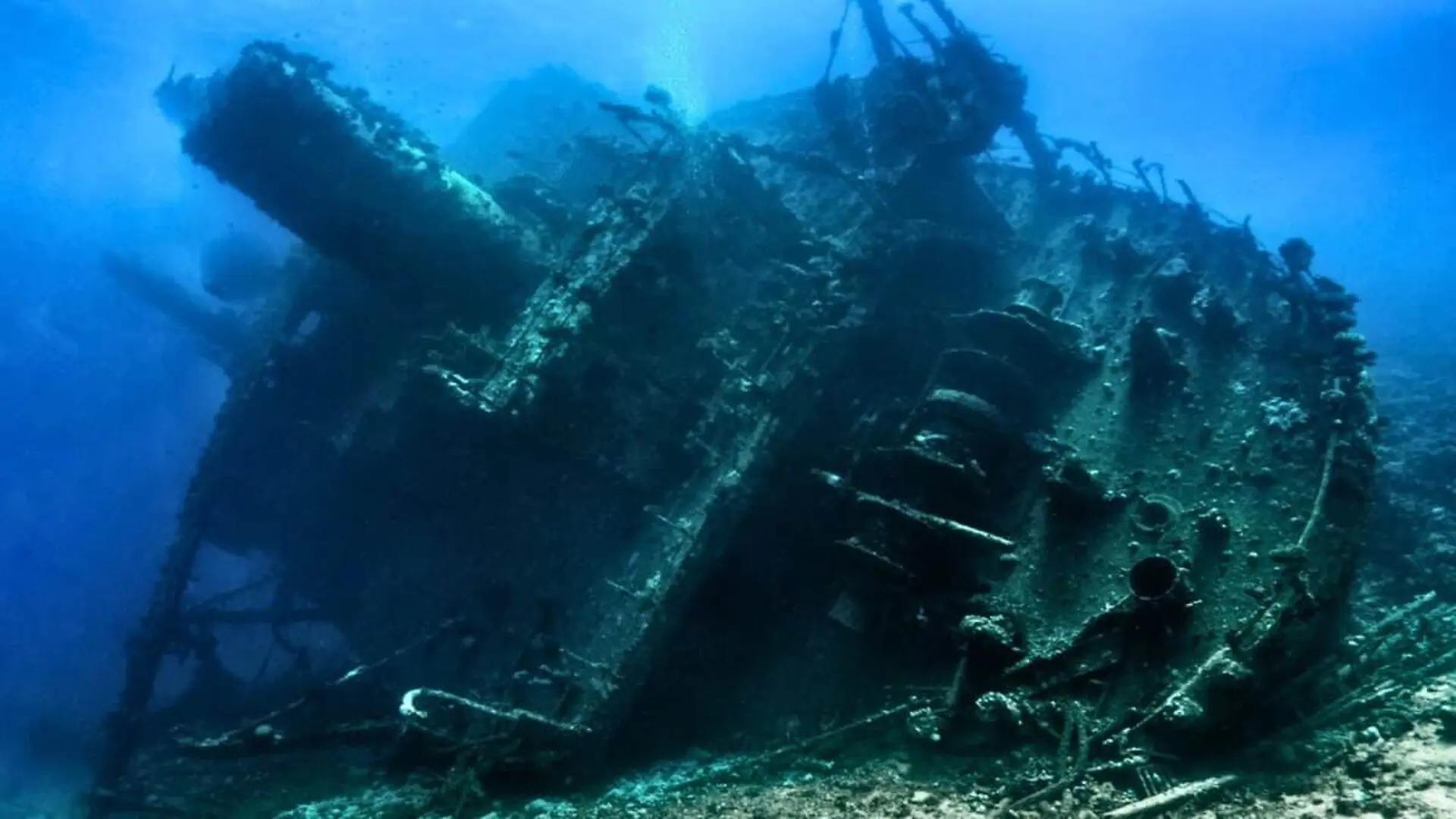
On September 16, 1981, a gold bar was lifted from the wreck of HMS Edinburgh, a British cruiser that had rested on its side in the Barents Sea for nearly four decades. The ship lay about 800 feet beneath the surface, roughly 200 miles east of Murmansk.
The recovered bar was part of a cache of 465 Soviet gold bars that the cruiser had been transporting when German forces attacked it in 1942. The engagement claimed the lives of fifty‑eight crew members, and the vessel was deliberately scuttled by British support ships. The bullion remained sealed in the bomb room until a salvage team located the wreck and cut through its armored hull.
During the initial salvage operation, divers brought up 431 bars. A subsequent mission added another 29, bringing the total to 460. According to a report by the London Bullion Market Association, five bars were never recovered.
German Assaults Rendered the Cruiser Irreparable
HMS Edinburgh departed Murmansk on April 28, 1942, escorting convoy QP11 through the Arctic. Inside its bomb room lay Soviet gold intended as payment to the United States for wartime supplies. At the time, Joseph Stalin led the Soviet Union, which was battling Nazi Germany on the Eastern Front.
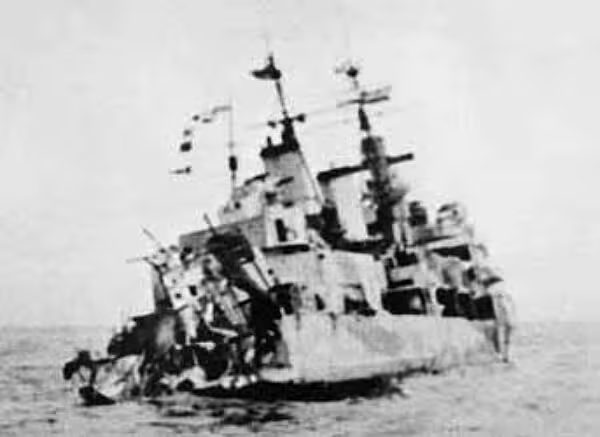
German aircraft spotted the convoy shortly after it set sail. The submarine U‑456 then struck Edinburgh with two torpedoes, crippling its steering and leaving the ship unable to maneuver. Efforts to tow the cruiser back toward port were thwarted by a second German attack on May 1.
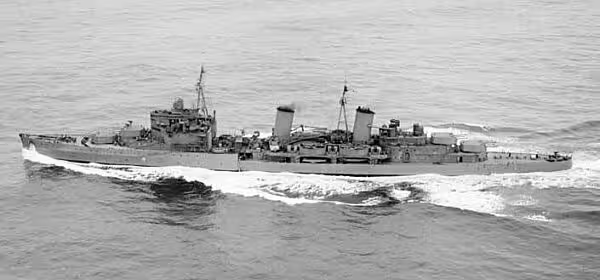
Minesweepers rescued wounded sailors and surviving crew members. With towing no longer feasible, British ships scuttled Edinburgh to prevent enemy capture. Approximately 750 people were saved, while fifty‑eight perished with the vessel.
Because the cargo was covered by wartime insurance, there was no immediate financial pressure to retrieve it. The extreme depth also placed the wreck beyond the reach of most divers at the time. In 1957, HMS Edinburgh was designated a British war grave, affording it legal protection from uncontrolled interference.
Survey Data and Sonar Guided the Hunt
Interest in the sunken treasure resurfaced in the 1970s as gold prices climbed. Salvage expert Keith Jessop examined Admiralty records, survivor testimonies, and reports from fishing vessels whose nets had snagged on underwater obstacles.
Jessop assembled a consortium that included the British diving firm Wharton & Williams, German operator Offshore Services Association, and marine survey company Racal‑Decca. The partnership agreed to a “no cure, no gain” contract, meaning compensation would come only from recovered cargo.
The plan avoided the use of explosives. Instead, divers would employ precision underwater cutting to breach a selected section of the hull while preserving the integrity of the war grave.
After obtaining Soviet approval, a survey vessel entered the Barents Sea in April 1981. On May 14, echo sounders and sonar equipment located a large wreck. A remotely operated vehicle descended and confirmed that Edinburgh rested on its port side in relatively good condition, as described in the LBMA’s historical account of the recovery.
The team also studied HMS Belfast, Edinburgh’s sister ship, to reconstruct the internal layout. Detailed plans and a scale model helped divers chart a route through damaged fuel tanks, collapsed passageways, twisted steel, and live ammunition toward the bomb room.
Saturation Divers Penetrate Armored Hull
The recovery vessel arrived over the wreck in late August 1981 with a crew of 25 divers and extensive support staff. At 800 feet, conventional diving was impractical because repeated descents would require lengthy decompression periods.
The operation relied on saturation diving, keeping divers in pressurized chambers between shifts. This allowed them to stay within the diving‑bell system for up to 30 days.
Divers breathed a helium‑oxygen mix to reduce the risk of nitrogen narcosis, a condition that can impair cognition at depth. Their diving bell remained tethered to the surface by a cable delivering breathing gas, communications, and hot water for their suits.
Ric Wharton, a founder of Wharton & Williams, later described the mission as “the maritime equivalent of a moonwalk” in an interview with The Scotsman.
The intended entry through a torpedo hole proved blocked by wreckage and ammunition. Divers selected an alternate passage and cut through four‑inch armor plating. Clearing a route through the fuel‑tank area to the bomb room took roughly a week.
On September 16, 27‑year‑old diver Jon Rossier located the cargo. His radio transmission, recorded in recovery logs, was succinct: “I’ve found the gold! I’ve found the gold!”
Each bar weighed about 23 pounds. The crew loaded 40 bars at a time into a metal cage and hoisted them to the surface. Soviet observer Igo Ilijn examined the haul and called it “the very best Soviet gold.”
Deteriorating weather forced the team to cease operations in early October. By that point they had retrieved 431 gold bars, roughly 93 percent of the cargo. Before departing, the crew held a remembrance service for the sailors who perished aboard the cruiser.
From Ocean Floor to National Vaults
The recovered gold was allocated among the Soviet Union, the British government, and the salvage consortium. In Murmansk, the Soviet share of 158 bars was offloaded onto a railway carriage. The remaining 272 bars were taken to Peterhead, Scotland, where 111 were assigned to Britain and 161 to the consortium.
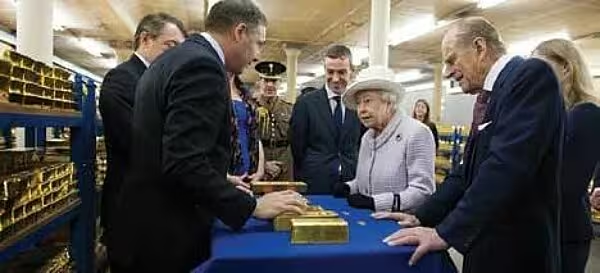
The British and consortium portions were then transferred to the Bank of England. Staff catalogued each bar and verified its weight, but the bullion lacked the assay certificates required for standard trading in London.
The bars had been minted at several Moscow refineries between 1937 and 1942. Without certificates confirming purity and production history, they did not meet the market’s “good delivery” standard.
The consortium exchanged most of its allocation for bars that satisfied the standard, retaining only a small number of the original pieces. Much of the government’s share was sent to the Royal Mint, where it was melted and minted into sovereign coins. Two Edinburgh bars were preserved as historically significant bullion.
A later expedition recovered 29 of the 34 bars left behind, raising the final tally to 460 of the original 465 bars. The remaining five bars were never retrieved.
This article has been fact checked for accuracy, with information verified against reputable sources. Learn more about us and our editorial process.
Last reviewed on .
Article history
- Latest version
Cite this page:
- Posted by Zara Tariq