Workers Found 117 Gold Artifacts Buried in Germany During Pipeline Construction, But the Biggest Mystery Is Why They Were Hidden
Archaeologists in Germany unearth 3000-year-old gold hoard revealing Bronze Age burial secrets

A 3,300‑year‑old cache of gold uncovered in northern Germany ranks among the largest Bronze Age hoards ever found in Europe. The collection, known as the Gessel gold hoard, comprises 117 items with a combined weight of more than 3.7 pounds, yet scholars are still debating its original purpose.
The treasure emerged in April 2011 while crews were laying a natural‑gas pipeline near the village of Gessel, close to Syke. Today the assemblage anchors the Forum Gesseler Goldhort museum.
Radiocarbon dating places the deposit around 1300 B.C., offering a rare snapshot of Bronze Age wealth and metal‑working techniques. Its importance stems not only from the volume of gold recovered but also from the distinctive manner in which the pieces were bundled and interred.
Unearthed Treasure Sheds Light on Bronze Age Wealth
According to Live Science, the find was accidental, sparked by pipeline construction near Gessel. The hoard immediately attracted attention because of its size, preservation state, and the unusually high concentration of gold objects in a single burial pit.
Archaeologists determined that the artifacts had been placed inside a linen bag fastened with six bronze pins before being covered. Unlike scattered debris, the items were tightly packed, suggesting a deliberate assembly and concealment.
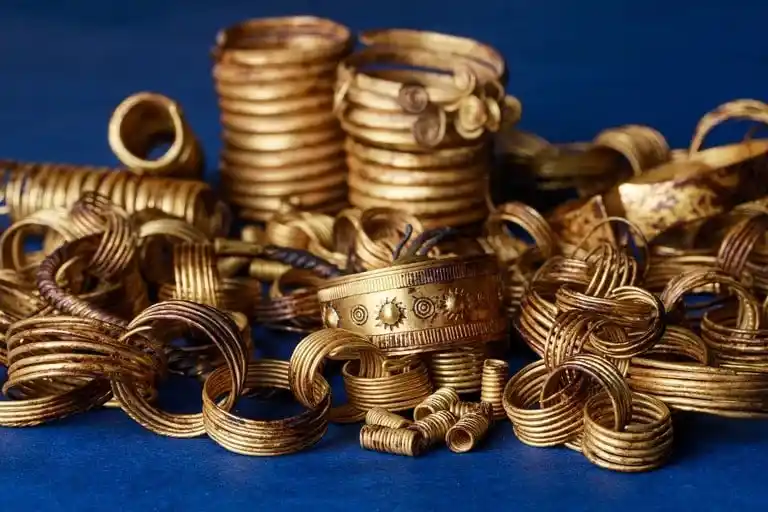
Excavations around the site have uncovered no contemporaneous settlement, grave, or workshop. In the absence of contextual architecture, researchers rely chiefly on the objects themselves to infer the hoard’s origins, possible owner, and the reasons it remained hidden for more than three millennia.
Gold Spirals Hint at Ancient Currency System
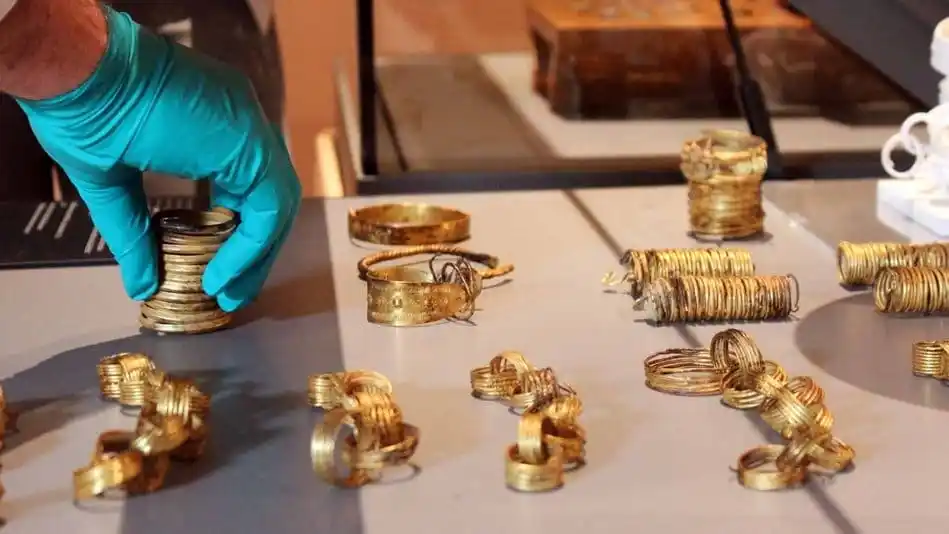
The bulk of the assemblage consists of spiral rings. Analysts identified 82 spirals linked into eight chains of ten rings and one chain of two, plus 32 additional spirals of varying dimensions. Evidence suggests these pieces functioned as a form of Middle Bronze Age currency rather than decorative jewelry. Prehistoric specialist Babette Ludowici notes that the gold was likely recycled from earlier objects.
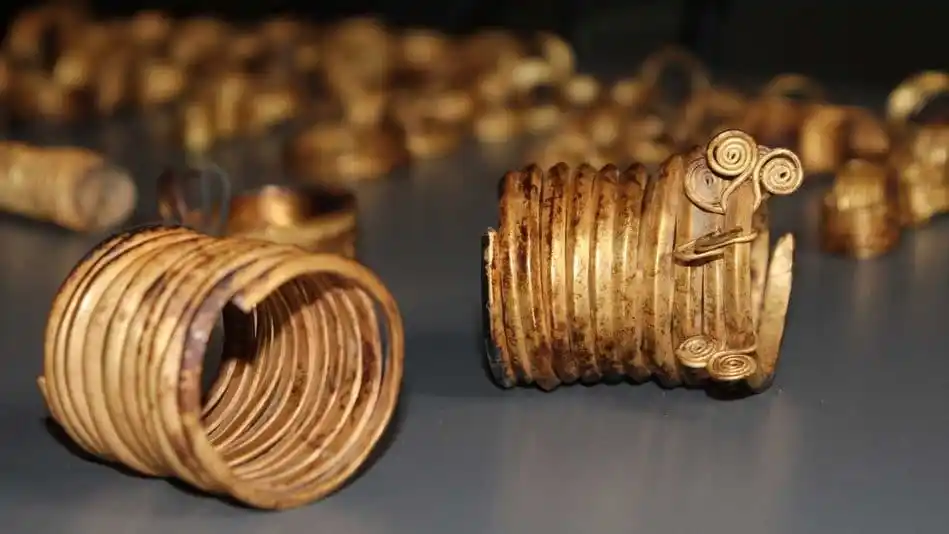
Only three items appear to be personal ornaments: a large gold bracelet, a twisted armband, and an ornate brooch. The bracelet and armband show signs of being unfinished, whereas the brooch exhibits a high degree of craftsmanship, featuring a ladder‑band motif, five raised sun symbols, and six concentric‑ring patterns stamped into its surface.
Unsolved Enigma: Why Was This Hoard Buried?
The brooch measured roughly 6.3 inches before it was bent and its pin removed for burial. A 2012 study highlighted it as the sole ancient brooch made entirely of gold discovered in Central Europe.
Archaeologist Stefan Winghart argues that the compact layout and intentional deformation of certain pieces indicate a carefully curated deposit rather than an emergency concealment.
The mystery endures. Some experts suggest the hoard may represent personal wealth, while others propose it belonged to a metal‑worker’s inventory. A research initiative launched in spring 2026 will probe the gold’s provenance, with preliminary analyses pointing to a possible Central Asian source. Researchers also hope to identify the original owner and clarify why the collection was concealed more than three thousand years ago.
This article has been fact checked for accuracy, with information verified against reputable sources. Learn more about us and our editorial process.
Last reviewed on .
Article history
- Latest version
Reference(s)
- Killgrove, Kristina. “Gessel gold hoard: A 3,300-year-old stash of gleaming treasures that's one of the largest Bronze Age hoards from Europe.”, June 1, 2026 Live Science <https://www.livescience.com/archaeology/gessel-gold-hoard-a-3-300-year-old-stash-of-gleaming-treasures-thats-one-of-the-largest-bronze-age-hoards-from-europe>.
- <https://3landesmuseen-braunschweig.academia.edu/BabetteLudowici>.
- Haßmann, Henning. “Der bronzezeitliche Goldhort von Gessel, Stadt Syke, Ldkr. Diepholz Beschreibung der einzelnen Goldobjekte, Beobachtungen zur Herstellungsweise und erste archäologische Einordnung.”, vol. 81, pp. 145-185., doi: 10.11588/nnu.2012.0.94929. <https://journals.ub.uni-heidelberg.de/index.php/nnu/article/view/94929>.
- <https://independent.academia.edu/stefanwinghart>.
- “Neues Forschungsprojekt zum Goldhort – Forum Gesseler Goldhort.” <https://forum-gesseler-goldhort.de/neues-forschungsprojekt-zum-goldhort/>.
Cite this page:
- Posted by Zara Tariq