Humanoid Robot Performs First Live Gallbladder Surgery Under Surgeon Control
A humanoid robot, guided by a surgeon, successfully removed a pig’s gallbladder using standard tools in a regular operating room.
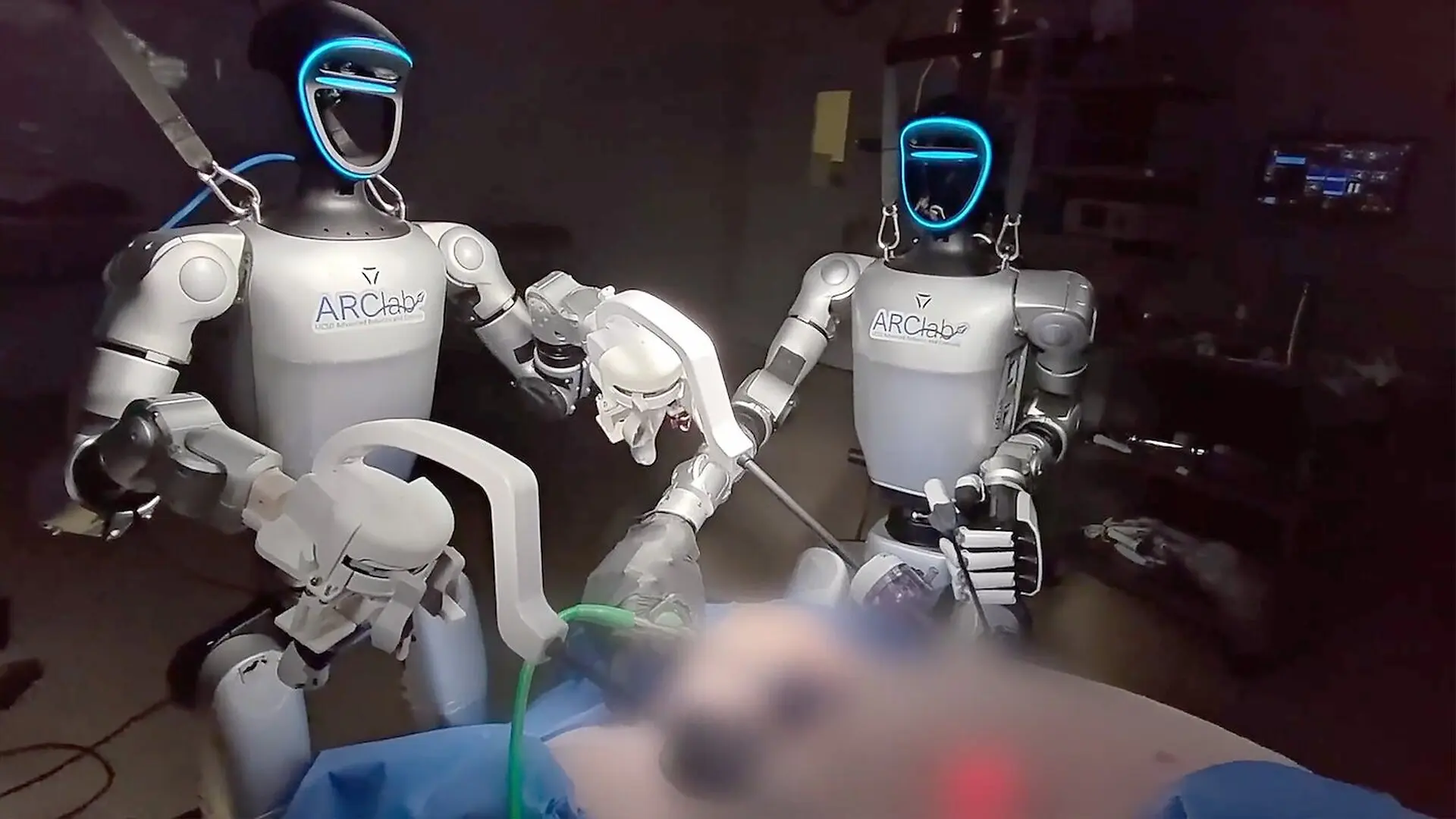
A humanoid robot successfully excised a pig’s gallbladder using conventional surgical instruments within a typical operating suite.
When the surgeon initiated the first cut, anticipation filled the room. The anesthetized pig lay on the table while a tele‑operated humanoid, assisted by a nearby robotic aide, guided its arm to the gallbladder and extracted it with measured precision.
This experiment marks the inaugural use of a human‑shaped robot in a conventional operating theater. Named Surgie, the system was not autonomous; an experienced surgeon directed every movement. Nevertheless, the research demonstrates a tangible step toward collaborative humanoid robots in minimally invasive procedures.
“Both remotely controlled and autonomous humanoid robots hold genuine promise for expanding access to essential surgeries that many patients currently cannot receive,” explained study co‑author Michael Yip of UC San Diego in the paper.
The investigation recorded two complete gallbladder removals. Human surgeons remained on standby for any emergency, yet the tele‑operated robot carried out the core tasks with only minimal human assistance.
Surgeons who piloted Surgie reported reduced physical fatigue and frustration, noting smoother overall performance. They also highlighted practical concerns such as occasional overheating and the necessity of frequent repositioning.
Yip added that humanoid robots “have a viable future.” He envisioned deployments in remote clinics with staffing shortages or in austere environments such as disaster‑relief medical camps where rapid, large‑scale field medicine is required according to the study.
Why Humanoid Platforms Matter
Robotic assistance in surgery has been established for years (see literature). Under a surgeon’s guidance, these machines excel at delicate, high‑precision tasks, particularly in laparoscopic procedures that rely on tiny incisions to lessen pain, accelerate recovery, and cut infection risk.
Traditional surgical robots, however, often demand extensive operating‑room modifications. Their designs typically involve multiple articulated arms mounted on carts that must be positioned close to the patient. For example, the Da Vinci system from Intuitive Surgical uses several independently controlled arms operated from a remote console. CMR Surgical’s Versius employs lightweight arms attached to mobile bases (vendor site). In each case, the surgeon works from a console while viewing a magnified, high‑definition 3D image of the surgical field, often superior to unaided eyesight.
These platforms are already employed across a spectrum of operations (review), yet they suffer from limitations. Proprietary instruments, the need for extra docking space, and extensive staff training increase complexity and cost, constraining where the technology can be installed (study).
In contrast, humanoid robots are compact and mobile. Their human‑like form factor enables navigation through standard operating rooms, use of off‑the‑shelf surgical tools, and potentially smoother integration into existing workflows.
Recent breakthroughs in actuation and control electronics have rendered modern humanoids faster and more stable than earlier, clumsy prototypes. Advanced AI models that anticipate full‑body motion (preprint) and deliver real‑time balance feedback (research) further enhance their adaptability. Today, such robots are already handling warehouse logistics (press release) and even setting marathon records (report). Surgery, however, imposes a stricter performance threshold.
The research team set out to determine whether a humanoid could meet those exacting standards.
Inside the Surgie System
Surgie consists of a surgeon‑operated console and the robot itself. The surgeon dons a stereoscopic headset that delivers a magnified, three‑dimensional view of the operative field, while an input device translates hand motions into robot actions in real time.
For the study, investigators selected the commercially available Unitree G1 platform. Unlike purpose‑built surgical robots, the G1 is a general‑purpose humanoid featuring dexterous wrists and multiple joints. Researchers modified its hands to enable rapid tool changes. Standing just over four feet tall and weighing roughly 77 pounds, the robot occupies a fraction of the footprint required by conventional surgical systems.
Laparoscopic procedures demand precise pivot points at the incision site, allowing instruments to move inside the body without exerting undue force on surrounding tissue. After extensive motion mapping, the team identified a configuration that provides sufficient range of motion for most minimally invasive surgeries.
Surgie satisfied standard robotics benchmarks that assess surgical skill for both humans and machines (metrics). The subsequent challenge involved two full gallbladder resections performed in a regular operating room. Each case followed a typical workflow: a lead surgeon directed the robot, while an assistant managed the camera, cleared lenses, and exchanged instruments.
During the procedures, Surgie collaborated with the human assistant to locate, isolate, and excise the gallbladder while preserving nearby liver tissue. In one instance, a second humanoid briefly assumed camera control while the assistant stepped away.
Both surgeries proceeded without major complications. Minor bleeding and a small bile leak occurred in one case but were easily resolved. Surgeons reported that operating the humanoid felt intuitive, citing the advantage of having two arms capable of handling standard tools.
“We were surprised at how seamlessly Surgie fit into our workspace and workflow,” noted study author Nikita Thareja.
Despite the encouraging results, the prototype displayed limitations. Its limited reach required frequent repositioning and recalibration, adding roughly three minutes each time. The robot also needed occasional cooling periods to prevent overheating. In a real‑world setting, such interruptions could raise risk by diverting the surgeon’s attention.
Nevertheless, Surgie holds a distinct advantage over stationary surgical robots: it can walk. Beyond assisting during an operation, a mobile humanoid could retrieve instruments or help clean the theater between cases.
The development team is now focused on reducing control latency, especially for long‑distance teleoperation, and on establishing safe sterilization protocols that would allow a humanoid to be “scrubbed in” for surgical use.
Yip summed up the vision: “Our aim is a future operating theater where humanoid robots and human clinicians function as an integrated team, delivering procedures both in conventional hospitals and in unconventional, field‑medicine environments.”
This article has been fact checked for accuracy, with information verified against reputable sources. Learn more about us and our editorial process.
Last reviewed on .
Article history
- Latest version
Reference(s)
- Liang, Zekai. “In vivo feasibility study of humanoid robots in surgery - Nature.”, July 8, 2026, pp. 1-9. Nature, doi: 10.1038/s41586-026-10796-x. <https://www.nature.com/articles/s41586-026-10796-x>.
- “Surgeons Use Teleoperated Humanoid Robots to Perform Live Surgery – a World First.”, July 08, 2026 <https://today.ucsd.edu/story/surgeons-use-teleoperated-humanoid-robots-to-perform-live-surgery-a-world-first>.
- “Robotic surgery: a current perspective - PubMed.”, vol. 239, no. 1 PubMed, doi: 10.1097/01.sla.0000103020.19595.7d. <https://pubmed.ncbi.nlm.nih.gov/14685095/>.
- “En Us.” <https://www.intuitive.com/en-us>.
- “CMR Surgical - Transforming Surgery. For Good..” CMR Surgical <https://us.cmrsurgical.com/>.
- Dagnino, Giulio., et al. “Robot-assistive minimally invasive surgery: trends and future directions.” International Journal of Intelligent Robotics and Applications, vol. 8, no. 4, May 6, 2024, pp. 812-826. Springer Science and Business Media LLC, doi: 10.1007/s41315-024-00341-2. <https://link.springer.com/article/10.1007/s41315-024-00341-2>.
- “Barriers to safety and efficiency in robotic surgery docking - PubMed.”, vol. 36, no. 1 PubMed, doi: 10.1007/s00464-020-08258-0. <https://pubmed.ncbi.nlm.nih.gov/33469695/>.
- Zhang, John. “Whole-Body Model-Predictive Control of Legged Robots with MuJoCo.” arXiv.org <https://arxiv.org/abs/2503.04613>.
- Radosavovic, Ilija., et al. “Real-world humanoid locomotion with reinforcement learning.” Science Robotics, vol. 9, no. 89, April 17, 2024 American Association for the Advancement of Science (AAAS), doi: 10.1126/scirobotics.adi9579. <https://www.science.org/doi/10.1126/scirobotics.adi9579>.
- “GXO Signs Industry-First Multi-Year Agreement with Agility Robotics | Agility.” <https://www.agilityrobotics.com/content/gxo-signs-industry-first-multi-year-agreement-with-agility-robotics>.
- “Unitree G1.” UnitreeRobotics <https://shop.unitree.com/products/unitree-g1>.
- “User Guides and Forms - Fundamentals of Laparoscopic Surgery.”, September 14, 2022 <https://www.flsprogram.org/user-guides-and-forms/>.
Cite this page:
- Posted by Zara Tariq