The New 5.6‑Trillion‑Pixel Sky Map Unveils Nearly 4 Billion Cosmic Objects
A groundbreaking universe map, built from years of observations, offers scientists an unprecedented view of hidden cosmic structures.
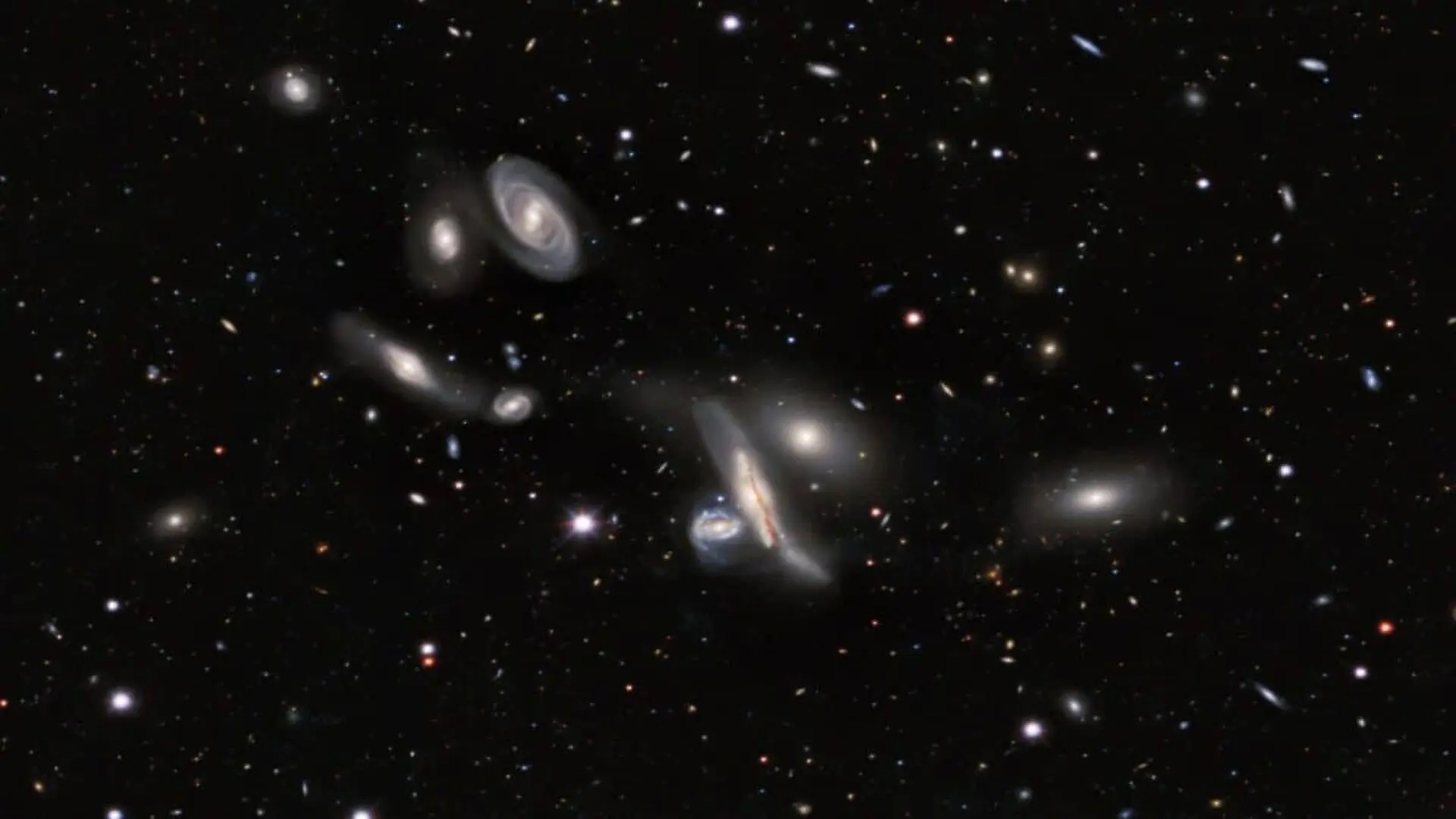
A consortium of astronomers has released the most expansive two‑dimensional view of the night sky to date, stitching together 13 years of imaging from the Mayall and Blanco telescopes into a single map that spans three‑quarters of the celestial sphere and catalogues nearly four billion objects.
The effort, carried out under the auspices of the NSF’s NOIRLab, merges 263 407 individual exposures into a 5.6‑trillion‑pixel mosaic that records the position and brightness of galaxies, stars, black holes, asteroids and other sources across visible and near‑infrared wavelengths.
A Landmark Survey for Dark Energy Research
Originally assembled to feed target selection for the Dark Energy Spectroscopic Instrument (DESI), the map now serves as a foundational reference for a broad range of astrophysical investigations, enabling researchers to trace the large‑scale structure of the universe and probe its expansion history.
DESI’s spectroscopic campaign, which has already measured more than 47 million galaxies and quasars, relies on the precise positional data supplied by the imaging survey to pinpoint objects for follow‑up observations.
How the Mosaic Was Built
The Blanco Telescope contributed images captured with the Dark Energy Camera, a 570‑megapixel instrument commissioned by the U.S. Department of Energy. Meanwhile, the Mayall Telescope supplied complementary data, together delivering a seamless view that penetrates dust clouds and reveals structures both near and far, including objects hidden within the Milky Way.
More than 160 scientists contributed to the compilation, resulting in a dataset that allows simultaneous study of nearby stars and distant galaxies. Lawrence Berkeley National Laboratory’s David Schlegel, co‑lead of the Legacy Surveys, notes that the resource has become a routine entry point for astronomers worldwide.
“When you’re working with astronomical objects today, you often start by pulling up the Legacy Imaging Viewer to see what you’re looking at,” he said.
Enabling Three‑Dimensional Cosmic Maps
By pairing the two‑dimensional catalog with DESI’s spectroscopic measurements, researchers obtain both a visual snapshot and a depth dimension, facilitating detailed reconstructions of the universe’s large‑scale structure.
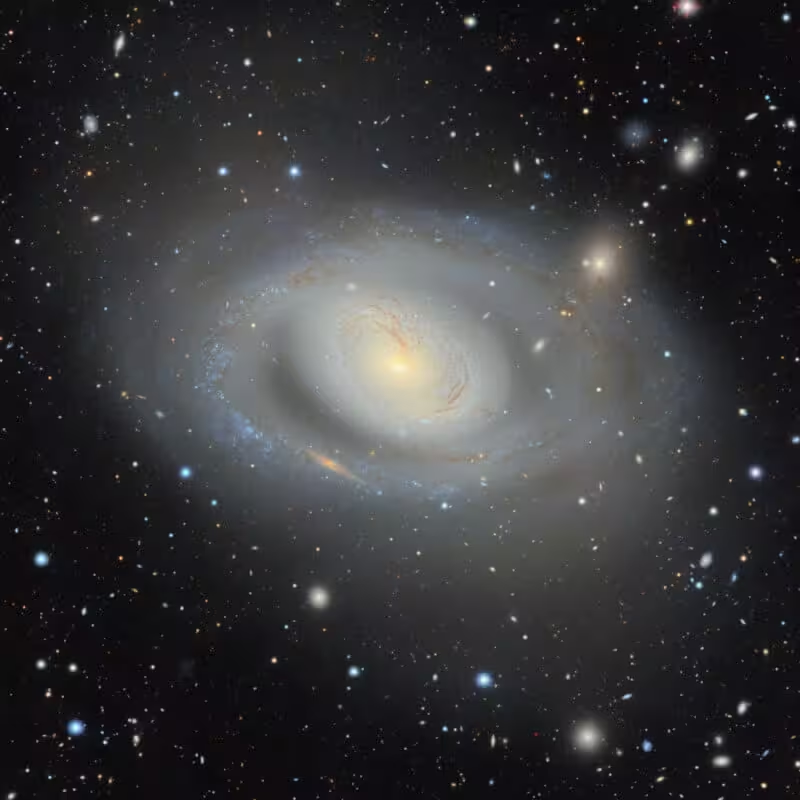
Among the highlighted objects is the well‑known spiral galaxy Messier 96 (NGC 3368), whose image in the release showcases the capabilities of the Dark Energy Camera.
A Public Resource for the Next Generation of Telescopes
The updated DESI Legacy Imaging Surveys are freely accessible, supporting both professional astronomers and citizen scientists. Earlier versions have already underpinned more than 1 800 peer‑reviewed articles, and the data will feed upcoming facilities such as the NSF‑DOE Vera C. Rubin Observatory, which will employ a 3.2‑gigapixel camera for wide‑field surveys.
“For our team, these data are fundamental to the investigation of the expansion history of the Universe and the formation of our galaxy. But the skies belong to everyone, and this survey gives everyone the chance to marvel at their wonders.”
By consolidating millions of individual exposures into a single digital portrait of the cosmos, the survey furnishes an unprecedented tool for exploring the universe’s myriad constituents.
This article has been fact checked for accuracy, with information verified against reputable sources. Learn more about us and our editorial process.
Last reviewed on .
Article history
- Latest version
Reference(s)
- “Index.”, September 2, 2022 Legacy Survey <https://www.legacysurvey.org/>.
Cite this page:
- Posted by Aisha Ahmed