Spectacular Green Comet 220P/McNaught Shines After 8,000‑Fold Brightness Surge
A 2026 outburst reshaped Comet 220P/McNaught, painting it green as astrophotographers snapped stunning shots over Namibia.
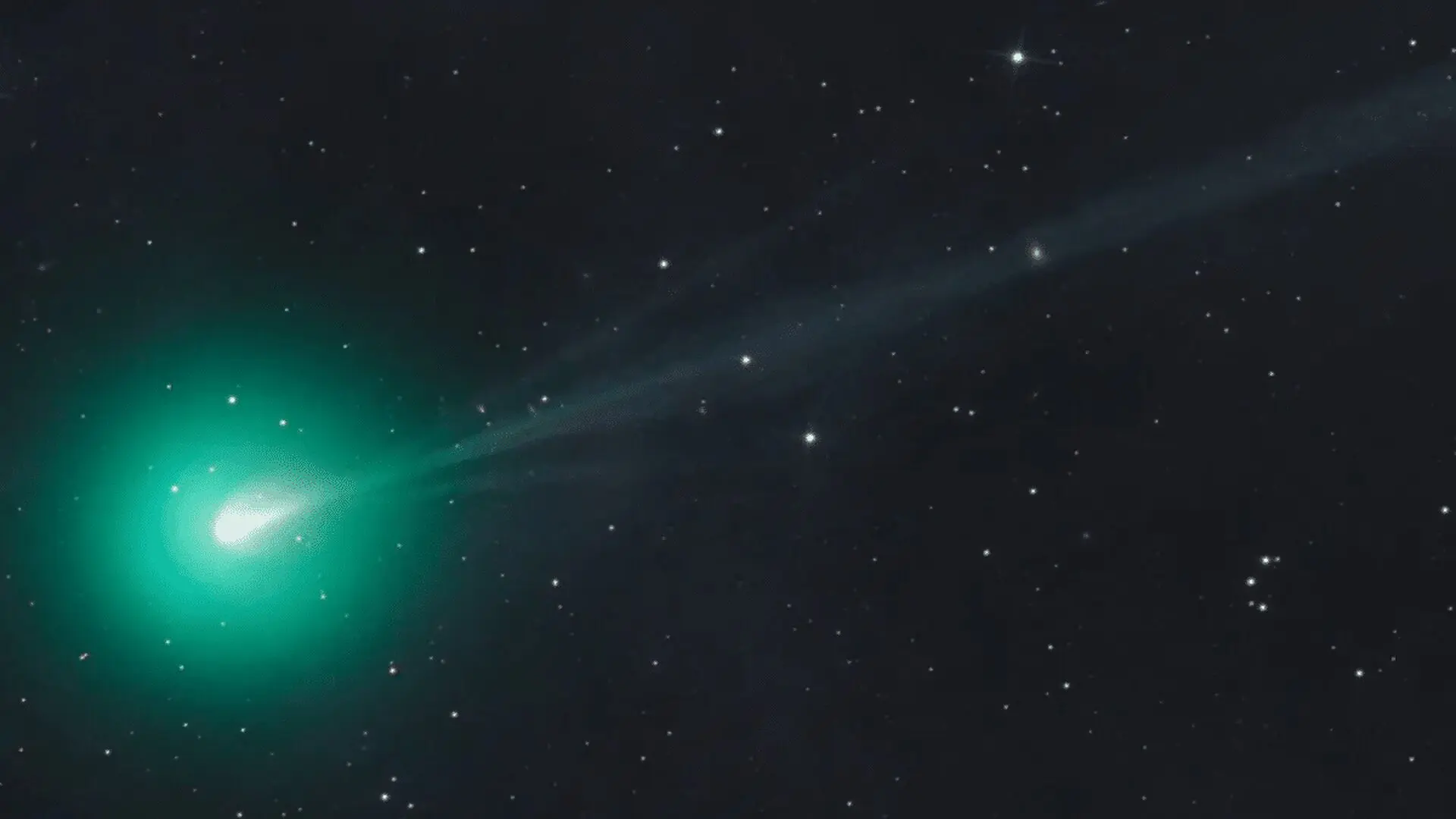
Astrophotographers Gerald Rhemann and Michael Jäger captured a vivid view of Comet 220P/McNaught on August 8, 2026, when the comet displayed an unusually bright green halo above the clear skies of Namibia. Their image, taken months after a dramatic outburst that amplified the comet’s luminosity by several thousand times, showcases the transient nature of this periodic visitor.
A Periodic Visitor Surges in Brightness
220P/McNaught, discovered by Australian astronomer Robert H. McNaught, follows an orbit of roughly 5.5 years, repeatedly diving into the inner solar system before retreating to the outer reaches.
During its 2026 passage, the comet reached perihelion in June, the point of closest approach to the Sun. At that time it underwent a sudden outburst that elevated its apparent magnitude by an estimated factor of eight thousand, according to observations reported by Space.com.
Outbursts of this kind arise when solar heating liberates volatile compounds from beneath the comet’s surface, allowing gas and entrained dust to stream outward. Because observers see reflected sunlight and fluorescent emissions from this expanding cloud rather than the dark nucleus itself, such releases can cause a dramatic jump in observed brightness.
The comet’s activity did not subside after the June event. By August, its brightness had settled to roughly six hundred times its quiescent level, creating the conditions that enabled Rhemann and Jäger to record their detailed photograph.
These observations illustrate that while a comet’s orbital path can be predicted, the timing and intensity of individual outbursts remain difficult to forecast.
Namibia’s Dark Skies Reveal the Comet
The image was captured from a remote site in Namibia on August 8, 2026, during the comet’s renewed bright phase. Rhemann and Jäger employed a 12‑inch Astrograph paired with a ZWO ASI 6200 MM Pro camera to record the scene.
This combination allowed the team to resolve fine structures and faint emissions that would be invisible to the naked eye. In the resulting frame, the comet appears as a striking green disc set against a dense backdrop of stars.
The photograph underscores the distinction between a comet’s tiny, dark nucleus and the expansive coma that surrounds it. Most of the visual spectacle originates from this diffuse atmosphere, which forms when material sublimates from the nucleus and is carried outward by solar radiation.
Namibia’s remote observing locations provide exceptionally dark horizons, minimal light pollution, and unobstructed views of the heavens. While these conditions do not increase a comet’s intrinsic brightness, they greatly enhance the ability to capture faint astronomical features.
Thus, the August exposure combines an actively shedding comet, high‑performance imaging gear, and an optimal observing site to reveal details far beyond what casual stargazing would reveal.
What Gives the Comet Its Green Hue
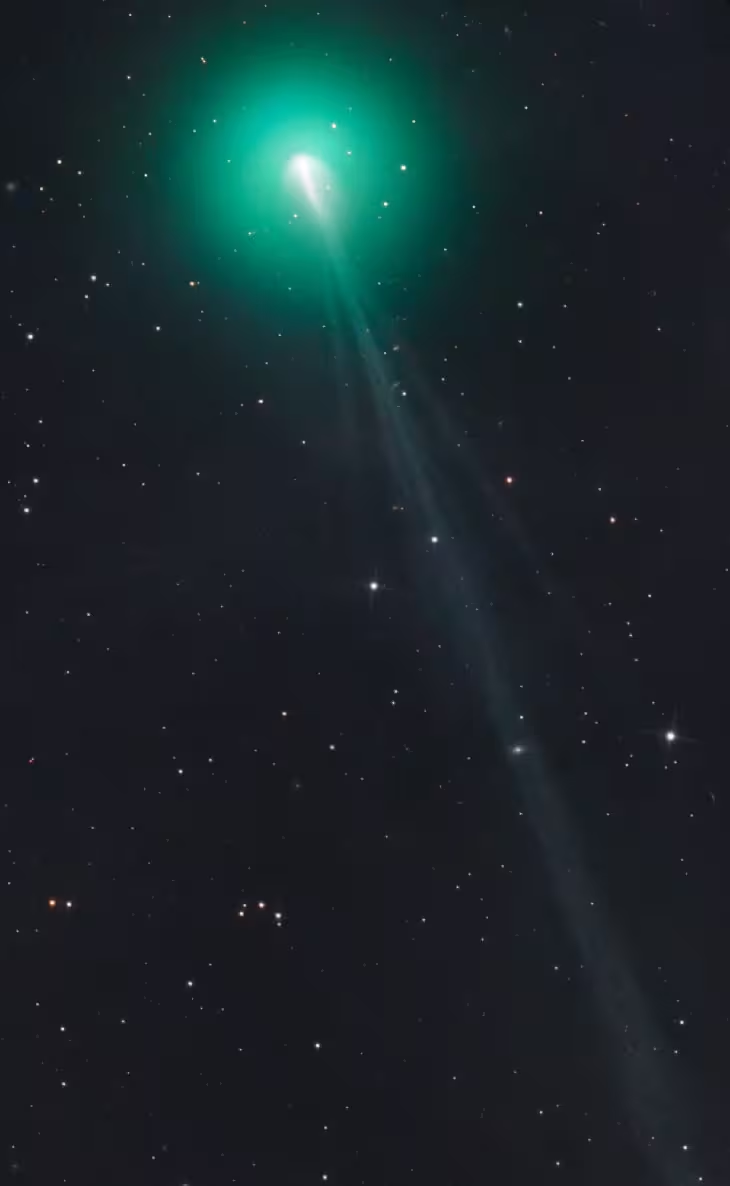
The comet’s distinct green glow arises from fluorescent emissions of molecules released into the coma. One of the primary contributors is diatomic carbon (C₂), which, when excited by solar photons, emits light at wavelengths that appear green to observers.
These emissions are typically confined to the inner coma, as ultraviolet radiation from the Sun breaks down the molecules farther from the nucleus, limiting the green coloration to the region close to the comet’s core.
The color therefore serves as a visual marker of ongoing chemical reactions between solar energy and the volatile material that composes the comet, linking the observed hue to underlying physical processes.
Comets are aggregates of frozen gases, dust, and rocky fragments dating back to the early solar system. Each close approach to the Sun can activate new volatile reservoirs or alter existing ones, driving changes in brightness and color.
Consequently, a green comet image provides a snapshot of solar heating actively reshaping the comet’s surface and atmosphere.
An 8,000‑Fold Surge Highlights a Violent Outburst
The most remarkable metric from the 2026 apparition of 220P/McNaught is the reported increase of roughly eight thousand times in brightness during the June outburst.
Such a rapid escalation can stem from several mechanisms: exposure of fresh volatile‑rich layers, buildup of internal gas pressure that eventually ruptures surface material, or thermal stresses that destabilize portions of the nucleus.
Determining the exact cause requires continuous monitoring of the comet’s composition, dust production rates, and morphological changes before, during, and after the event.
The magnitude of the brightening underscores how a relatively modest comet can become dramatically more visible when a sudden release of material envelops the nucleus.
By August, the comet’s brightness had moderated to about six hundred times its baseline level, yet it remained sufficiently active to be captured in the Namibia image.
The sequence of perihelion, a major outburst, and a secondary phase of heightened activity makes the 2026 passage a noteworthy episode in the comet’s ongoing journey around the Sun.
This article has been fact checked for accuracy, with information verified against reputable sources. Learn more about us and our editorial process.
Last reviewed on .
Article history
- Latest version
Reference(s)
- “Comet 220P/McNaught.” <https://spaceweathergallery2.com/indiv_upload.php?upload_id=235453>.
Cite this page:
- Posted by Aisha Ahmed