Andromeda’s Star Birth Slows Dramatically - M32 May Be the Culprit
Astronomers find unexpected slowdown in Andromeda’s core, pointing to a nearby object with a tangled past.
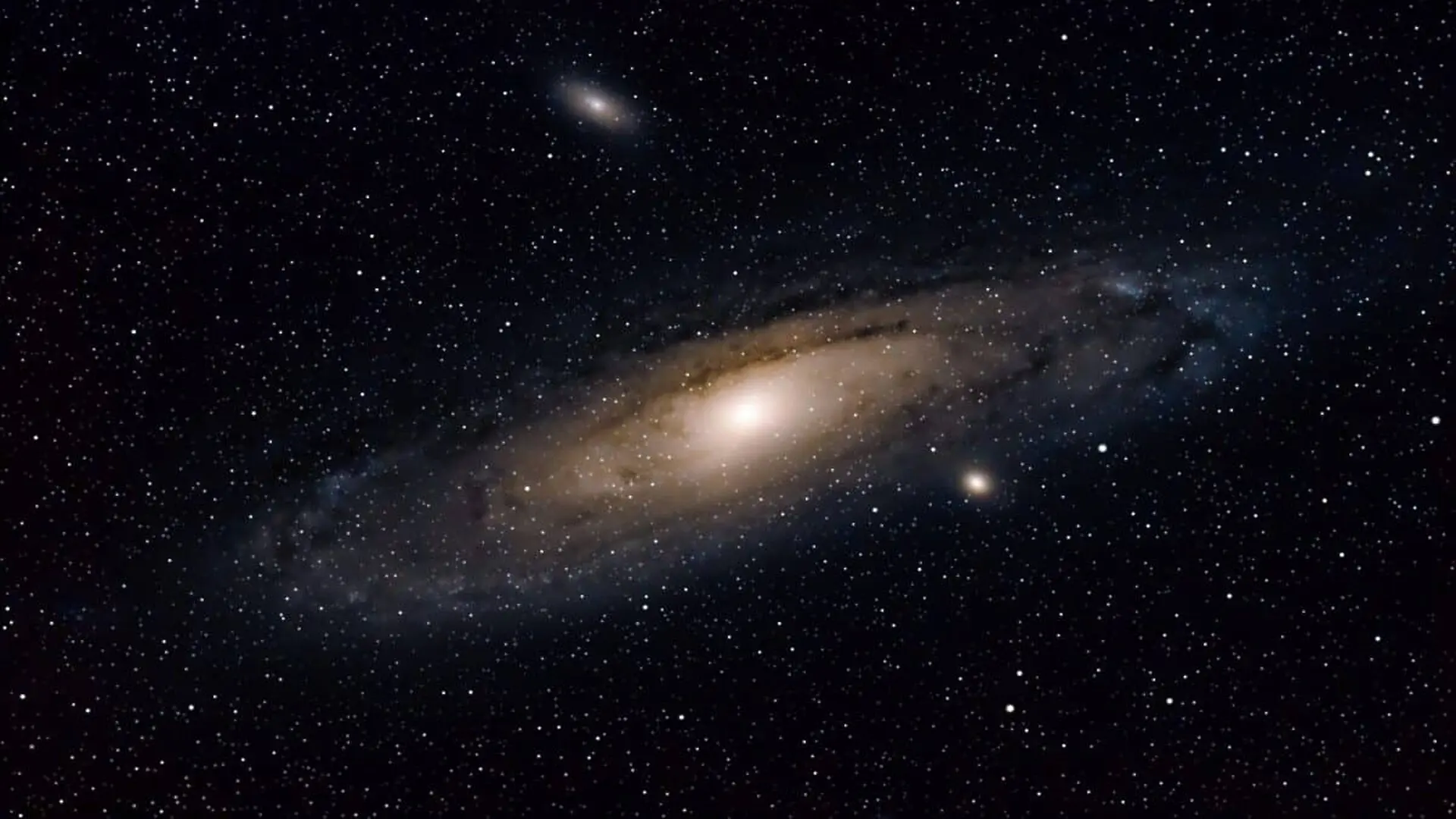
A recent analysis of Hubble Space Telescope observations indicates that the Andromeda galaxy (M31) has experienced a sharp decline in its star‑formation activity over the past few hundred million years, with the most pronounced drop occurring in the sector nearest to its compact companion, the dwarf galaxy M32.
At a distance of roughly 2.5 million light‑years, Andromeda offers astronomers a rare opportunity to resolve individual stars and piece together its recent evolutionary narrative. Earlier work had identified a vigorous starburst roughly two billion years ago, likely tied to a prior encounter, but the new study focuses on the subsequent era, revealing how quickly the galaxy’s stellar production tapered off.
Hubble Mapping Highlights Regional Star‑Formation Slowdown
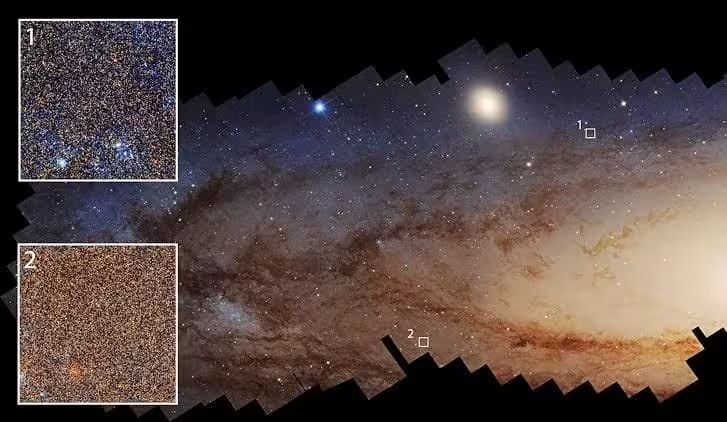
Using data from two extensive Hubble surveys that catalogued about 200 million stars across two‑thirds of Andromeda’s disk, researchers segmented the galaxy into roughly 300‑light‑year squares. By comparing the color distribution of stars in each segment—blue, luminous stars signifying recent births and redder, dimmer stars marking older populations—they reconstructed a timeline of star‑forming activity across the spiral.
The analysis suggests that roughly 500 million years ago Andromeda was forming stars at a rate equivalent to one solar mass of gas per year. This pace steadily waned, reaching roughly half that value about 40 million years ago, and continuing to drop to approximately one‑fifth of a solar mass per year in the present epoch.
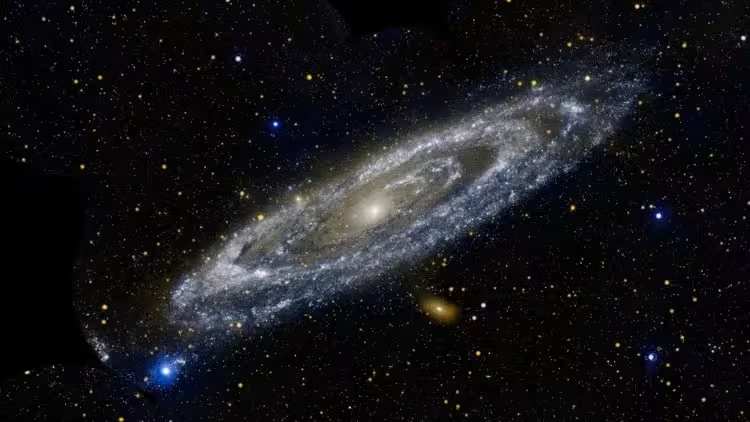
The slowdown is not uniform across the disk. The side of Andromeda that faces the dwarf galaxy M32—located merely 16,000 light‑years from the larger spiral—shows the steepest reduction in recent star formation, hinting at a possible gravitational influence from the smaller neighbor.
M32’s Role in Andromeda’s Recent History
M32, an enigmatic compact galaxy that may represent the stripped core of a former spiral, has long been suspected of having interacted with Andromeda. Its proximity and peculiar morphology make it a plausible catalyst for the observed decline, although researchers caution that a direct causal link cannot yet be confirmed.
“We can’t explicitly say that we are seeing a decrease in star formation because of M32,” saidTobin Wainer, a graduate student at the University of Washington and one of the astronomers involved in the research. “But it’s right there, and it’s definitely the most likely suspect.”
Future Missions Set to Expand the View
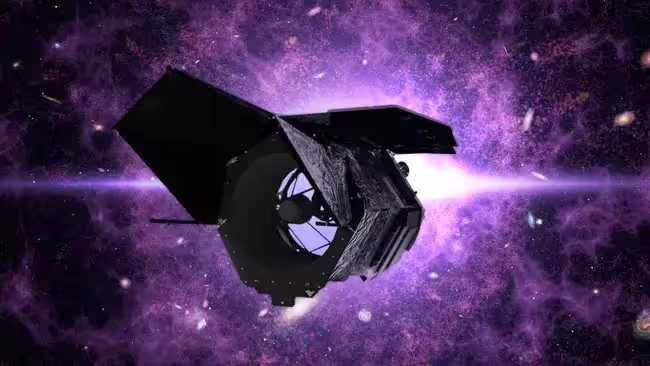
The findings lay groundwork for upcoming surveys with the Nancy Grace Roman Space Telescope, whose wide‑field infrared capabilities will map the entirety of Andromeda’s disk and halo in a single observation. NASA notes that Roman’s field of view exceeds Hubble’s by a factor of about one hundred, promising a more comprehensive portrait of the galaxy’s stellar population.
“Roman’s gigantic field of view can cover at least 100 times as much area as Hubble at near‑infrared wavelengths in a single observation. A newly approved Roman observing program will image the entirety of Andromeda’s disk and areas of its surrounding halo,” stated NASA.
As the next generation of space observatories comes online, astronomers anticipate a clearer picture of how close encounters between massive spirals and their satellite companions sculpt galactic evolution. For now, M32 stands as the most compelling candidate for driving the recent star‑formation slowdown observed in Andromeda.
This article has been fact checked for accuracy, with information verified against reputable sources. Learn more about us and our editorial process.
Last reviewed on .
Article history
- Latest version
Cite this page:
- Posted by Aisha Ahmed