NASA’s Triple‑Telescope Image Reveals Mystery of Missing X‑Ray Gas in Tarantula Nebula
NASA’s latest composite of the Tarantula Nebula shows hot gas escaping and losing energy in a neighboring galaxy, shedding light on stellar processes.
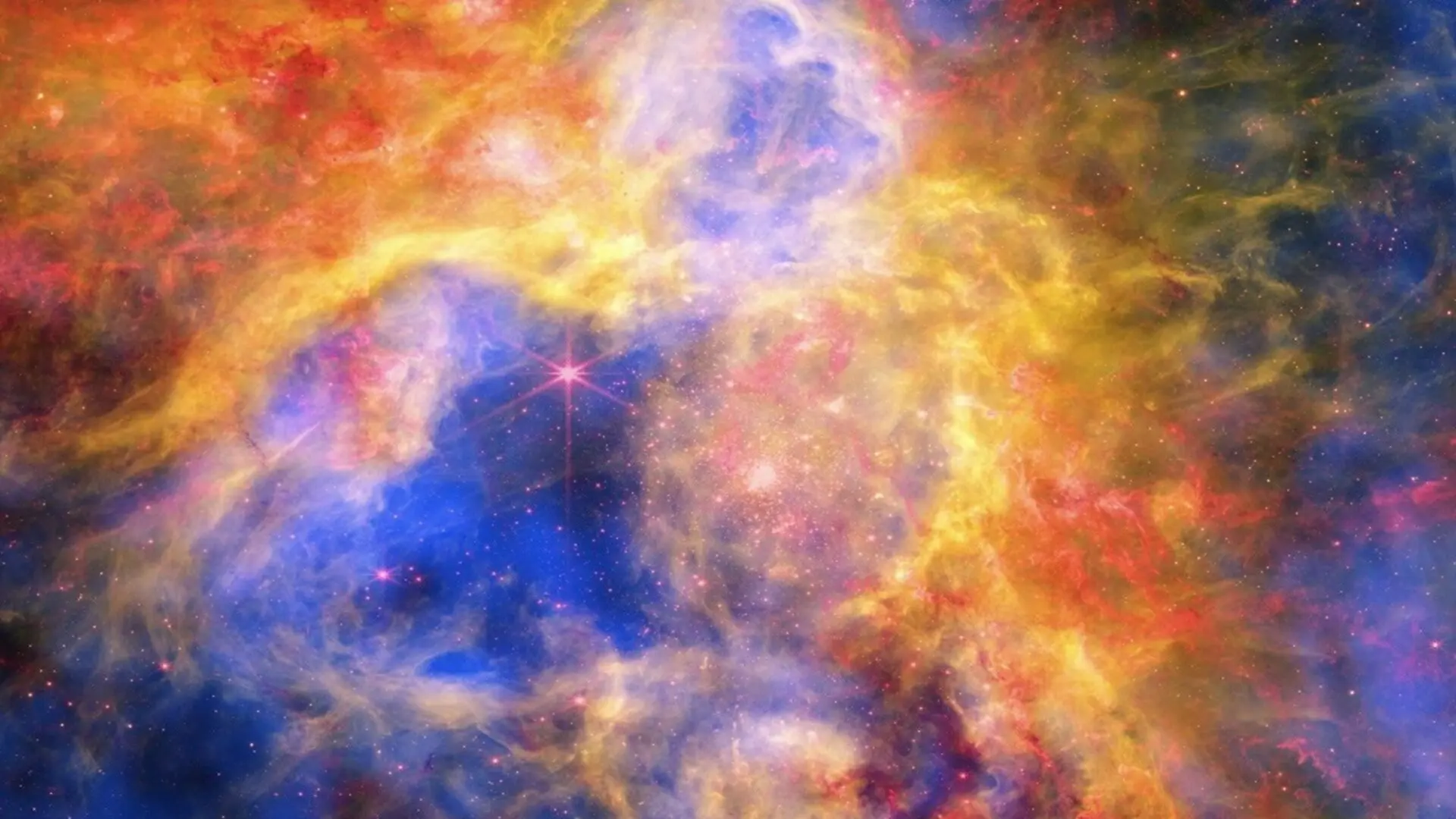
A fresh composite assembled from NASA’s Chandra X‑ray Observatory, James Webb Space Telescope, and Hubble Space Telescope reveals that the Tarantula Nebula is shedding considerably more energy than astronomers had anticipated. Situated roughly 160,000 light‑years away in the Large Magellanic Cloud, this colossal star‑forming complex hosts thousands of newly born stars enshrouded by a tangled web of gas and dust. While the striking multicolour image highlights the nebula’s intricate architecture, it also brings to light a long‑standing puzzle: the observed amount of X‑ray‑bright hot plasma falls far short of theoretical expectations based on stellar‑wind power.
A Stellar Crèche Viewed Across the Spectrum
Better known as 30 Doradus, the Tarantula Nebula stands out as one of the most active stellar nurseries in the Local Group. Nestled within the Small Magellanic Cloud that orbits the Milky Way, its dense population of massive, young stars drives fierce outflows that inject mechanical energy into the surrounding medium. When these winds slam into ambient gas, they generate shock fronts capable of heating material to several million degrees, a temperature regime that shines in X‑rays and makes the region a prime target for Chandra.
The new NASA composite merges the high‑energy X‑ray view from Chandra with infrared data from Webb and optical imaging from Hubble, creating a layered map where each hue corresponds to a distinct physical component. Rather than a single visual photograph, the result resembles a scientific “stack” that lets researchers examine the same patch of sky through three complementary lenses.
How the Three Observatories Complement One Another
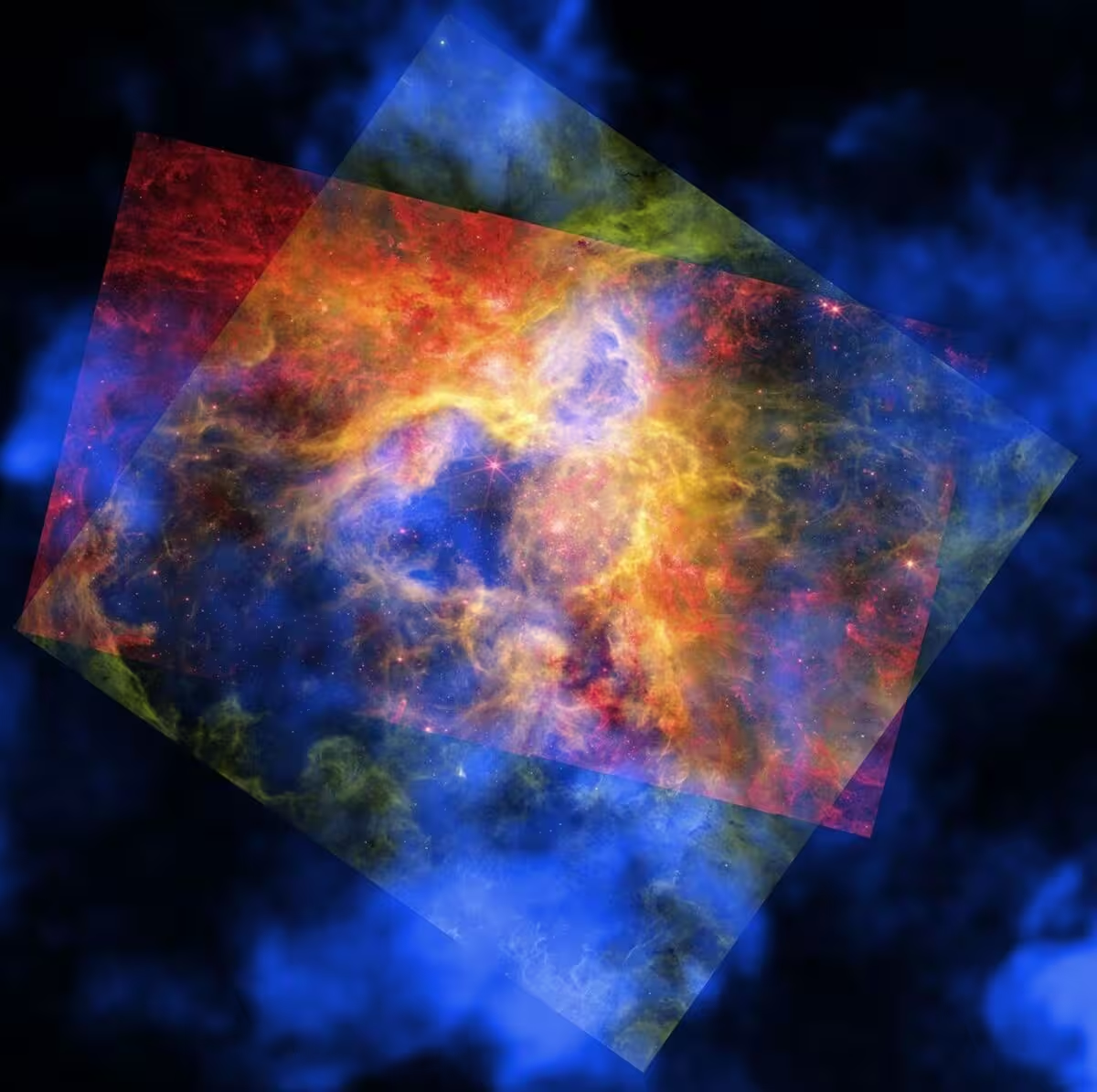
Chandra contributes a blue‑tinted X‑ray layer that traces the hottest gas created where stellar winds collide. Webb adds a red‑orange infrared slice, unveiling both the swarm of infant stars and the cool dust that will later seed new planetary systems. Hubble supplies a green‑hued optical component that maps ionised hydrogen and resolves individual stars against the nebular backdrop. Where the datasets intersect, blended colours emerge—yellow, orange, and cyan—each encoding a mix of temperature, density, and composition.
In the core of the nebula, all three layers overlap, offering an unprecedented, multi‑wavelength snapshot of the region’s dynamics. NASA likens the composite to stacked sheets of transparent cellophane, each revealing a different facet of the same celestial structure.
Why So Little X‑Ray Emission?
Previous calculations based on the measured strength of stellar winds predicted a far richer reservoir of X‑ray‑emitting plasma than what Chandra actually detects. The disparity implies that the bulk of the wind‑driven energy is being siphoned away or transformed before it can accumulate as hot gas. Led by Jennifer Rodriguez of Ohio State University, the recent study combined Chandra’s X‑ray data with Webb, Hubble, and archival observations from the now‑retired Spitzer telescope to explore possible escape routes for this missing energy.
Three Pathways for Energy Drainage
The analysis points to a trio of mechanisms that could jointly account for the deficit. First, the porous nature of the surrounding shells may allow up to fifty percent of the hot gas to vent outward, carrying thermal energy beyond the nebula’s confines. Second, turbulent mixing at the shell boundaries can blend hot and cold material, lowering overall temperatures and reducing X‑ray brightness. Third, thermal conduction—analogous to heat transfer between a pan and its burner—may enable heat to flow directly from the hot interior to cooler gas without requiring full mixing, gradually equilibrating temperatures.
NASA illustrates the conduction concept with the frying‑pan analogy, emphasizing how direct contact between disparate temperature zones can redistribute energy. Together, these processes provide a plausible explanation for why the observed X‑ray output falls short of theoretical predictions.
Implications for Understanding Massive‑Star Feedback
The Tarantula Nebula serves as a nearby laboratory for probing how massive, short‑lived stars sculpt their environments. Deciphering the fate of wind‑generated energy informs models of star‑formation regulation, gas recycling, and the broader evolution of galaxies. The composite data set demonstrates that multi‑wavelength observations are essential for disentangling complex physical interactions that a single instrument would miss. Infrared imaging exposes cool dust and nascent stars, optical data track ionised gas, X‑rays reveal the hottest plasma, and Spitzer’s legacy measurements add further depth.
By weaving together these complementary views, astronomers now possess a more nuanced picture of how energy moves, escapes, and reshapes a massive stellar nursery—insights that will refine theories of feedback processes across the cosmos.
This article has been fact checked for accuracy, with information verified against reputable sources. Learn more about us and our editorial process.
Last reviewed on .
Article history
- Latest version
Reference(s)
- lamohon, Megan. “NASA Telescopes Create Colorful ‘Craft’ From Nearby Nebula - NASA Science.”, August 11, 2026 NASA <https://science.nasa.gov/missions/chandra/nasa-telescopes-create-colorful-craft-from-nearby-nebula/>.
Cite this page:
- Posted by Aisha Ahmed