VLT Captures First Clear Image of Betelgeuse’s Secret Companion Star
New observations of Betelgeuse may finally uncover the long‑standing mystery surrounding the iconic red supergiant, shedding light on its behavior.
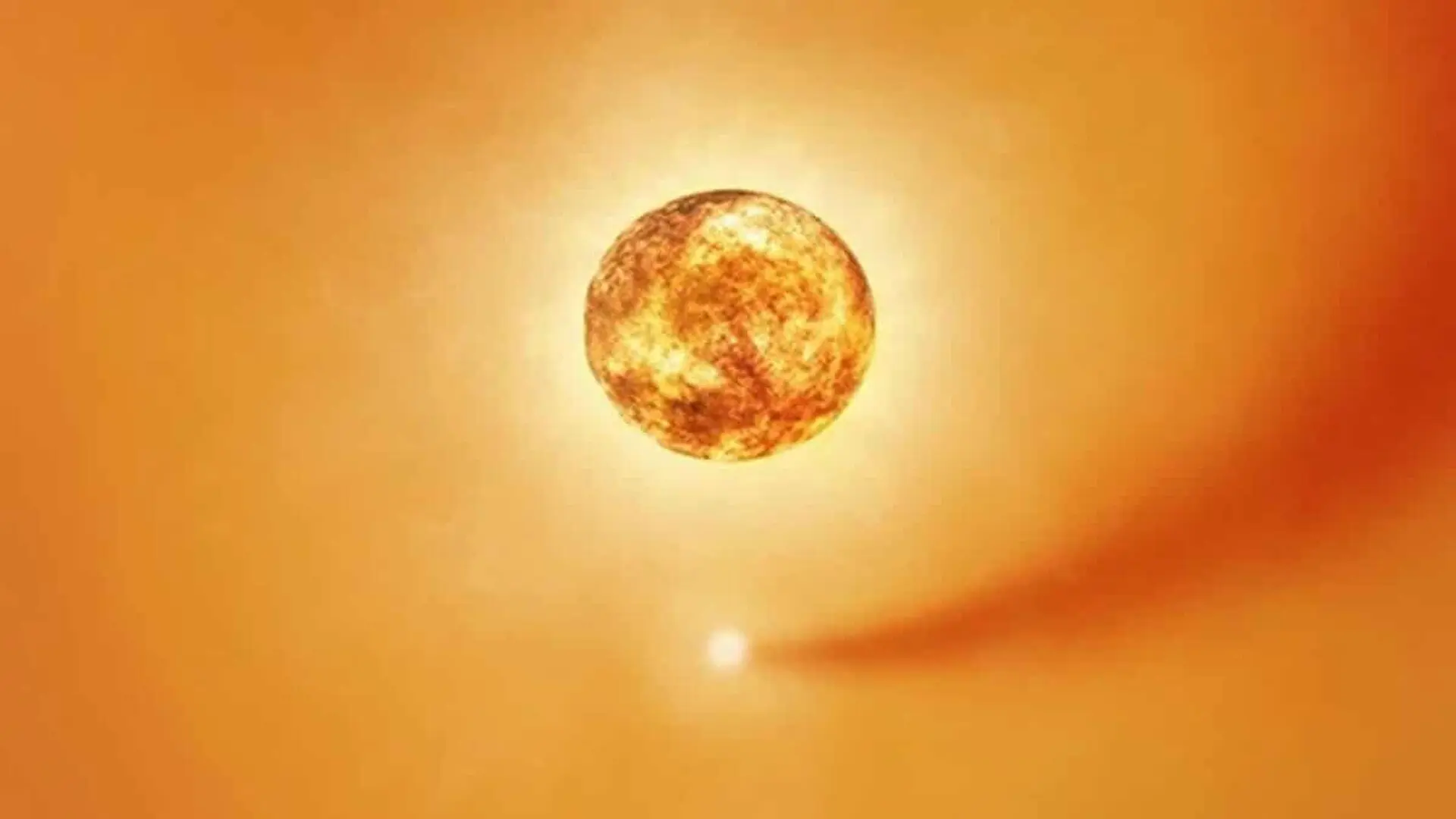
A team of researchers using the European Southern Observatory’s Very Large Telescope (VLT) has captured what appears to be the first direct image of a faint companion orbiting the red supergiant Betelgeuse. The detection, reported in Astronomy & Astrophysics, could finally resolve a century‑old hypothesis that the star has a hidden partner.
Betelgeuse, the bright orange beacon in Orion, has long intrigued observers with its irregular brightness fluctuations. While its status as a massive red supergiant destined for a supernova is well established, the possibility of a nearby stellar companion has remained speculative.
The investigation was led by French astronomer Miguel Montargès, who employed the SPHERE instrument on the VLT to probe the region around Betelgeuse. Their analysis provides the strongest evidence yet that a secondary object, tentatively named Betelgeuse B, exists.
Timing the Search for a Hidden Partner
Two recent studies12 predicted that the companion would reach its maximum apparent separation from Betelgeuse in December 2024, offering an optimal window for detection. Montargès and his collaborators scheduled observations for that month, subsequently dedicating several months to processing the data.
Initial doubts about the instrument’s sensitivity gave way to surprisingly clear results, prompting the team to reassess the feasibility of spotting such a dim object next to a luminous star.
“I was unsure whether we could achieve the required sensitivity to reveal Betelgeuse B as predicted,” Montargès explained. “The object turned out to be more massive than anticipated, and we detected it!”
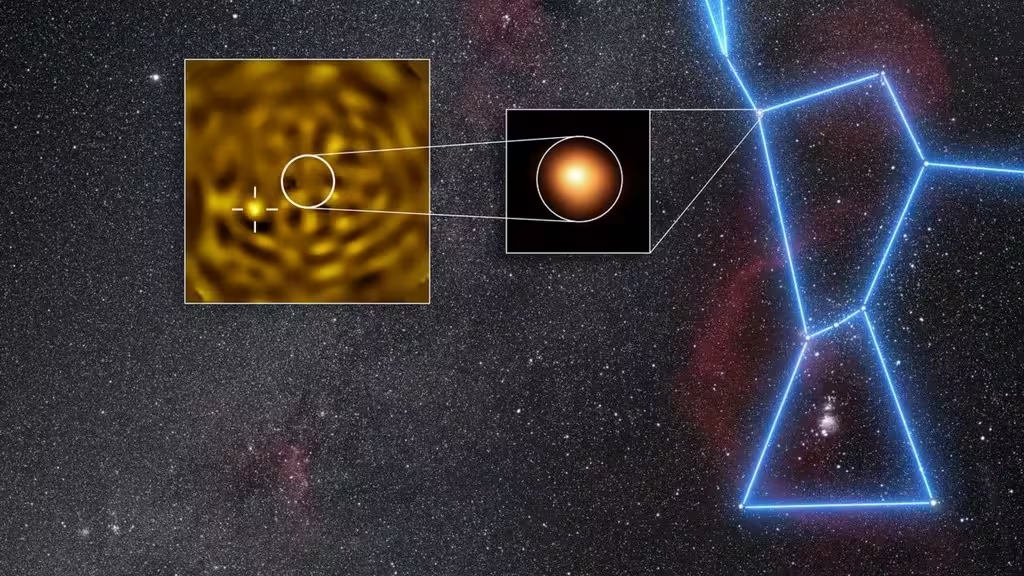
Analysis of the light from the candidate suggests a mass roughly two to three times that of the Sun, substantially higher than earlier estimates that placed it near solar mass.
“Discovering a nearby companion that is brighter and more massive than the Sun around such a well‑studied star is striking,” Montargès added in an ESO statement. “Moments like this—seeing something unexpected—are among the most rewarding in science.”
A Direct Glimpse of the Suspected Star
What distinguishes this result is the actual detection of photons from the companion, rather than an inference based on Betelgeuse’s behavior. SPHERE, originally designed for exoplanet imaging, proved capable of isolating faint sources adjacent to an extremely bright primary.
Earlier hints of a secondary object emerged from observations with the Gemini North Telescope in Hawaii, but the VLT data constitute the most compelling evidence to date.
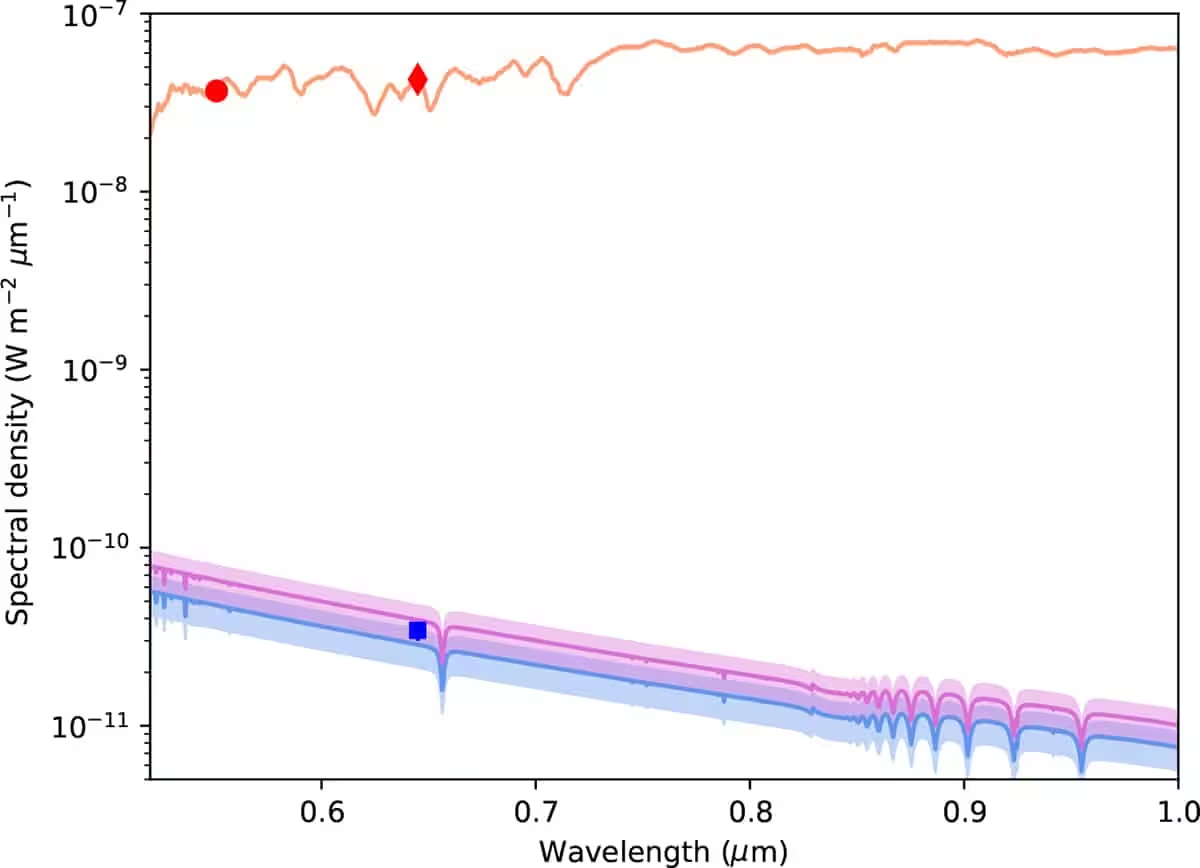
Anthony Boccaletti, an astronomer at the Observatoire de Paris and co‑author of the paper, highlighted the significance of applying SPHERE’s advanced processing to a massive, evolved star. The team plans a follow‑up observation roughly a year later, when the companion should appear on the opposite side of Betelgeuse, to confirm its orbital motion.
“To definitively verify the companion’s existence, we need a second observation when it transits the other side of the star, but the evidence is already compelling.”
New Questions About Betelgeuse’s Future
The putative companion emerges amid renewed interest in Betelgeuse’s recent dimming episode, which was ultimately attributed to a dust cloud obscuring the star rather than an imminent supernova. Researchers now wonder whether the presence of Betelgeuse B could influence the red supergiant’s long‑term evolution.
“It remains an open question whether this companion will affect the evolution of the red supergiant,” Montargès remarked.
This article has been fact checked for accuracy, with information verified against reputable sources. Learn more about us and our editorial process.
Last reviewed on .
Article history
- Latest version
Reference(s)
- Goldberg, Jared A.., et al. “A Buddy for Betelgeuse: Binarity as the Origin of the Long Secondary Period in α Orionis.” The Astrophysical Journal, vol. 977, no. 1, November 29, 2024, pp. 35 American Astronomical Society, doi: 10.3847/1538-4357/ad87f4. <https://iopscience.iop.org/article/10.3847/1538-4357/ad87f4>.
- MacLeod, Morgan., et al. “Radial Velocity and Astrometric Evidence for a Close Companion to Betelgeuse.” The Astrophysical Journal, vol. 978, no. 1, December 24, 2024, pp. 50 American Astronomical Society, doi: 10.3847/1538-4357/ad93c8. <https://iopscience.iop.org/article/10.3847/1538-4357/ad93c8>.
- “Astronomers find strongest evidence yet that Betelgeuse has a companion - “The conclusion of a century-long quest”.” www.eso.org <https://www.eso.org/public/news/eso2611/>.
- “Anthony Boccaletti.” <https://lira.obspm.fr/perso/anthony-boccaletti/Home.html>.
Cite this page:
- Posted by Aisha Ahmed