Stunning VST Image Shows Gum 10 and Gum 11 Nebulae Shaped Like Dragons and Chickens
VLT captures stunning images of Gum 10 and Gum 11 nebulae in Puppis, unveiling dramatic cosmic shapes and glowing star-forming clouds
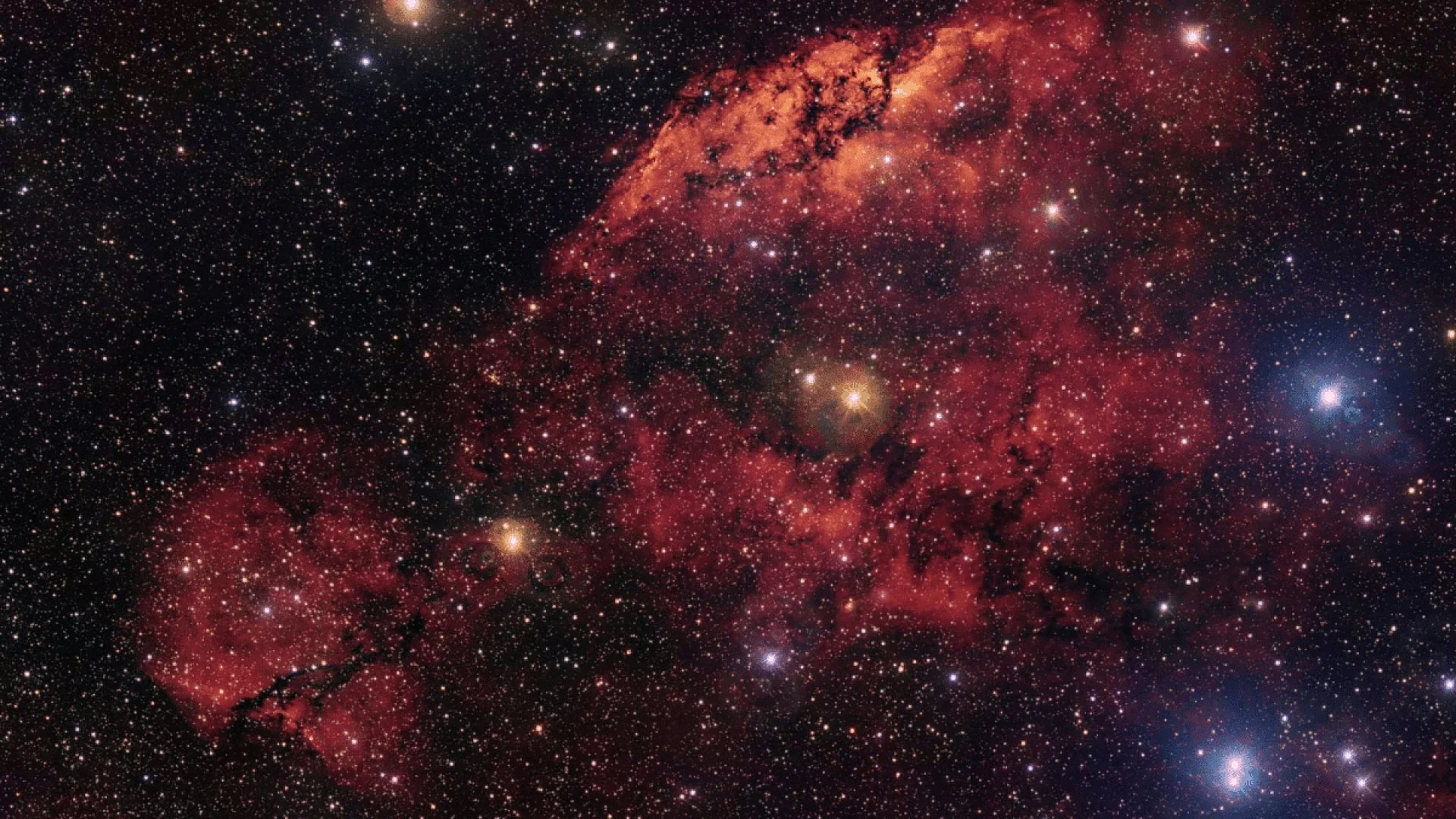
Using the European Southern Observatory’s VLT Survey Telescope (VST), astronomers have obtained a vivid view of two neighboring nebulae—Gum 10 and Gum 11—situated in the southern constellation Puppis. The image highlights the tangled interplay of dust, gas, and stellar radiation that shapes these star‑forming regions.
Nebular Forms That Spark the Imagination
ESO researchers invite viewers to spot familiar figures in the clouds, asking, “What shapes do you see? A chicken pecking seeds on the ground, the head of a dragon, or something else entirely?” These clouds, composed of interstellar dust and gas, are officially catalogued as Gum 10 and Gum 11. From our perspective, they can resemble recognizable silhouettes, even though each structure spans a massive star‑birth zone.
In the composite, Gum 10 dominates the scene with a bright, expansive glow, while the more distant Gum 11 appears as a fainter, detached feature, adding depth and contrast that illustrate the complex beauty of turbulent nebular environments.
Hot Stars Power the Nebular Light
Scientists explain that the striking illumination results from ultraviolet radiation emitted by massive, hot stars embedded within the clouds. “Their bright glow comes from a special interaction between hydrogen and the hot massive stars in each nebula,” the team noted. The energetic photons ionise hydrogen atoms; when the ions recombine with electrons, they emit the characteristic red light captured by the VST.
The dark filaments that thread through the nebulae are created by dust that absorbs background light, outlining intricate structures that trace the forces shaping ongoing star formation.
Location and Scale of the Southern Nebulae
Gum 10, also known as RCW 19, lies about 10,760 light‑years from Earth and spans roughly 155 light‑years across. Its companion, Gum 11 (catalogued as NGC 2579), is closer at an estimated distance of 4,000 light‑years. Both objects are primarily observable from the southern hemisphere and belong to a larger stellar‑nursery complex.
“Visible mostly from the southern hemisphere, they are part of a larger complex, in which stars are born,” the astronomers emphasized, underscoring both the visual spectacle and the scientific value of probing these regions to understand how massive stars sculpt their surroundings and drive galactic evolution.
VST Marks an Anniversary With a Deep Survey
The image of Gum 10 and Gum 11 was recorded to commemorate the 15th anniversary of the VST’s first light, showcasing the instrument’s ability to map extensive sky areas with exceptional clarity.
As a dedicated survey telescope, the VST continues to uncover previously hidden structures throughout the Milky Way, providing researchers with a powerful tool for investigating nebulae, star‑formation processes, and the dynamic forces that shape our galaxy.
What the Nebulae Reveal About Stellar Birth
Beyond their aesthetic appeal, Gum 10 and Gum 11 serve as natural laboratories for examining the violent and dynamic mechanisms of star formation. Within the illuminated clouds, pockets of gas and dust collapse under gravity, while the radiation and stellar winds from nearby massive stars influence their evolution.
The team highlighted the contrast between the two objects: “Gum 10 is the brightest cloud that occupies most of the image,” and “Gum 11 is the fainter, detached cloud to the bottom‑left,” illustrating the range of environmental conditions that can coexist within a single star‑forming complex.
This article has been fact checked for accuracy, with information verified against reputable sources. Learn more about us and our editorial process.
Last reviewed on .
Article history
- Latest version
Reference(s)
- “Celebrating the birth of new stars... and the VST!.” www.eso.org <https://www.eso.org/public/netherlands/images/potw2623a/?lang>.
Cite this page:
- Posted by Aisha Ahmed