Scientists Watch Large Magellanic Cloud Slowly Tear Its Smaller Sibling Apart Near the Milky Way
Billions of years of gravitational tug-of-war reshaping the Small Magellanic Cloud by the Large Magellanic Cloud revealed.
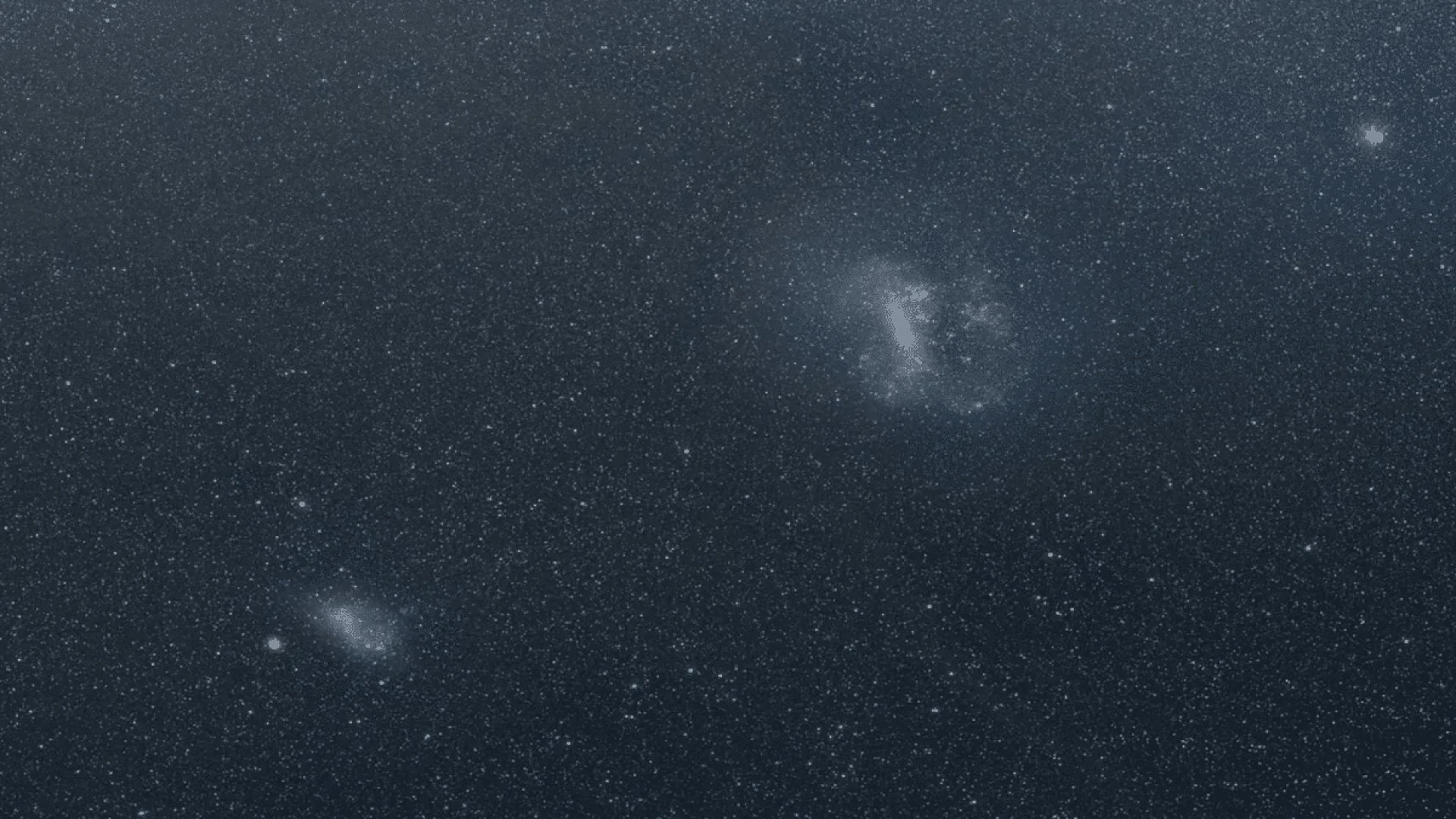
New near‑infrared data from the Visible and Infrared Survey Telescope for Astronomy (VISTA) show that the Small Magellanic Cloud is being pulled apart by its larger companion, the Large Magellanic Cloud. The observations trace streams of stars escaping the SMC’s core, a process that has been underway for billions of years as the two dwarf galaxies interact.
Precision Mapping of Star Motions in the SMC
For the first time, researchers have measured the motions of millions of SMC stars with ground‑based accuracy that rivals space telescopes. “Seeing the results was astonishing; the motion data are incredibly precise,” said Florian Niederhofer of the Leibniz Institute for Astrophysics Potsdam (AIP). “By stitching together more than a decade of observations, we achieved an unprecedented view of the Small Magellanic Cloud’s internal kinematics.”
The analysis reveals that the stellar population is not simply orbiting the galaxy’s centre. Instead, stars drift outward along an axis that points directly toward the Large Magellanic Cloud, a pattern that matches expectations for tidal stretching. With average speeds near 17 km s⁻¹, these stars will travel thousands of light‑years over several hundred million years, highlighting the long‑term impact of gravitational tug‑of‑war.
How the LMC Drives the Small Galaxy’s Transformation
The Large Magellanic Cloud acts as more than a neighbour; repeated close passages over billions of years have forced the Small Magellanic Cloud to expand tidally. “Our results expose a galaxy‑wide tidal expansion in the SMC and overturn the long‑standing view that it behaves like a rotating disc,” explained lead author Sreepriya Vijayasree, whose study appears in Astronomy & Astrophysics. “The stellar motions are dominated by gravitational disturbances from the LMC rather than orderly rotation.”
While the Milky Way’s gravity has long been recognised as a disruptive force, the new findings demonstrate that the Magellanic pair itself reshapes each other, pulling streams of stars and gas from the SMC and leaving a stretched, irregular silhouette. This insight refines models of dwarf‑galaxy evolution and illustrates how a larger companion can remodel a smaller system.
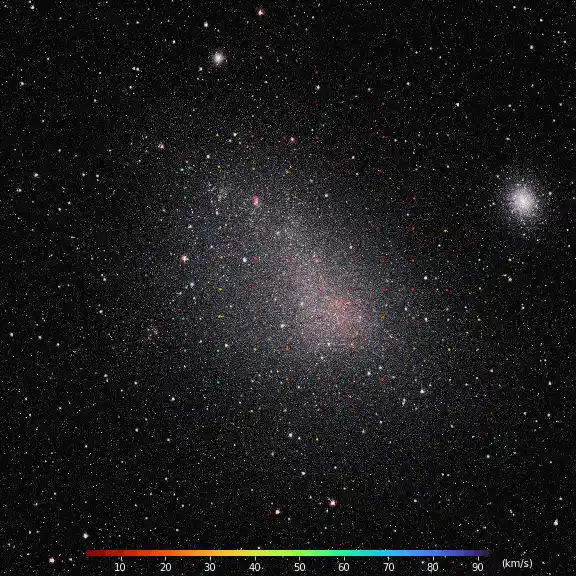
Image credit: ESO/VISTA VMC/AIP/S. Vijayasree
Ancient Stellar Motions Reveal Deep‑Time Interactions
A subset of older red‑giant stars in the SMC shows a collective drift toward the north, a signature that likely stems from a gravitational encounter roughly two billion years ago. The timing suggests the event may have occurred without the Milky Way’s involvement, underscoring the complexity of long‑range galactic interactions. By tracking these motions, astronomers can piece together a chronological record of past encounters, using the stars themselves as a fossil‑like archive of gravitational history.
This article has been fact checked for accuracy, with information verified against reputable sources. Learn more about us and our editorial process.
Last reviewed on .
Article history
- Latest version
Reference(s)
- Vijayasree, S.. “The VMC survey. LV. The coherent expansion of the SMC.”, doi: 10.1051/0004-6361/202659431. <https://www.aanda.org/component/article?access=doi&doi=10.1051/0004-6361/202659431>.
Cite this page:
- Posted by Aisha Ahmed