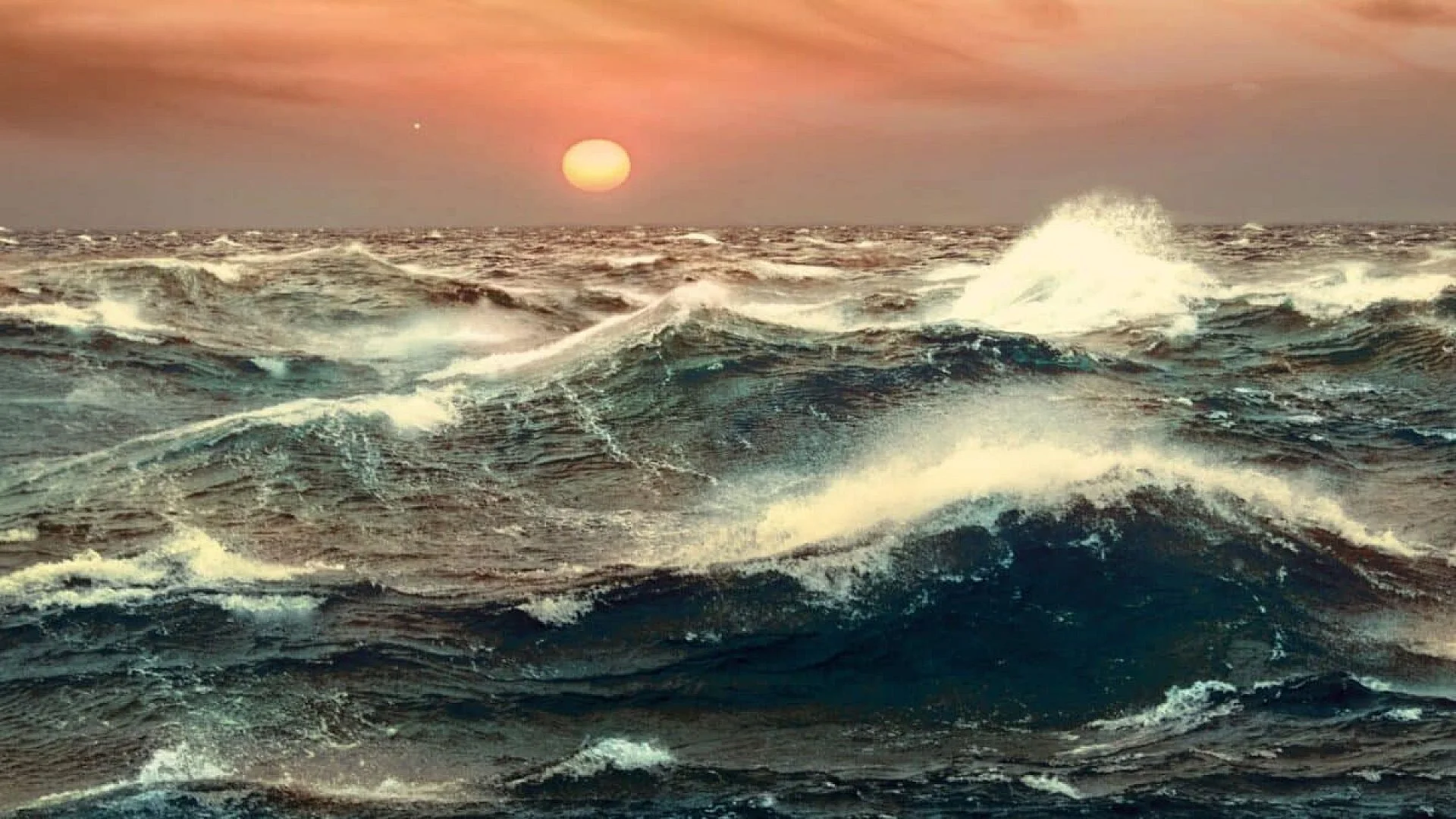
Credit: Benoit Gougeon, Université de Montréal | Dungrela Publishing
A consortium of astronomers has announced the discovery of TOI-1452 b, an exoplanet situated roughly 100 light‑years from our planet and likely rich in water. By combining measurements of its radius, mass and bulk density, the team argues that this world may be one of the most promising ocean‑planet candidates identified to date.
The planet circles the larger member of a binary star pair located in the constellation Draco. Its detection relied on observations from NASA’s TESS mission together with follow‑up data collected at several ground‑based facilities.
With a diameter slightly exceeding Earth’s and a mass estimated at nearly five times that of our world, TOI‑1452 b resides in a temperate zone where surface temperatures could permit liquid water to persist.
TESS Detects a Repeating Light Curve
The hunt began when NASA’s TESS telescope, which monitors stellar brightness for the tell‑tale dimming caused by transiting planets, recorded a periodic dip every 11 days. Researchers at the Université de Montréal noted that the signal corresponded to a body roughly 70 % larger than Earth.
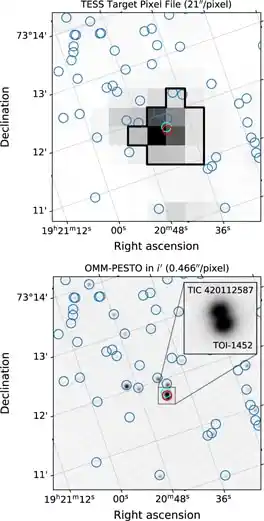
Because the host star belongs to a binary system, TESS could not separate the two sources of light. To disentangle the contribution of each star, the investigators turned to the PESTO camera at the Observatoire du Mont‑Mégantic.
Images comparing observations of the TOI‑1452 system from NASA’s TESS telescope (top) and the PESTO instrument at the Observatoire du Mont‑Mégantic (bottom). Credit: The Astronomical Journal
These follow‑up images confirmed that the transiting body orbits the brighter component of the binary pair.
“This was no routine check,” Charles Cadieux of the Université de Montréal explained, “We had to make sure the signal detected by TESS was really caused by an exoplanet circling TOI‑1452.”
Mass Determination Shows an Over‑Dense World
After establishing the planet’s existence, the team employed SPIRou at the Canada‑France‑Hawaii Telescope to pin down its mass, accumulating more than 50 hours of spectroscopic data.
The analysis yielded a mass close to five Earth masses for TOI‑1452 b. Researchers also applied the LBL method, a data‑processing technique devised by Étienne Artigau and Neil Cook, to isolate the faint planetary signal from stellar noise.
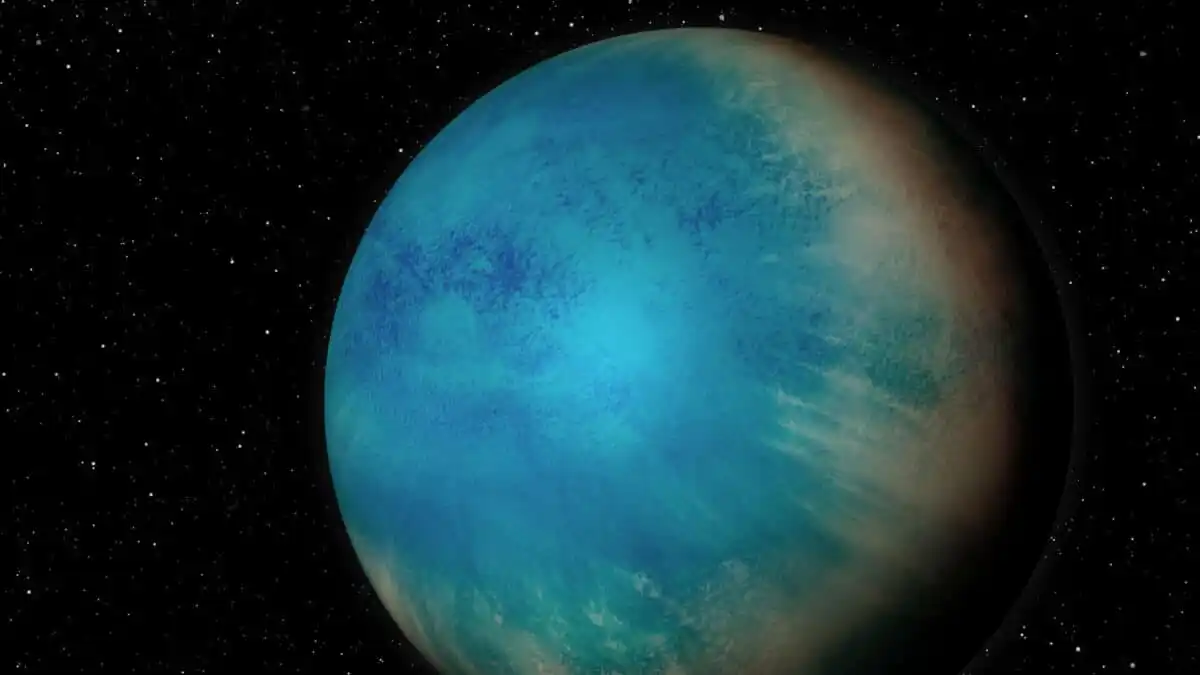
Artist’s impression of TOI‑1452 b. Credit: The Astronomical Journal
Because its bulk density is lower than that expected for a purely rocky planet, the object stands out among the many terrestrial exoplanets identified so far.
A World Potentially Swathed in Deep Oceans
The most intriguing implication concerns the planet’s water inventory. The study, published in The Astronomical Journal, notes that Earth’s total water accounts for less than 1 % of its mass.
Modeling work by University of Toronto scientists Mykhaylo Plotnykov and Diana Valencia suggests that water could represent as much as 30 % of TOI‑1452 b’s mass, a proportion that would dwarf Earth’s oceans.
Such a composition places the exoplanet in the same category as several icy moons of our Solar System, including Ganymede, Callisto, Titan and Enceladus.
Because of its relative closeness and favorable sky position, TOI‑1452 b is also a prime candidate for detailed atmospheric characterization with the James Webb Space Telescope. Future observations could clarify whether the planet truly harbors a global ocean.
Earth is 70% covered by water. That water is less than 1% of Earth’s total mass. TOI 1452 b is 70% larger than Earth. Water may make up 30% of its entire mass. No continents. No beaches. No floor you could stand on. The ocean could be thousands of kilometers deep before… pic.twitter.com/9mzR9HilkA
Ahmed, Aisha. “Astronomers Found a Strange Planet With No Continents at All, Just a Vast Ocean Stretching Across the Entire World.” BioScience. BioScience ISSN 2521-5760, 06 June 2026. <https://www.bioscience.com.pk/en/subject/astronomy/astronomers-found-a-strange-planet-with-no-continents-at-all-just-a-vast-ocean-stretching-across-the-entire-world>.
Ahmed, A. (2026, June 06). “Astronomers Found a Strange Planet With No Continents at All, Just a Vast Ocean Stretching Across the Entire World.” BioScience. ISSN 2521-5760. Retrieved June 06, 2026 from https://www.bioscience.com.pk/en/subject/astronomy/astronomers-found-a-strange-planet-with-no-continents-at-all-just-a-vast-ocean-stretching-across-the-entire-world
Ahmed, Aisha. “Astronomers Found a Strange Planet With No Continents at All, Just a Vast Ocean Stretching Across the Entire World.” BioScience. ISSN 2521-5760. https://www.bioscience.com.pk/en/subject/astronomy/astronomers-found-a-strange-planet-with-no-continents-at-all-just-a-vast-ocean-stretching-across-the-entire-world (accessed June 06, 2026).