First Helium Escape Confirms Atmosphere on Habitable Zone Rocky Planet LHS 1140 b
Astronomers confirm the first atmosphere on a rocky exoplanet in the habitable zone, proving an Earth-sized world can retain air for billions of years.

Astronomers have captured the first clear sign of an atmosphere around the rocky exoplanet LHS 1140 b, located roughly 48 light‑years from Earth, by spotting helium atoms fleeing its upper layers. The detection marks a milestone for the study of potentially habitable worlds beyond the Solar System.
LHS 1140 b circles an elderly, quiet red dwarf star and completes an orbit in just under 25 days. With a mass about 5.6 times that of Earth and a radius 1.73 times larger, the planet receives roughly 42 % of the solar radiation Earth does, situating it squarely within its star’s habitable zone.
Helium Signature Confirms Atmospheric Presence
The research team, led by Harvard’s Collin Cherubim, employed the WINERED spectrograph on the Magellan Clay Telescope at Las Campanas Observatory to probe the system during a rare September 2024 alignment. Both known rocky planets, LHS 1140 b and its sibling LHS 1140 c, transited the star in the same night, allowing a direct side‑by‑side comparison under nearly identical stellar conditions.
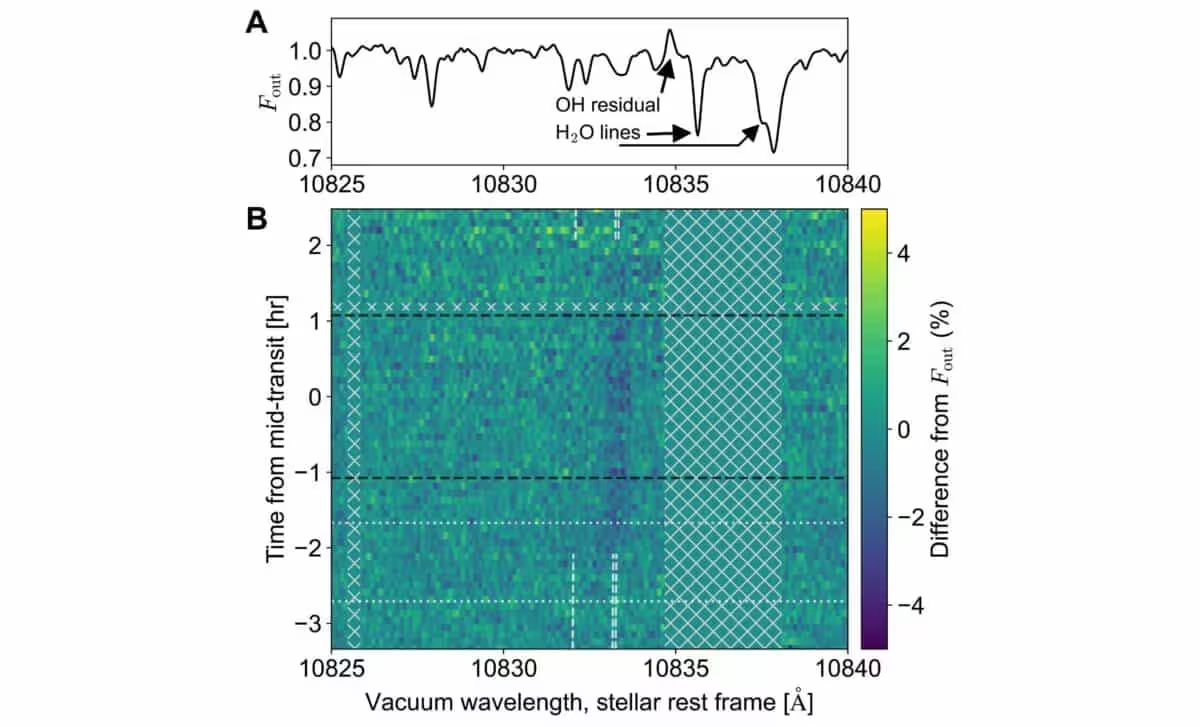
Spectra recorded during LHS 1140 b’s transit displayed a distinct helium absorption feature, indicating that helium is escaping from the planet’s upper atmosphere. In contrast, the data for LHS 1140 c showed no comparable signal, underscoring the uniqueness of the atmospheric escape on the inner planet.
“An atmosphere is essential for a planet to support life as we know it. This is the first time anyone has found an atmosphere on a rocky planet in the habitable zone of another star,” said lead author Collin Cherubim in a statement released by the Center for Astrophysics | Harvard & Smithsonian.
Follow‑up observations in 2025 failed to reproduce the helium signal, a discrepancy the authors attribute to time‑variable atmospheric loss. Their models suggest that, under certain conditions, the escaping helium would fall below the detection threshold of the later campaign.
Theoretical Forecast Validated by Ground‑Based Spectroscopy
Prior to the observations, a model developed by Harvard researchers predicted that a helium‑rich layer should be detectable above LHS 1140 b’s surface. Senior author David Charbonneau initially expressed skepticism, noting that such a signature had never been confirmed for a terrestrial exoplanet.
The measured helium profile matched the predicted pattern closely enough for Charbonneau to describe the result as “statistically rock solid,” highlighting the successful bridge between theory and observation.
The escaping helium implies a helium‑dominated upper atmosphere that has persisted for billions of years, with stellar radiation identified as the primary driver of the observed loss. Earlier studies had excluded a clear hydrogen‑rich envelope but could not rule out any atmosphere at all; the new data fills that gap and suggests hydrogen is substantially depleted relative to helium.
Beyond confirming the presence of an atmosphere, the work demonstrates that ground‑based facilities can effectively search for escaping gases on rocky worlds, opening a new avenue for probing the composition of exoplanetary atmospheres.
Future campaigns aim to apply the same technique to additional systems and to expand the spectral coverage of LHS 1140 b, seeking a more complete picture of its atmospheric makeup.
This article has been fact checked for accuracy, with information verified against reputable sources. Learn more about us and our editorial process.
Last reviewed on .
Article history
- Latest version
Reference(s)
- “Collin Cherubim.” <https://scholar.google.com/citations?user=QtLXi0EAAAAJ&hl=en>.
- <https://astronomy.fas.harvard.edu/people/david-charbonneau>.
Cite this page:
- Posted by Farah Siddiqui