Astronomers Unmask Decades‑Old Milky Way Mystery as Nearby Stellar Bubble
After 40 years of hunting the Milky Way’s giant arc, astronomers uncovered a hidden clue that reveals an even stranger nearby structure.
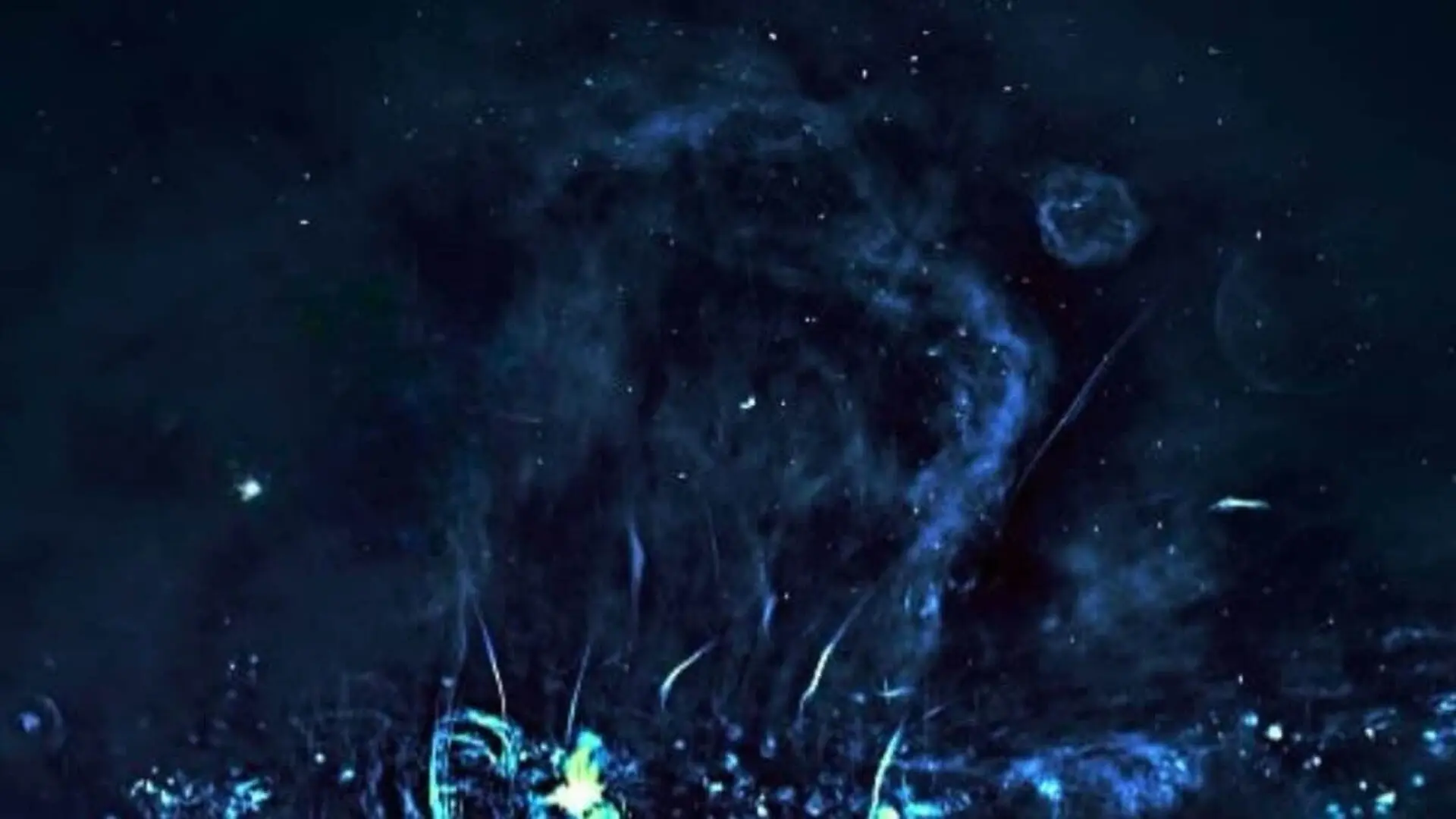
For forty years astronomers have debated the nature of a striking radio feature that arches away from the Milky Way’s crowded core. Dubbed the Galactic center lobe, the structure was alternately interpreted as a lingering supernova shell or the imprint of a powerful outburst from the supermassive black hole at the galaxy’s centre.
A new study published in Astronomy & Astrophysics argues that the feature is neither a nuclear outflow nor a lobe at all. Instead, it is a closed, spherical bubble of ionized gas located roughly 6,520 light‑years from the Sun, well in front of the true galactic centre. Lead author Kathryn Kreckel of Heidelberg University suggests the term “greatly confused loop” to reflect both its true geometry and the decades of misidentification.
Obstacles to Determining Its Position
The Milky Way’s centre is a dense superposition of stars, gas clouds, and dust, making distance estimates along that line of sight notoriously uncertain. Even well‑characterised objects in the region suffer from large positional errors, leaving little reference for new structures.
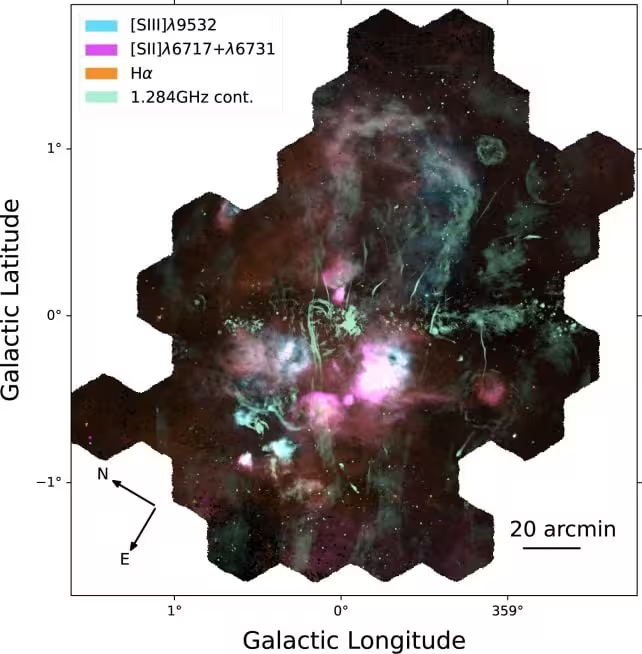
Compounding the problem, the lower portion of the so‑called lobe sits against the bright radio emission of the Galactic plane, causing it to merge with background noise. Radio surveys have only ever captured the upper arc, creating the illusion of an open, upward‑pointing structure emerging from the nucleus. In reality, the missing half forms the concealed base of a complete bubble, a detail obscured by the very material researchers aim to probe.
Ionized Sulfur Emission Reveals the Full Bubble
The breakthrough arrived via the SDSS‑V Local Volume Mapper, which records a suite of optical and infrared emission lines across the Milky Way. Among these, the red‑shifted line of ionized sulfur stood out. Its longer wavelength penetrates dust more efficiently than the shorter‑wavelength tracers typically used, allowing the signal from the hidden lower segment to reach the detectors.
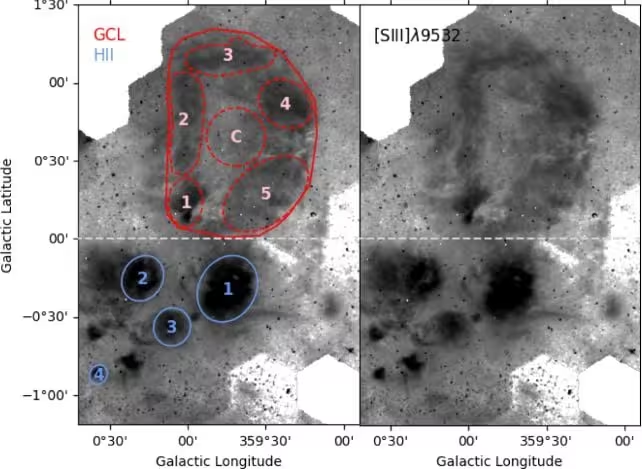
By cross‑referencing the observed dust attenuation with three‑dimensional dust maps of the Galaxy, the team derived a distance of roughly 6,520 light‑years—far shorter than the 26,000‑light‑year separation to the true centre. At this nearer range, the bubble spans about 115 light‑years across, placing it in the same size class as Barnard’s Loop in Orion.
Stellar Winds and Supernovae, Not the Central Black Hole, Drive the Bubble
The structure consists of hydrogen gas energized by intense ultraviolet radiation. While the exact stellar sources remain to be identified, the researchers propose a formation scenario mirroring that of other Galactic bubbles: massive stars born in a common cluster explode as supernovae, carving out a cavity in the surrounding medium. The expanding shock front compresses adjacent gas, potentially triggering a secondary wave of star formation. Newly formed massive stars then bathe the cavity walls in UV light, causing the gas to glow.
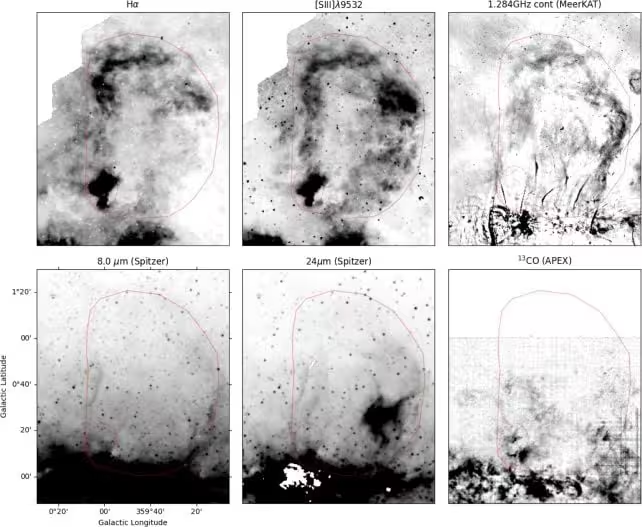
From Earth’s perspective, the illuminated rim of the sphere appears as a bright arc, explaining why earlier observations interpreted it as a lobe rather than a closed bubble. The similarity in scale and formation mechanism to Barnard’s Loop suggests that the so‑called Galactic centre lobe is a relatively ordinary byproduct of massive‑star evolution within the Milky Way’s disk, rather than a signature of black‑hole‑driven activity.
This article has been fact checked for accuracy, with information verified against reputable sources. Learn more about us and our editorial process.
Last reviewed on .
Article history
- Latest version
Reference(s)
- Kreckel, K.., et al. “SDSS-V LVM: Verifying what, and where, the “Galactic center lobe” is.” Astronomy & Astrophysics, vol. 710, June 12, 2026, pp. A205 EDP Sciences, doi: 10.1051/0004-6361/202659505. <https://doi.org/10.1051/0004-6361/202659505>.
- “Local Volume Mapper - SDSS.”, June 10, 2024 SDSS - Mapping the Universe <https://www.sdss.org/dr19/lvm/>.
- <https://en.wikipedia.org/wiki/Barnard%27s_Loop>.
Cite this page:
- Posted by Farah Siddiqui